Physio Hub:
Evidence-Based Article
Does BlazePod Training Actually Improve Athletic Performance?
What the Science Really Says
Walk into almost any modern gym, training facility, or sports academy and you’ll likely see glowing pods on the floor, walls, or turf. BlazePod has become one of the most popular reaction-training tools for athletes—from kids learning basic coordination to elite professionals refining split-second decision-making.
But popularity doesn’t equal effectiveness.
So what does the science actually say?
Does BlazePod training truly improve speed, agility, and cognitive performance—or is it just a flashy gadget?
What Is BlazePod Training?
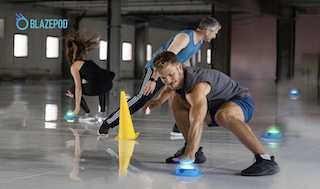
BlazePod is a light-based neurocognitive training system designed to challenge:
- Reaction speed
- Decision-making
- Visual processing
- Agility and movement precision
Athletes respond to randomly illuminated pods using hands, feet, or sport-specific movements. Unlike pre-planned drills, BlazePod introduces unpredictable stimuli, forcing the brain and body to adapt in real time.
This distinction is critical:
Reactive agility ≠ planned agility

Does BlazePod Improve Reaction Time and Cognitive Performance?
Recent high-quality research strongly supports BlazePod’s effectiveness in neurocognitive and motor performance.
A randomized controlled study by Alecu et al. (2025) examined adolescent athletes over six weeks of BlazePod training:
Key findings:
- Significant improvements in simple and choice reaction time
- Faster responses in Go/No-Go and Stroop tasks
- Improved agility performance
- Large effect sizes (Cohen’s d > 2.0) across all outcomes
- Benefits seen in both male and female athletes
Importantly, these gains exceeded those seen with standard sport training alone.
👉 This supports BlazePod’s role in enhancing executive function, attention, and stimulus–response speed, not just physical quickness.
Can BlazePod Improve Strength and Power?
Surprisingly — yes, when integrated correctly.
A 10-week intervention in youth volleyball players (Grădinaru et al., 2023) combined BlazePod-based sensory training with jump development.
Results showed significant improvements in:
- Countermovement jump height
- Squat jump height
- Drop jump performance
- Power output and energy production
These changes were objectively measured using OptoJump technology, not subjective observation.
👉 While BlazePod doesn’t directly build strength, it appears to enhance neuromuscular efficiency, which can transfer into explosive performance.
Does BlazePod Help Skill Development in Young Athletes?
Yes — especially for perception–action coupling.
A study by Stoica et al. (2024) examined soccer players aged 8–10 and found that BlazePod-based training improved:
- Head-up ball control
- Visual awareness during play
- Decision-making under movement constraints
By forcing athletes to process external stimuli rather than fixating on the ball, BlazePod helped reinforce game-relevant behaviors, not just drill performance.
Is BlazePod a Reliable Training and Testing Tool?
Reliability matters — especially if you’re using a tool to track progress.
Research by Hoffman et al. (2020) demonstrated that BlazePod reactive agility drills showed:
- Excellent reliability (ICC = 0.83–0.88)
- Strong correlation with coach-rated agility
- Valid assessment of sport-specific reactive agility
This confirms BlazePod is not just a fun drill tool, but a legitimate performance assessment device.
Limitations: What BlazePod Cannot Do
Despite strong evidence, BlazePod is not a standalone solution.
- It does not replace strength training
- It does not automatically transfer to sport performance without proper context
- Poor programming = flashy but ineffective sessions
Like any tool, its effectiveness depends on:
- Drill selection
- Sport specificity
- Integration into a broader training plan
Conclusion: Is BlazePod Worth Using?
The evidence is clear:
BlazePod training meaningfully improves reaction time, cognitive-motor performance, agility, and neuromuscular coordination across youth and athletic populations.
It works best when used as:
- A supplement to traditional training
- A way to challenge decision-making under pressure
- A bridge between cognitive and physical performance
It’s not magic — but it is scientifically supported when applied intelligently.
< Recommendation by Our Experts>
✔ Use BlazePod to train reactive decision-making, not just speed
✔ Integrate it into sport-specific movement patterns
✔ Pair it with strength, conditioning, and skill training for best transfer


< Reference >
- Alecu, Ștefan, and Gheorghe Adrian Onea. “The Effectiveness of Blazepod-Based Neurocognitive Training on Reaction Time and Agility in Young Competitive Athletes.” Studia Universitatis Babeş-Bolyai Educatio Artis Gymnasticae, November 20, 2025, 81–94. https://doi.org/10.24193/subbeag.70(3).25.
- Grădinaru, Liviu, Simona Petracovschi, Eugen Bota, Petru Mergheș, and Mihaela Oravițan. “The Effect of Blazepod Flash Reflex Training Program on Vertical Jump in U15 Female Volleyball Players.” Timisoara Physical Education and Rehabilitation Journal 16, no. 30 (2023): 31–37. https://doi.org/10.2478/tperj-2023-0004.
- Stoica, Marius, Ciolcă Sorin, Rafael Vișan, and Adina Dreve. “AI, BlazePod Sensors, and Head Vests Implemented in Assessments on Reaction Time and Gaze Training Program in U10 Football Game.” Applied Sciences 14, no. 14 (2024): 6323. https://doi.org/10.3390/app14146323.
- Hoffman, Jay R. “Evaluation of a Reactive Agility Assessment Device in Youth Football Players.” Journal of Strength and Conditioning Research 34, no. 12 (2020): 3311–15. https://doi.org/10.1519/JSC.0000000000003867.
Stay Informed with Physio Hub
Unlock a world of knowledge with our expertly curated articles on fitness, rehabilitation, and health & diet. Stay ahead with the latest evidence-based insights and practical advice. Subscribe now to receive updates and never miss out on new content!