Physio Hub:
Evidence-Based Article
Kinesio Tape: What It Can — and Can’t — Do for Athletes
A popular tool, but not a performance shortcut
Kinesio tape (KT) has become a familiar sight in sports — seen on shoulders, knees, ankles, and backs of athletes at every level.
It’s lightweight, flexible, and designed to support movement without restricting it.
But despite its popularity, a key question remains:
Does kinesio tape actually improve performance or recovery — or does it just feel helpful?
Let’s look at what the research says.
What is kinesio tape?
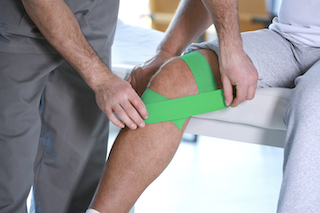
Kinesio tape is an elastic therapeutic tape designed to move with the body.
Unlike rigid athletic tape, KT allows near-full range of motion while providing mild external support and sensory input.
It is commonly used to:
- Reduce discomfort during activity
- Provide a sense of joint or muscle support
- Improve movement confidence
- Assist with swelling or muscle soreness (short term)
Its proposed mechanisms include:
- Increased sensory feedback
- Mild changes in muscle activation
- Altered pain perception
However, these mechanisms are still not fully understood.

Does kinesio tape improve performance?
The evidence is mixed — and often underwhelming
Multiple systematic reviews have evaluated KT’s effect on athletic performance.
- Reneker et al. (2017) reviewed 15 studies and found no strong evidence that kinesio tape enhances strength, power, or athletic performance.
- Dehghan et al. (2023) reported that:
- 54% of studies showed no meaningful benefit
- 46% showed some positive effect
This near-even split suggests that any performance benefit is inconsistent and highly context-dependent.
👉 Bottom line:
Kinesio tape should not be viewed as a performance enhancer.
Where kinesio tape may help
While KT does not reliably boost performance, research suggests possible short-term benefits in certain situations:
- Pain modulation
Mild pain reduction has been reported in some conditions (Ling et al., 2021) - Muscle soreness relief
Short-term reduction in delayed onset muscle soreness (Jianping et al., 2021) - Joint stability perception
Potential improvements in chronic ankle instability symptoms (Li et al., 2023)
Importantly, these benefits are:
- Typically small
- Short-term
- Highly individual
KT does not “fix” injuries — but it may help athletes feel more comfortable moving while they recover.
What kinesio tape does not do
It’s equally important to be clear about limitations.
Current evidence does not support KT as a:
- Substitute for strength training
- Correction for faulty movement mechanics
- Long-term solution for injury prevention
- Proven enhancer of speed, power, or endurance
The overall quality of evidence remains limited, and results should be interpreted cautiously.
When does kinesio tape make sense for athletes?
Kinesio tape may be reasonable when:
- Pain is mild and movement is still allowed
- An athlete needs temporary support during training or competition
- It is used alongside proper rehab, not instead of it
- The athlete reports subjective benefit without symptom worsening
KT is best viewed as a supportive tool, not a treatment.
A note on tape quality
While the tape itself does not change the underlying physiology, comfort, adhesion, and skin tolerance matter — especially for athletes training daily.
Some athletes prefer higher-quality synthetic kinesiology tapes that:
- Maintain elasticity over several days
- Stay on during sweat or water exposure
- Use skin-friendly, latex-free adhesives
- Offer pre-cut strips for consistent application
The key is not the brand, but whether the tape allows comfortable, unrestricted movement without irritation.
Final thoughts
Kinesio tape is neither a miracle tool nor useless placebo.
When used with realistic expectations, it can:
- Support movement confidence
- Reduce mild discomfort
- Help athletes stay active during recovery
But it works best when paired with:
- Strength training
- Load management
- Movement retraining
- Evidence-based rehabilitation
Tape can support movement — but it can’t replace good training or rehab.
< Recommendation by Our Experts>
✔ Kinesio tape does not reliably improve performance
✔ It may provide short-term pain relief or comfort
✔ Effects vary widely between individuals
✔ Best used as an adjunct to proper rehab and training
✔ If it helps you move with less pain and no downside, it can be reasonable to use



< Reference >
- Reneker, Jennifer C., Lisa Latham, Ryan McGlawn, and Matthew R. Reneker. “Effectiveness of Kinesiology Tape on Sports Performance Abilities in Athletes: A Systematic Review.” Physical Therapy in Sport 31 (May 2018): 83–98. https://doi.org/10.1016/j.ptsp.2017.10.001.
- Dehghan, Fatemeh, Rose Fouladi, and Jeffrey Martin. “Kinesio Taping in Sports: A Scoping Review.” Journal of Bodywork and Movement Therapies 40 (October 2024): 1213–23. https://doi.org/10.1016/j.jbmt.2023.05.008.
- Tran, Linh, Abdelrahman M Makram, Omar Mohamed Makram, et al. “Efficacy of Kinesio Taping Compared to Other Treatment Modalities in Musculoskeletal Disorders: A Systematic Review and Meta-Analysis.” Research in Sports Medicine 31, no. 4 (2023): 416–39. https://doi.org/10.1080/15438627.2021.1989432.
- Lin, Jianping, Ming Ling Guo, Hao Wang, et al. “Effects of Kinesio Tape on Delayed Onset Muscle Soreness: A Systematic Review and Meta‐” BioMed Research International 2021, no. 1 (2021): 6692828. https://doi.org/10.1155/2021/6692828.
- Li, Rui, Rui Qin, Yajun Tan, Hengxian Liu, Kun Wang, and Liang Cheng. “Effect of Kinesio Taping Intervention on the Muscle Strength and Balance of College Basketball Players with Functional Ankle Instability.” Frontiers in Physiology 14 (2023): 1064625. https://doi.org/10.3389/fphys.2023.1064625.
Stay Informed with Physio Hub
Unlock a world of knowledge with our expertly curated articles on fitness, rehabilitation, and health & diet. Stay ahead with the latest evidence-based insights and practical advice. Subscribe now to receive updates and never miss out on new content!