Physio Hub:
Evidence-Based Article
Can You Really Stretch the IT Band?
What Athletes Should Know About IT Band Stretching and IT Band Syndrome
Key Points
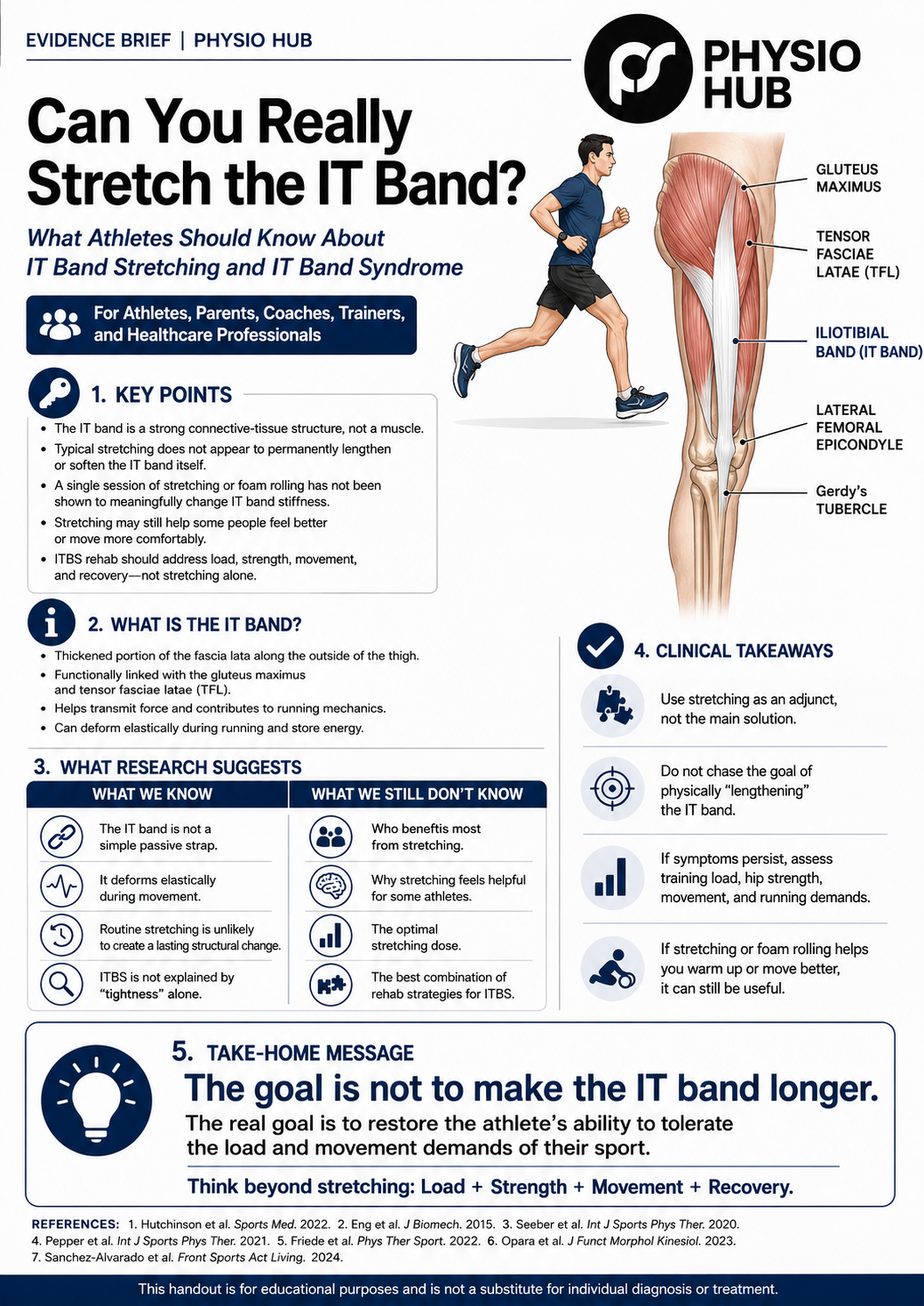
- The iliotibial band (ITB) is a strong connective-tissue structure, not a muscle.
- The ITB does deform elastically during movement, but there is limited evidence that typical stretching can permanently lengthen or soften the ITB itself.
- A single session of stretching or foam rolling has not been shown to significantly change ITB stiffness.
- Stretching may still make someone feel better or move more comfortably, so it is not necessarily useless.
- Rehabilitation for iliotibial band syndrome (ITBS) should usually consider load, strength, movement, running demands, and recovery, rather than relying on stretching alone.
What is IT Band?
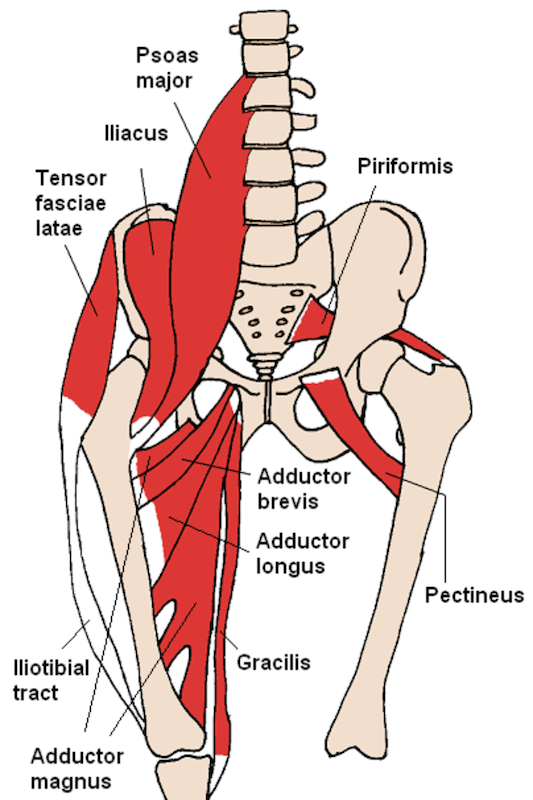
The iliotibial band is a thickened portion of the fascia lata running along the outside of the thigh.
It has important functional relationships with the:
- Gluteus maximus
- Tensor fasciae latae (TFL)
and inserts distally around the lateral knee and tibia.¹
The ITB is not simply a tight piece of tissue sitting passively along the thigh.
It participates in force transmission during movement and its mechanical behavior is influenced by muscle activity, joint position, anatomy, and movement.¹
Biomechanical modeling suggests that the ITB can stretch elastically and store approximately 1 to 7 joules of energy per stride during running, depending on running speed.²
So:
The IT band is not a structure that “doesn’t stretch at all.”
The more important question is whether a typical clinical stretch can create a meaningful, lasting change in its length or stiffness.
Can Stretching Permanently Lengthen the IT Band?
Current evidence suggests that this is unlikely.
A cadaveric study testing isolated human ITB tissue found that the tissue tolerated very high tensile loads. At a mean peak load of approximately 873 N (roughly equivalent to the downward pull of a 200-lb object hanging from a rope), average deformation was around 9%.³
The authors concluded that the forces generated during typical clinical stretching likely remain within the ITB’s elastic range and may therefore not produce permanent tissue deformation.³
A randomized controlled trial also compared:
- ITB stretching
- Foam rolling
- No intervention
in healthy adults.
After a single intervention, researchers found no significant change in ITB stiffness with either stretching or foam rolling.⁴
This challenges the traditional explanation:
“I am stretching because I need to physically make my IT band longer.”
That may not be what is actually happening.
Then Why Can Stretching Feel Helpful?
Many athletes report:
“My outer thigh feels looser.”
“My hip moves better.”
“It feels less tight after I stretch.”
Those experiences can be real without requiring permanent structural lengthening of the ITB.
Possible contributors include changes in:
- The TFL or gluteal tissues
- Hip range of motion
- Stretch tolerance
- Sensory perception
- Pain perception
- The subjective feeling of muscle or tissue tension
In the randomized trial by Pepper and colleagues, ITB stiffness itself did not significantly change, but hip-adduction range of motion increased slightly after the interventions.⁴
That distinction matters:
Feeling looser does not necessarily mean the IT band itself became longer.

Is IT Band Syndrome Simply Caused by a “Tight IT Band”?
Probably not.
IT band syndrome is a common source of lateral knee pain, particularly among runners.¹
Traditionally, ITBS was described as a “friction syndrome,” where the band repeatedly moved forward and backward over the lateral femoral epicondyle.
Current anatomical and biomechanical thinking is more complex.
Because the ITB has substantial attachments around the femur, it does not simply slide back and forth like a loose strap. Compression or impingement of sensitive tissues beneath the ITB may contribute to symptoms, along with other mechanical and individual factors.¹˒⁵
Potential contributors may include:
- Training load
- Anatomy
- Running mechanics
- Hip and knee movement
- Muscle function
- Individual tissue capacity
The evidence remains incomplete and sometimes conflicting.¹˒⁵
Therefore:
ITBS should not automatically be reduced to “your IT band is too tight.”
Is IT Band Stretching Useless?
Not necessarily.
A 2023 narrative review concluded that stretching and “release” techniques may have a role in the early rehabilitation of ITBS. However, the authors also emphasized that it remains unclear how much stretching itself contributes to symptom resolution when it is included within a multimodal rehabilitation program.⁶
This is an important distinction.
Many rehabilitation programs combine stretching with:
- Strengthening
- Training-load modification
- Manual therapy
- Running modification
- Progressive return to activity
If symptoms improve, we cannot automatically assume stretching was the key ingredient.
The current evidence therefore supports a more balanced position:
There is no strong reason to prohibit stretching if it helps—but there is also insufficient evidence to make stretching the centerpiece of ITBS rehabilitation.
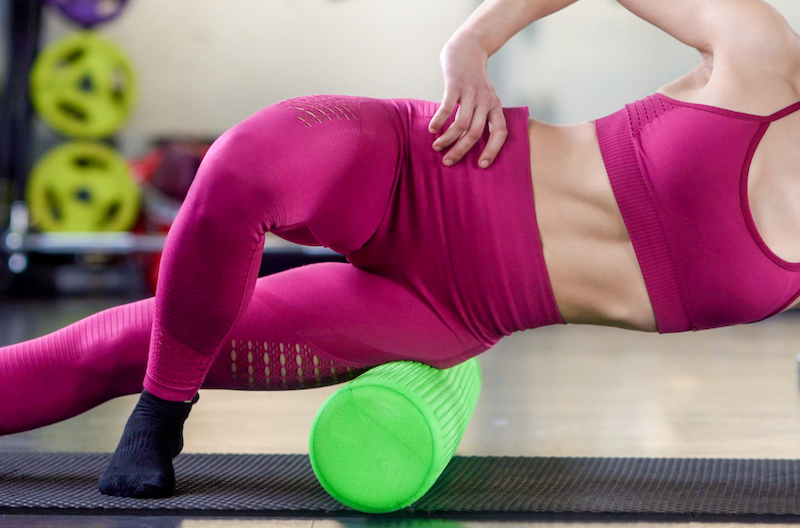
What Should Rehabilitation Focus On?
A 2024 systematic review examined 13 studies involving conservative treatment for runners with ITBS.⁷
Interventions varied substantially, which makes it difficult to identify one ideal rehabilitation protocol.
Hip-abductor strengthening was one of the most commonly used active strategies, with improvements in pain and function reported across multimodal programs.⁷
However, reviews also emphasize that high-quality trials comparing rehabilitation strategies are still limited.⁵˒⁷
Rather than assuming every athlete needs the same exercises, rehabilitation should consider questions such as:
- When does the pain occur?
- Has training volume or intensity recently changed?
- What running or sport loads can the athlete currently tolerate?
- Are strength or movement limitations clinically relevant?
- Does running technique contribute to symptoms?
- How is the athlete recovering between sessions?
This makes ITBS rehabilitation a load-and-function problem, not simply a flexibility problem.
How Should Stretching Be Used?
If an ITB-related stretch:
- Feels comfortable
- Temporarily reduces symptoms
- Helps someone move more easily
- Works well as part of a warm-up or rehabilitation routine
there is little reason it cannot be used as an adjunct.
But athletes do not need to aggressively stretch through significant pain because they believe they must “break up” or “lengthen” the ITB.
There is also currently no well-established ITBS-specific prescription showing that:
“X seconds × X repetitions”
or
“X minutes per week”
will structurally lengthen the IT band or reliably improve ITBS.
The goal should be to use stretching as a tool when useful, not as the treatment objective itself.

What We Know
Current evidence supports several important points:
- The ITB is a strong connective-tissue structure with functional relationships to the gluteus maximus and TFL.¹
- It deforms elastically and may contribute to energy storage during running.²
- Typical intermittent stretching is unlikely to create substantial permanent changes in ITB length or mechanical properties.³˒⁵
- A single session of stretching or foam rolling does not appear to meaningfully change ITB stiffness.⁴
- The independent contribution of ITB stretching to ITBS recovery remains uncertain.⁶
- Contemporary conservative rehabilitation commonly uses active strategies such as strengthening within a multimodal program.⁷
What We Still Don’t Know
Important questions remain:
- Which people with ITBS benefit most from stretching?
- Why does stretching make some people feel better?
- How important is ITB stiffness in the development of ITBS?
- What is the optimal stretching dose, if one exists?
- What is the best combination of strengthening, gait retraining, load management, and other interventions?
The current literature does not provide universal answers.
What Athletes, Parents, Coaches, and Trainers Should Know
If the outside of the thigh feels tight, you do not need to immediately assume:
“My IT band has shortened and I need to stretch it longer.”
If stretching or foam rolling feels good, it can be part of a routine.
But if lateral knee pain continues, repeatedly stretching the area without addressing anything else may miss the bigger picture.
Consider:
Training Load + Strength + Movement + Running Demands + Recovery
rather than treating “IT band tightness” as the entire diagnosis.
< Take-Home Message >
The IT band is not an unstretchable piece of tissue.
It deforms elastically during movement and helps transmit forces during running.
However:
Current evidence does not strongly support the idea that ordinary stretching permanently lengthens or “loosens” the IT band itself.
Stretching may still provide temporary symptom relief or improve how movement feels, making it a reasonable adjunct when helpful.
But ITBS rehabilitation should not be reduced to stretching.
The bigger picture is:
Load + Strength + Movement + Sport Demands + Recovery
The goal is not to make the IT band longer. The goal is to restore the athlete’s ability to tolerate the movement and loading their sport requires.
<PDF file>


< Reference >
- Hutchinson LA, Lichtwark GA, Willy RW, Kelly LA. The iliotibial band: a complex structure with versatile functions. Sports Med. 2022;52(5):995-1008. doi:10.1007/s40279-021-01634-3.
- Eng CM, Arnold AS, Lieberman DE, Biewener AA. The capacity of the human iliotibial band to store elastic energy during running. J Biomech. 2015;48(12):3341-3348. doi:10.1016/j.jbiomech.2015.06.017.
- Seeber GH, Wilhelm MP, Sizer PS Jr, et al. The tensile behaviors of the iliotibial band—a cadaveric investigation. Int J Sports Phys Ther. 2020;15(3):451-459.
- Pepper TM, Brismée JM, Sizer PS Jr, et al. The immediate effects of foam rolling and stretching on iliotibial band stiffness: a randomized controlled trial. Int J Sports Phys Ther. 2021;16(3):651-661. doi:10.26603/001c.23606.
- Friede MC, Innerhofer G, Fink C, Alegre LM, Csapo R. Conservative treatment of iliotibial band syndrome in runners: are we targeting the right goals? Phys Ther Sport. 2022;54:44-52. doi:10.1016/j.ptsp.2021.12.006.
- Opara M, Kozinc Ž. Stretching and releasing of iliotibial band complex in patients with iliotibial band syndrome: a narrative review. J Funct Morphol Kinesiol. 2023;8(2):74. doi:10.3390/jfmk8020074.
- Sanchez-Alvarado A, Bokil C, Cassel M, Engel T. Effects of conservative treatment strategies for iliotibial band syndrome on pain and function in runners: a systematic review. Front Sports Act Living. 2024;6:1386456. doi:10.3389/fspor.2024.1386456.
Stay Informed with Physio Hub
Unlock a world of knowledge with our expertly curated articles on fitness, rehabilitation, and health & diet. Stay ahead with the latest evidence-based insights and practical advice. Subscribe now to receive updates and never miss out on new content!