Physio Hub:
Evidence-Based Article
Can You Really Stretch the IT Band?
What Athletes Need to Know About IT Band Stretching
If you’re a runner or cyclist, chances are you’ve been told your IT band is tight.
You stretch it.
You foam roll it.
You grit your teeth through the discomfort — hoping it will “loosen up.”
But here’s the problem:
The IT band may not actually be stretchable in the way most people think.
So what does science really say about IT band stretching — and should athletes keep doing it?
What is the IT band?
The iliotibial (IT) band is a thick band of connective tissue that runs along the outside of the thigh, from the hip down to the knee.
Its main role is to:
- Help stabilize the hip and knee
- Transfer force during walking, running, and cutting
- Contribute to lateral knee and pelvic control
In sports that involve repetitive loading — especially running and cycling — the IT band plays a major mechanical role.
Not surprisingly:
- Grzelak et al. (2024) report Iliotibial Band Syndrome (ITBS) as one of the most common overuse injuries in runners and cyclists.
- Scola et al. (2016) showed that the IT band spans a wide anatomical region, linking hip, pelvis, and knee mechanics.
Because ITBS is painful and frustrating, athletes often try to stretch the IT band directly.
But that leads to an important question.
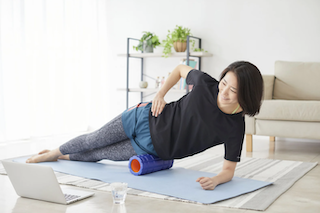
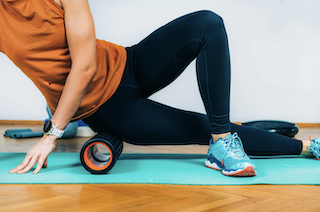
Can you actually stretch the IT band?
Structurally speaking — not really
This is where a major misconception comes in.
The IT band is not a muscle.
It is dense, non-contractile connective tissue.
Research highlights this clearly:
- Porrino et al. (2023) describe the IT band as a strong, fibrous structure — not elastic like muscle.
- Eng et al. (2015) found it stores only 1–7 joules of elastic energy during running (about 14% of the Achilles tendon).
- Seeber et al. (2020) showed it tolerates ~872 N of tensile force with only ~9% deformation.
In simple terms:
👉 The IT band is extremely strong and not designed to lengthen with stretching.
Then why does stretching sometimes feel helpful?
Because stretching doesn’t have to change tissue length to influence symptoms.
Research suggests that stretching may help by:
- Modulating pain sensitivity
- Improving movement tolerance
- Reducing protective muscle tone around the hip and knee
Supporting evidence:
- Rahman et al. (2023) found stretching improved pain and disability in individuals with knee osteoarthritis.
- Kane et al. (2013) reported added benefits when stretching was combined with standard physical therapy.
However, results are mixed:
- Pepper et al. (2021) found no change in IT band stiffness after a single stretching session.
- Opara et al. (2023) suggested stretching may help early in ITBS rehab, but its exact contribution remains unclear.
Key takeaway:
Stretching may help symptoms — but not because it “loosens” the IT band itself.
When should athletes use IT band stretching?
Most useful in early-stage ITBS
Evidence suggests stretching may be helpful:
- Early in rehabilitation
- When pain is limiting movement or training tolerance
- As a complement to other interventions
For example:
- Opara et al. (2023) support stretching as part of early rehab
- Balachandar et al. (2019) showed that combining stretching with NSAIDs and hip abductor strengthening reduced pain and prevented recurrence for up to 6 months
Important reminder
Stretching alone is not enough.
- Friede et al. (2021) found intermittent stretching does not meaningfully change IT band mechanics.
- Hip strength, load management, and movement patterns matter far more long-term.
Stretching should be treated as one tool — not the solution.
How much stretching is actually needed?
Research protocols vary widely:
- Pepper et al. (2021): 15-second holds × 3 reps
- Friede et al. (2021): 60-second holds × 2 reps, twice daily
- McKay et al.: Progressive 8-week programs with increasing volume
A recent review suggests:
- Total weekly stretching time matters more than single-session duration
- At least 5 minutes per week is needed for meaningful ROM changes
- 5+ sessions per week tends to produce better results
Final thoughts: should you stretch your IT band?
Stretching the IT band does not significantly lengthen it.
However, when used appropriately, stretching may:
- Reduce pain
- Improve movement tolerance
- Support early rehabilitation
< Recommendation by Our Experts>
✔ Don’t expect structural changes — the IT band is too strong to “stretch out”
✔ Use stretching early in ITBS rehab, not as a long-term fix
✔ Combine it with hip strengthening, load management, and movement correction
✔ Focus on consistency across the week, not aggressive single sessions


< Reference >
- Grzelak, Alicja. “Understanding ITBS in Athletes: A Comprehensive Systematic Review.” Quality in Sport 34 (December 2024): 56734. https://doi.org/10.12775/QS.2024.34.56734.
- Scola, Franco. “Iliotibial Band Syndrome.” In Org. Radiopaedia.org, 2016. https://doi.org/10.53347/rID-49962.
- Rahman, Hamna, Zirwa Afzal, Osama Ramzan, et al. “Effects of Iliotibial Band Myofascial Release with/without Stretching with Iliotibial Band Tightness Secondary to Knee Osteoarthritis.” Pakistan Journal of Medical and Health Sciences 17, no. 2 (2023): 73–76. https://doi.org/10.53350/pjmhs202317273.
- Kane, Ketki Wishwas, Mhatre Bhavana Suhas, and Mehta Amita. “Effect of Iliotibial Band Stretching on Pain and Functional Activities in Patients with Knee Osteoarthritis.” Indian Journal of Physiotherapy and Occupational Therapy – An International Journal 7, no. 2 (2013): 107. https://doi.org/10.5958/j.0973-5674.7.2.022.
- Opara, Manca, and Žiga Kozinc. “Stretching and Releasing of Iliotibial Band Complex in Patients with Iliotibial Band Syndrome: A Narrative Review.” Journal of Functional Morphology and Kinesiology 8, no. 2 (2023): 74. https://doi.org/10.3390/jfmk8020074.
- Pepper, Talin M, Jean-Michel Brismée, Phillip S Sizer Jr, et al. “The Immediate Effects of Foam Rolling and Stretching on Iliotibial Band Stiffness: A Randomized Controlled Trial.” International Journal of Sports Physical Therapy 16, no. 3 (2021). https://doi.org/10.26603/001c.23606.
- Porrino, Jack, Risa Kent, Kimia Kani, and Ezekiel Maloney. “The Fascia Lata and Iliotibial Band: An Imaging Overview of Iliotibial Band Syndromes.” PM&R 15, no. 7 (2023): 925–28. https://doi.org/10.1002/pmrj.12985.
- Eng, Carolyn M., Allison S. Arnold, Daniel E. Lieberman, and Andrew A. Biewener. “The Capacity of the Human Iliotibial Band to Store Elastic Energy during Running.” Journal of Biomechanics 48, no. 12 (2015): 3341–48. https://doi.org/10.1016/j.jbiomech.2015.06.017.
- Seeber, Gesine H., Mark P. Wilhelm, Phillip S. Sizer Jr*, et al. “THE TENSILE BEHAVIORS OF THE ILIOTIBIAL BAND – A CADAVERIC INVESTIGATION.” International Journal of Sports Physical Therapy 15, no. 3 (2020): 451–59. https://doi.org/10.26603/ijspt20200451.
- Felipe, Jack T., Adam M. Burk, Katherine M. Duong, and Stephanie G. Cone. “In Vivo Kinetic and Kinematic Analysis of Healthy Iliotibial Band Biomechanics.” Journal of Applied Biomechanics 41, no. 5 (2025): 396–401. https://doi.org/10.1123/jab.2025-0048.
- Balachandar, V., M. Hampton, O. Riaz, and S. Woods. “Iliotibial Band Friction Syndrome: A Systematic Review and Meta-Analysis to Evaluate Lower-Limb Biomechanics and Conservative Treatment.” Muscle Ligaments and Tendons Journal 09, no. 01 (2019): 181. https://doi.org/10.32098/mltj.02.2019.05.
- Friede, Miriam C., Gunnar Innerhofer, Christian Fink, Luis M. Alegre, and Robert Csapo. “Conservative Treatment of Iliotibial Band Syndrome in Runners: Are We Targeting the Right Goals?” Physical Therapy in Sport 54 (March 2022): 44–52. https://doi.org/10.1016/j.ptsp.2021.12.006.
Stay Informed with Physio Hub
Unlock a world of knowledge with our expertly curated articles on fitness, rehabilitation, and health & diet. Stay ahead with the latest evidence-based insights and practical advice. Subscribe now to receive updates and never miss out on new content!