Physio Hub:
Evidence-Based Article
Is Asymmetry Bad?
How to Interpret Right-to-Left Differences in Rehabilitation and Sports
Key Points
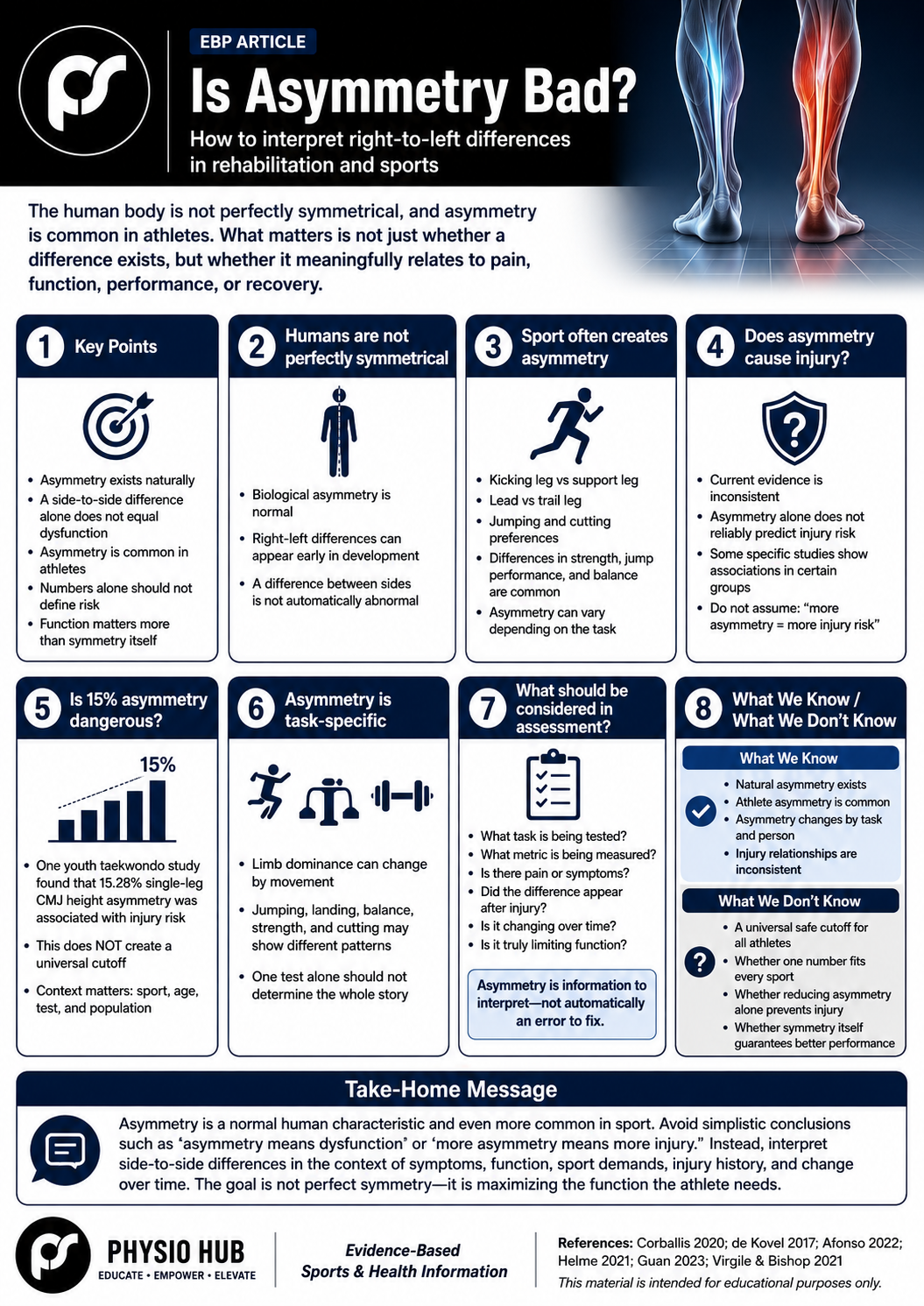
- The human body is not perfectly symmetrical, and right-to-left differences are normal.
- Asymmetry is common in athletes and does not automatically indicate dysfunction or increased injury risk.
- The magnitude and direction of asymmetry can change depending on the task, metric, sport, individual, and time of testing.
- Cutoffs such as “10%” or “15%” should not be treated as universal thresholds for injury risk.
- The goal of rehabilitation should not necessarily be perfect symmetry. The more important question is whether an asymmetry is meaningfully related to pain, function, performance, or recovery.
Humans Are Not Perfectly Symmetrical
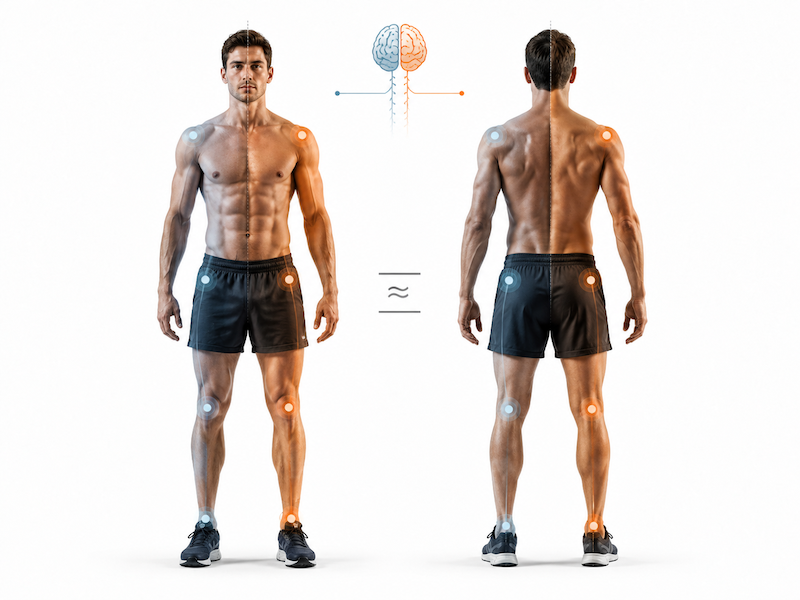
The human body may look symmetrical from the outside, but biologically, the right and left sides are not identical.
Functional laterality and asymmetry occur throughout human biology, including the nervous system, and should not automatically be viewed as errors.¹
These differences also begin very early in development.
Research examining human embryos has demonstrated left-to-right differences in maturation within the spinal cord and hindbrain during early development.²
This gives us an important starting point:
A right-to-left difference does not automatically mean something is wrong.
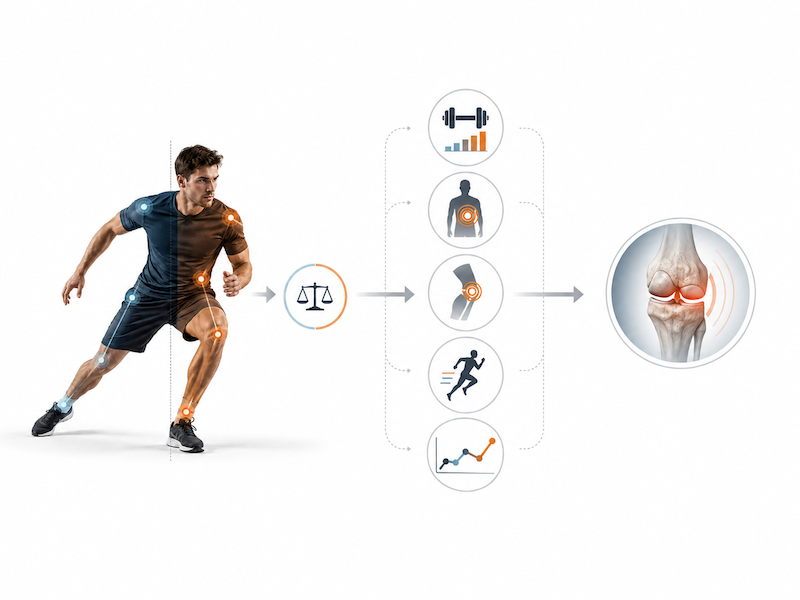
Asymmetry Is Common in Sport
Athletes frequently perform tasks in which each side of the body has a different role.
Consider:
- The kicking leg versus the support leg
- The lead and trail legs during throwing
- A preferred jumping leg
- A preferred direction for cutting or turning
It is therefore not surprising to find differences in strength, jumping performance, force production, balance, or movement between limbs.
A review of bilateral asymmetry in sport concluded that asymmetries are common across sports, ages, sexes, and competitive levels. Importantly, asymmetry can also vary substantially depending on the task, metric, athlete, sport, and timing of the assessment.³
In other words:
Finding an asymmetry and identifying a meaningful problem are not the same thing.
Does Asymmetry Increase Injury Risk?
This is one of the most common assumptions surrounding asymmetry testing.
Current evidence does not support a simple rule that athletes with greater asymmetry are automatically more likely to become injured.
A systematic review involving 6,228 participants across 31 studies examined the relationship between lower-limb functional asymmetry and sports injury. Some studies found associations, others found only partial associations, and others found no significant relationship.⁴
Overall, the authors described the evidence as low to moderate in quality and noted substantial methodological inconsistency.⁴
This means asymmetry may provide useful information in certain situations, but it should not be treated as an independent injury predictor.
Is 15% Asymmetry a “Danger Zone”?
Not universally.
A prospective study followed 415 youth taekwondo athletes for 12 months and found that greater interlimb asymmetry in single-leg countermovement jump height was associated with noncontact lower-extremity injury.⁵
Among the boys in that specific cohort, a jump-height asymmetry of 15.28% or greater was identified as a cutoff associated with increased injury risk.⁵
That is an interesting and clinically relevant finding—but it does not mean:
“Any athlete with more than 15% asymmetry is at high risk of injury.”
The finding came from:
- Youth athletes
- Taekwondo
- A single-leg countermovement jump
- A specific outcome measure
- A specific study population
We cannot automatically apply the same threshold to an adult runner, baseball player, soccer player, strength test, hop test, or balance assessment.
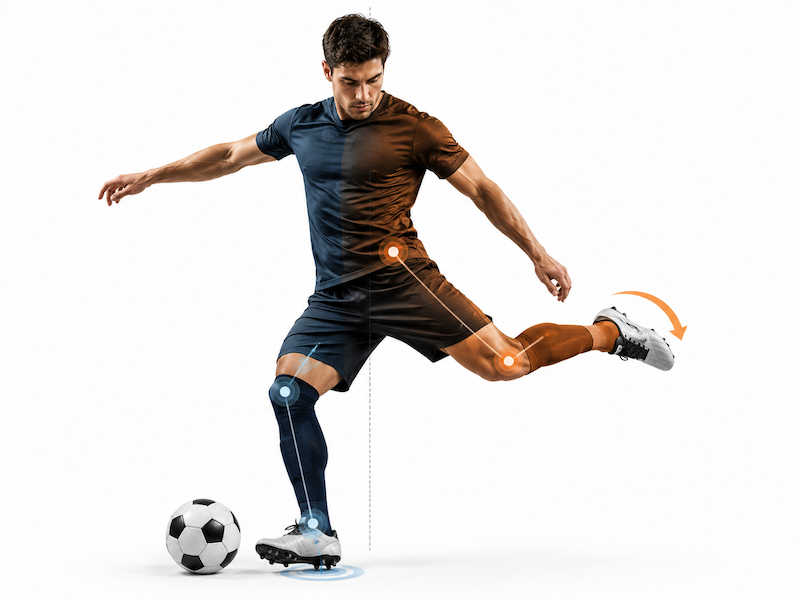
Asymmetry Is Task-Specific
The terms “dominant leg” and “nondominant leg” can also be misleading.
An athlete who prefers the right leg to kick a ball may not necessarily perform better with the right leg during:
- Jumping
- Landing
- Balance
- Maximum strength testing
- Cutting
Research on limb dominance emphasizes that dominance is often task-specific.⁶
For this reason, clinicians and coaches should always ask:
What ability are we measuring, and during what task?
A single asymmetry score should rarely be used by itself to declare a limb dysfunctional or identify the “cause” of a problem.
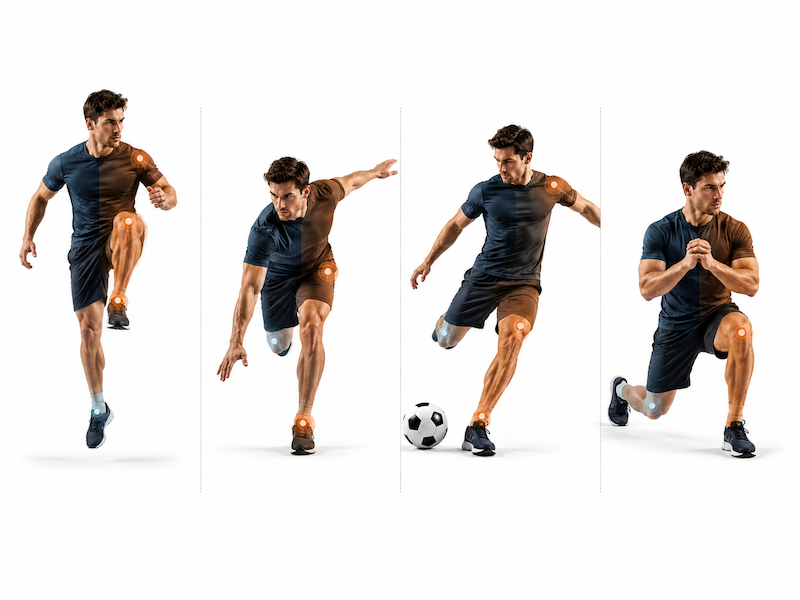
Does That Mean We Should Ignore Asymmetry?
No.
The fact that asymmetry can be normal does not mean it is always irrelevant.
An asymmetry may deserve more attention when:
- It develops or increases after an injury
- The injured limb demonstrates substantial loss of strength or power
- The asymmetry matches the athlete’s symptoms or functional limitation
- It changes meaningfully throughout rehabilitation
- It affects an ability that is important for the athlete’s sport
The key distinction is this:
The asymmetry itself is not the diagnosis. Its meaning within the athlete’s overall presentation is what matters.
When Might Asymmetry Matter—and When Might It Not?
The easiest way to understand asymmetry is to look at examples.
Consider two athletes who both show a right-to-left difference during testing.
The number itself may be similar.
The meaning may be completely different.
Example 1: An Asymmetry That May Deserve Attention
Imagine a soccer player returning from ACL reconstruction.
Before the injury, the athlete had no major functional limitation. Several months after surgery, testing shows that the reconstructed leg still produces substantially less quadriceps force than the other leg.
The athlete also:
- Produces less force through that leg when landing
- Performs worse during single-leg hopping
- Reports difficulty with deceleration and cutting
- Developed the asymmetry after the injury
In this situation, the asymmetry is much more clinically meaningful.
Research after ACL reconstruction has shown that greater quadriceps strength asymmetry can be associated with altered knee mechanics and poorer functional performance.
This does not mean that a specific percentage automatically determines whether the athlete is ready to return to sport.
But the asymmetry is consistent with the athlete’s injury history, functional deficit, and sport demands.
Therefore, it is reasonable for the clinician to address it.
Example 2: An Asymmetry That May Be Normal for the Athlete
Now imagine a healthy soccer player with no history of recent injury.
Testing shows that one leg produces somewhat greater knee-flexor strength, while the other produces greater knee-extensor strength.
However, the athlete:
- Has no pain
- Performs well
- Has no meaningful functional limitation
- Has played soccer for many years
- Uses the two legs differently when kicking and supporting the body
Should we immediately try to make both legs identical?
Probably not.
Research in elite soccer players demonstrates that asymmetry can differ according to the variable being tested, and the preferred kicking limb is not necessarily superior during every task.
In this situation, the difference may represent a sport-specific or individual characteristic rather than a deficit requiring correction.
It may still be worth monitoring, but the presence of asymmetry alone does not establish a problem.
Example 3: The Throwing Shoulder
Consider a baseball pitcher whose throwing shoulder has more external rotation and less internal rotation than the nonthrowing shoulder.
At first glance, the shoulders are clearly asymmetric.
But repetitive throwing produces long-term structural and functional adaptations in the throwing arm. Pitchers commonly demonstrate side-to-side differences in shoulder rotation, including increased external rotation, decreased internal rotation, and differences in humeral torsion.
Therefore, attempting to make the throwing shoulder identical to the nonthrowing shoulder may not necessarily be appropriate.
However, imagine that the same pitcher suddenly loses additional motion during the season, develops shoulder pain, and has difficulty reaching his normal throwing velocity.
Now the asymmetry becomes more relevant.
The question is no longer simply:
“Are the shoulders symmetrical?”
It becomes:
“Has something changed, and is that change related to the athlete’s symptoms or function?”
The Same Number Can Have Different Meanings
This is why an asymmetry percentage cannot be interpreted in isolation.
Imagine two athletes who both demonstrate a 15% difference on a particular test.
One athlete is healthy, symptom-free, performing normally, and has shown a similar difference for years.
The other recently sustained an injury, suddenly developed the difference, has weakness on the injured side, and cannot perform an important sport-specific task.
Mathematically, both athletes may have “15% asymmetry.”
Clinically, they are not the same situation.
The more useful question is therefore not:
“How much asymmetry is acceptable?”
It is:
“What does this asymmetry mean for this athlete?”
What Matters in Assessment?
Rather than asking only, “How asymmetric is this athlete?” consider:
What task are we testing?
Strength, jumping, balance, running, cutting, or another skill?
What variable are we measuring?
Peak force, average force, velocity, power, jump height, or another outcome?
Does the athlete have symptoms?
Did the difference appear or increase after injury?
Is it changing over time?
Is some degree of asymmetry expected in this sport?
Is the asymmetry actually limiting function or performance?
This changes the clinical perspective.
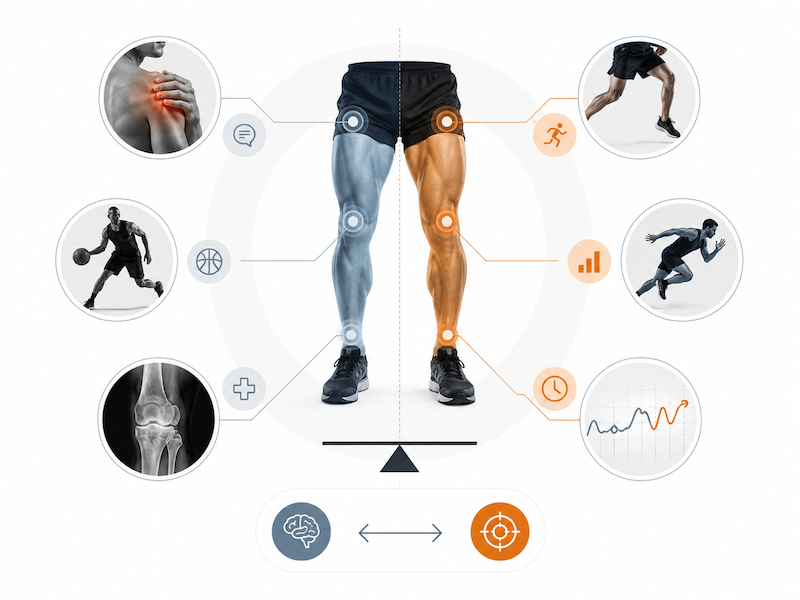
Asymmetry is not necessarily an error that must be corrected. It is information that must be interpreted.
What We Know
Current evidence supports several important points:
- Biological and functional asymmetries occur naturally in humans.¹˒²
- Interlimb asymmetry is common among athletes.³
- Asymmetry is highly task-, metric-, individual-, sport-, and time-specific.³˒⁶
- Evidence connecting asymmetry with sports injury is inconsistent.⁴
- Certain asymmetries may be associated with injury in specific populations and specific tests.⁵
What We Still Don’t Know
Important questions remain:
- Is there a universal “safe” amount of asymmetry for athletes?
- Can a single cutoff such as 10% or 15% be meaningfully applied across different sports and tests?
- Does reducing asymmetry itself reduce injury risk?
- Does becoming more symmetrical necessarily improve sport performance?
- How can we reliably distinguish adaptive asymmetry from dysfunctional asymmetry using a single assessment?
At present, the evidence does not provide simple universal answers to these questions.
What Athletes, Parents, Coaches, and Trainers Should Know
If testing shows that one side is stronger, more powerful, or more mobile than the other, there is no reason to immediately assume something is wrong.
Instead, ask:
What test showed the difference?
Is it related to the athlete’s symptoms or performance?
Is the difference new or changing?
Does the athlete’s sport naturally create different roles for each side?
Finding asymmetry is only the beginning.
The important part is determining whether that asymmetry actually matters for this athlete.
< Take-Home Message >
Right-to-left differences are normal in humans and especially common in athletes.
Therefore:
“Asymmetry exists” does not mean “something is wrong.”
“Greater asymmetry” does not automatically mean “greater injury risk.”
At the same time, asymmetry should not simply be ignored.
Its meaning should be interpreted alongside the athlete’s:
symptoms, function, sport demands, task being tested, injury history, and changes over time.
The goal is not necessarily to make both sides identical.
The goal is to maximize the function the individual athlete needs.
<PDF file>
Read More


< Reference >
- Corballis MC. Bilaterally symmetrical: to be or not to be? Symmetry. 2020;12(3):326. doi:10.3390/sym12030326.
- de Kovel CGF, Lisgo S, Karlebach G, et al. Left-right asymmetry of maturation rates in human embryonic neural development. Biol Psychiatry. 2017;82(3):204-212. doi:10.1016/j.biopsych.2017.01.016.
- Afonso J, Peña J, Sá M, Virgile A, García-de-Alcaraz A, Bishop C. Why sports should embrace bilateral asymmetry: a narrative review. Symmetry. 2022;14(10):1993. doi:10.3390/sym14101993.
- Helme M, Tee J, Emmonds S, Low C. Does lower-limb asymmetry increase injury risk in sport? A systematic review. Phys Ther Sport. 2021;49:204-213. doi:10.1016/j.ptsp.2021.03.001.
- Guan Y, Bredin SSD, Taunton J, Jiang Q, Wu N, Warburton DER. Predicting the risk of injuries through assessments of asymmetric lower limb functional performance: a prospective study of 415 youth taekwondo athletes. Orthop J Sports Med. 2023;11(8):23259671231185586. doi:10.1177/23259671231185586.
- Virgile A, Bishop C. A narrative review of limb dominance: task specificity and the importance of fitness testing. J Strength Cond Res. 2021;35(3):846-858. doi:10.1519/JSC.0000000000003851.
Stay Informed with Physio Hub
Unlock a world of knowledge with our expertly curated articles on fitness, rehabilitation, and health & diet. Stay ahead with the latest evidence-based insights and practical advice. Subscribe now to receive updates and never miss out on new content!