
How to Regain Change of Direction Ability After Injury
A Practical Return-to-Sport Progression From Strength and Deceleration to Cutting and Reactive Agility
What Is Change of Direction Ability, and Why Does It Matter?
After a hip, knee, or ankle injury, athletes typically focus on restoring range of motion, strength, and pain-free movement.
However, even after apparently successful rehabilitation, some athletes report that they still cannot move the same way they did before the injury.
They may notice:
- Difficulty changing direction quickly
- Reduced confidence when stopping on the previously injured leg
- Slower lateral movement
- Hesitation when pushing off the injured side
- Difficulty responding to opponents or unexpected movements
These problems may reflect incomplete recovery of Change of Direction (COD) ability.
Change of direction refers to the ability to modify movement speed and direction.
Successful COD requires the athlete to:
- Decelerate: Reduce or stop the body’s momentum
- Absorb Force: Control loading through the lower extremities
- Reaccelerate: Produce force in a new direction
- Control Multidirectional Movement: Maintain coordination during forward, backward, lateral, and diagonal movement
In many sports, athletes must also react to opponents, teammates, or the ball. This adds perceptual and decision-making demands, commonly referred to as reactive agility.
Planned change of direction and reactive agility are therefore related, but they are not identical abilities.
Strength Recovery Does Not Guarantee COD Recovery
A review by Marques et al. (2020) highlighted that athletes following ACL reconstruction may demonstrate deficits in cutting mechanics and movement strategies that are not adequately captured by traditional strength or single-leg hop testing.[1]
Similarly, Mausehund and Krosshaug (2024) found that female elite athletes with a previous ACL injury continued to unload the previously injured knee during cutting maneuvers.[2]
Importantly, the biomechanical variables measured in that study did not predict future secondary ACL injury.
These findings illustrate an important distinction:
Restoring muscle strength does not automatically restore the ability to decelerate, cut, and reaccelerate at sport-specific speed.
Persistent limitations may involve insufficient force production, impaired braking control, altered movement strategies, reduced sensory-motor control, psychological apprehension, or inadequate exposure to sport-specific movements.
How Can Change of Direction Ability Be Improved?
Identify the Limiting Factors
Before introducing more demanding agility drills, identify the factors limiting COD performance.
Relevant components include:
- Hip, knee, and ankle mobility
- Lower-limb strength
- Explosive force production
- Eccentric braking capacity
- Single-leg control
- Movement coordination
- Confidence in the previously injured limb
Buckthorpe (2021) recommended considering neuromuscular, biomechanical, sensorimotor, cognitive, task-related, and environmental factors when retraining movement after ACL reconstruction.[3]
Rather than assuming that all athletes need the same exercises, rehabilitation should target the individual’s remaining limitations.
Restore Strength and Braking Capacity
Changing direction involves reducing momentum before generating force in another direction.
Rehabilitation should therefore consider both force production and force absorption.
Relevant areas include:
- Quadriceps and hamstring strength
- Hip extensor, abductor, and adductor strength
- Ankle plantarflexor strength
- Eccentric control
- Landing and deceleration mechanics
These capacities provide a foundation for more demanding movement, but strength training alone is not a complete substitute for practicing the target skill.
Introduce COD Preparation During Rehabilitation
Change-of-direction preparation does not necessarily have to wait until conventional rehabilitation is finished.
However, this does not mean introducing high-speed cutting during early tissue healing.
When medically appropriate, foundational tasks such as controlled lateral lunges, weight shifting, single-leg loading, and low-speed braking may be incorporated before progressing to demanding running or cutting drills.
The Aspetar ACL reconstruction guideline emphasizes criteria-based progression while respecting healing time, symptoms, and the athlete’s functional capacity.[4]
The objective is to prepare the athlete progressively rather than suddenly introducing high-demand sport movement near the end of rehabilitation.
Progress From Controlled to Reactive Movement
A practical progression is:
Controlled Movement → Braking → Planned COD → Reactive Agility → Sport-Specific Movement
Training demands can be adjusted by modifying:
- Approach speed
- Cutting angle
- Braking intensity
- Decision-making requirements
- Fatigue and training volume
Sharper cutting angles generally require more braking than shallower changes of direction when approach speed and other conditions are comparable. Actual loading also depends on technique and task constraints.[1]
Buckthorpe et al. (2019) described a staged on-field rehabilitation model progressing from linear movement to multidirectional movement, sport-specific skills, and practice simulations.[5]
Integrate Realistic Sport Demands
A player may perform controlled cutting drills successfully but still struggle with unpredictable game situations.
The final phase should therefore incorporate the athlete’s sport, movement speed, reaction requirements, and training exposure.
A 2026 scoping review of on-field rehabilitation following ACL injuries identified widespread use of staged, criteria-based progressions. However, much of the available literature remains descriptive, and the optimal combination of exercises has not been established through robust intervention trials.[6]
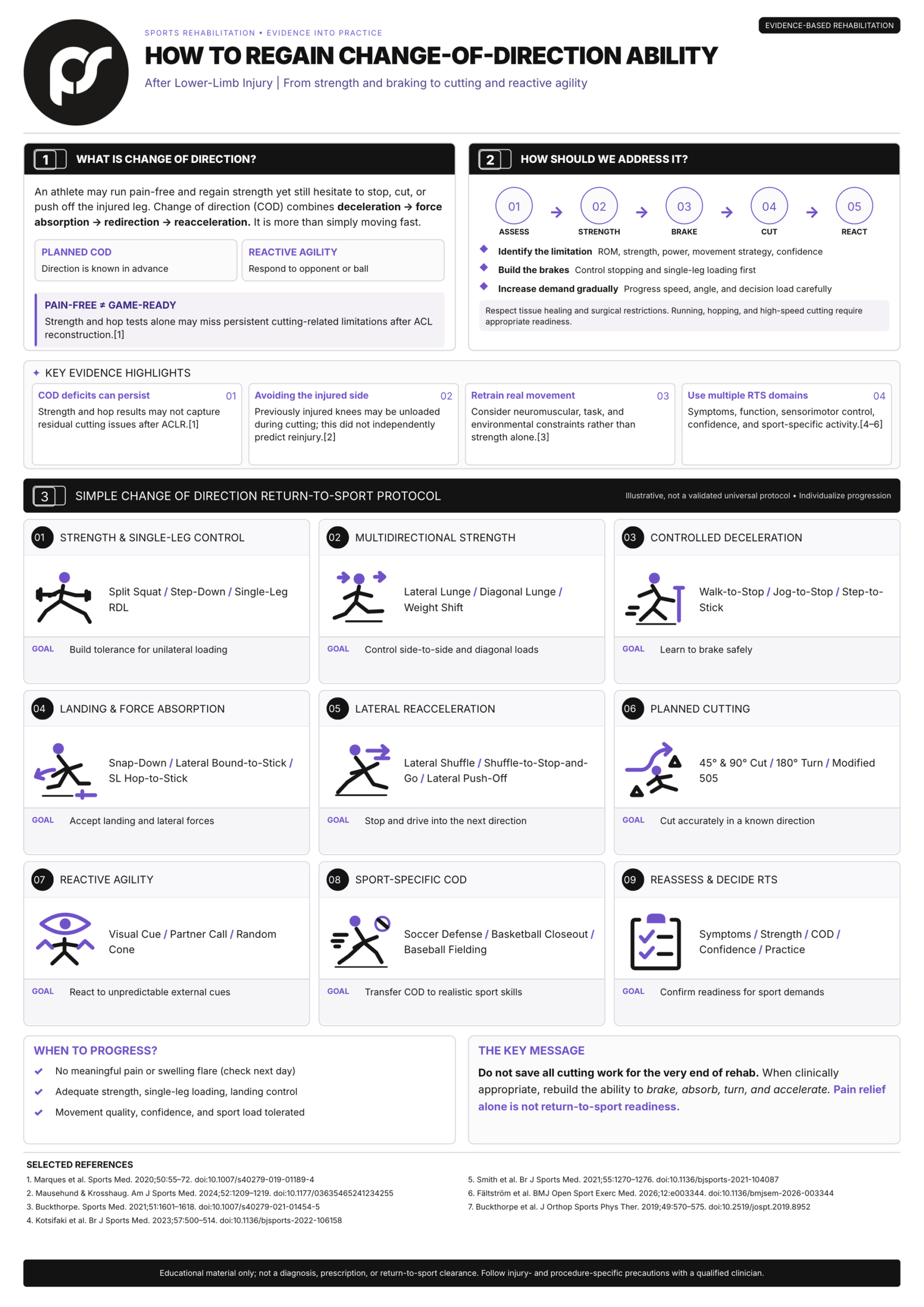
Simple Change of Direction Return-to-Sport Protocol
The following is a practical progression synthesized from rehabilitation principles and available research.
This complete exercise sequence has not been validated as a single universal rehabilitation protocol.
The selection, timing, and progression of exercises must be individualized according to the injury, surgery, tissue healing, symptoms, strength, and sport requirements.
Stages may overlap when appropriate. Specific sets and repetitions are intentionally omitted.
- Restore Basic Strength and Single-Leg Control
Examples:
- Split Squat
- Controlled Step-Down
- Single-Leg Calf Raise
- Single-Leg RDL
Goal: Restore foundational lower-limb strength and single-leg load tolerance.
- Multidirectional Strength and Weight Transfer
Examples:
- Lateral Lunge
- Diagonal Lunge
- Multidirectional Weight Shift
Goal: Develop the ability to accept and control loading in lateral and diagonal directions.
- Controlled Deceleration
Examples:
- Forward Walk-to-Stop
- Controlled Jog-to-Stop, when running is permitted
- Lateral Step-to-Stick
- Lateral Shuffle-to-Stop, when appropriate
Goal: Restore braking control by progressively reducing momentum under controlled conditions.
Begin with slower speeds and longer stopping distances before increasing braking demands.
- Landing and Lateral Force Absorption
Examples:
- Double-Leg Snap-Down
- Lateral Bound-to-Stick
- Single-Leg Lateral Hop-to-Stick
Goal: Develop the ability to absorb landing forces and control lateral loading.
Introduce hopping and jumping only after appropriate strength, loading tolerance, and clinical clearance have been achieved.
- Lateral Movement and Reacceleration
Examples:
- Lateral Shuffle
- Shuffle-to-Stop-and-Go
- Short Lateral Push-Off
- Short Acceleration-to-Stop
Goal: Restore the ability to move laterally, decelerate, and produce force in a new direction.
- Planned Change of Direction
Examples:
- Pre-Planned 45° Cut
- Pre-Planned 90° Cut
- Controlled 180° Turn
- Modified Shuttle / 505-Style Drill
Goal: Restore controlled cutting mechanics and reacceleration during predetermined movement tasks.
Gradually increase approach speed, cutting angle, and task complexity as tolerated.
- Reactive Agility
Examples:
- Visual-Cue Direction Change
- Partner-Directed Cutting
- Random Cone-Call Drill
- Ball-Reaction Agility Drill
Goal: Restore the ability to respond to external cues and change direction while making rapid movement decisions.
Assess both movement performance and the ability to maintain control under reactive conditions.
- Sport-Specific Change of Direction
Examples:
Soccer
- Defensive Cutting
- Reactive Footwork
- Ball-Driven Direction Changes
Basketball
- Defensive Shuffle
- Closeout-to-Cut
- Reactive Defensive Movement
Baseball
- Reactive Infield Footwork
- Fielding-to-Throw Transition
- Lateral Ball-Reaction Drill
Goal: Integrate COD ability into realistic sport-specific movements, including appropriate speed, decision-making, and repeated efforts.
- Reassess
Relevant assessments may include:
- Pain, swelling, and next-day symptom response
- Hip, knee, and ankle function
- Lower-limb strength and power
- Single-leg landing and braking control
- Left- and right-sided COD performance
- Planned and reactive agility
- Movement quality
- Athlete confidence
- Tolerance to sport-specific training
The 505 test, other directional change assessments, and video analysis may help identify relevant performance limitations.
However, a single test score or symmetrical performance result should not independently determine return-to-sport readiness.
The PAASS framework for lateral ankle sprain highlights the importance of assessing pain, ankle impairments, athlete perception, sensorimotor control, and sport-specific functional performance.[7]
If strength and hop performance have recovered but the athlete continues to unload the injured limb during cutting, additional movement retraining and progressive sport exposure may be appropriate.
Clinical Considerations
This progression should not be interpreted as a universal timeline.
Following ACL reconstruction, meniscal repair, hip arthroscopy, fracture, or significant ligament injury, exercise progression must respect procedure-specific precautions and biological healing.
Athletes who experience increasing joint swelling, recurrent instability, locking, or persistent symptom aggravation during or after activity should reduce the demand and seek appropriate clinical assessment.
< Take-Home Message >
Regaining change-of-direction ability after injury requires more than restoring muscle strength or achieving pain-free movement.
A practical progression is:
Restore Strength and Single-Leg Control
→ Develop Braking and Landing Capacity
→ Restore Lateral Movement and Reacceleration
→ Progress to Planned COD
→ Integrate Reactive Agility
→ Return to Sport-Specific Movement
When appropriate, the foundations of change-of-direction training should be introduced during rehabilitation rather than reserved exclusively for the final stage.
Being pain-free is not the same as being fully prepared for sport.
Successful return to sport requires the ability to tolerate and control the specific speeds, directions, loading demands, and decisions encountered during athletic performance.
< PDF file>
< Reference >
- Marques JB, Paul DJ, Graham-Smith P, Read PJ. Change of direction assessment following anterior cruciate ligament reconstruction: a review of current practice and considerations to enhance practical application. Sports Med. 2020;50(1):55-72. https://doi.org/10.1007/s40279-019-01189-4
- Mausehund L, Krosshaug T. Knee biomechanics during cutting maneuvers and secondary ACL injury risk: a prospective cohort study of knee biomechanics in 756 female elite handball and soccer players. Am J Sports Med. 2024;52(5):1209-1219. https://doi.org/10.1177/03635465241234255
- Buckthorpe M. Recommendations for movement re-training after ACL reconstruction. Sports Med. 2021;51(8):1601-1618. https://doi.org/10.1007/s40279-021-01454-5
- Kotsifaki R, Korakakis V, King E, et al. Aspetar clinical practice guideline on rehabilitation after anterior cruciate ligament reconstruction. Br J Sports Med. 2023;57(9):500-514. https://doi.org/10.1136/bjsports-2022-106158
- Buckthorpe M, Della Villa F, Della Villa S, Roi GS. On-field rehabilitation part 2: a 5-stage program for the soccer player focused on linear movements, multidirectional movements, soccer-specific skills, soccer-specific movements, and modified practice. J Orthop Sports Phys Ther. 2019;49(8):570-575. https://doi.org/10.2519/jospt.2019.8952
- Fältström A, Gustafsson T, Hermansen A, Sonesson S. On-field rehabilitation after anterior cruciate ligament injury in contact team sports: a scoping review of exercises, progression and key principles. BMJ Open Sport Exerc Med. 2026;12. https://doi.org/10.1136/bmjsem-2026-003344
- Smith MD, Vicenzino B, Bahr R, et al. Return to sport decisions after an acute lateral ankle sprain injury: introducing the PAASS framework—an international multidisciplinary consensus. Br J Sports Med. 2021;55(22):1270-1276. https://doi.org/10.1136/bjsports-2021-104087
- Buckthorpe M. Optimising the late-stage rehabilitation and return-to-sport training and testing process after ACL reconstruction. Sports Med. 2019;49:1043-1058. https://doi.org/10.1007/s40279-019-01102-z