Physio Hub:
Evidence-Based Article
Evidence vs Clinical Experience
Why Evidence-Based Practice Requires Both
Key Points
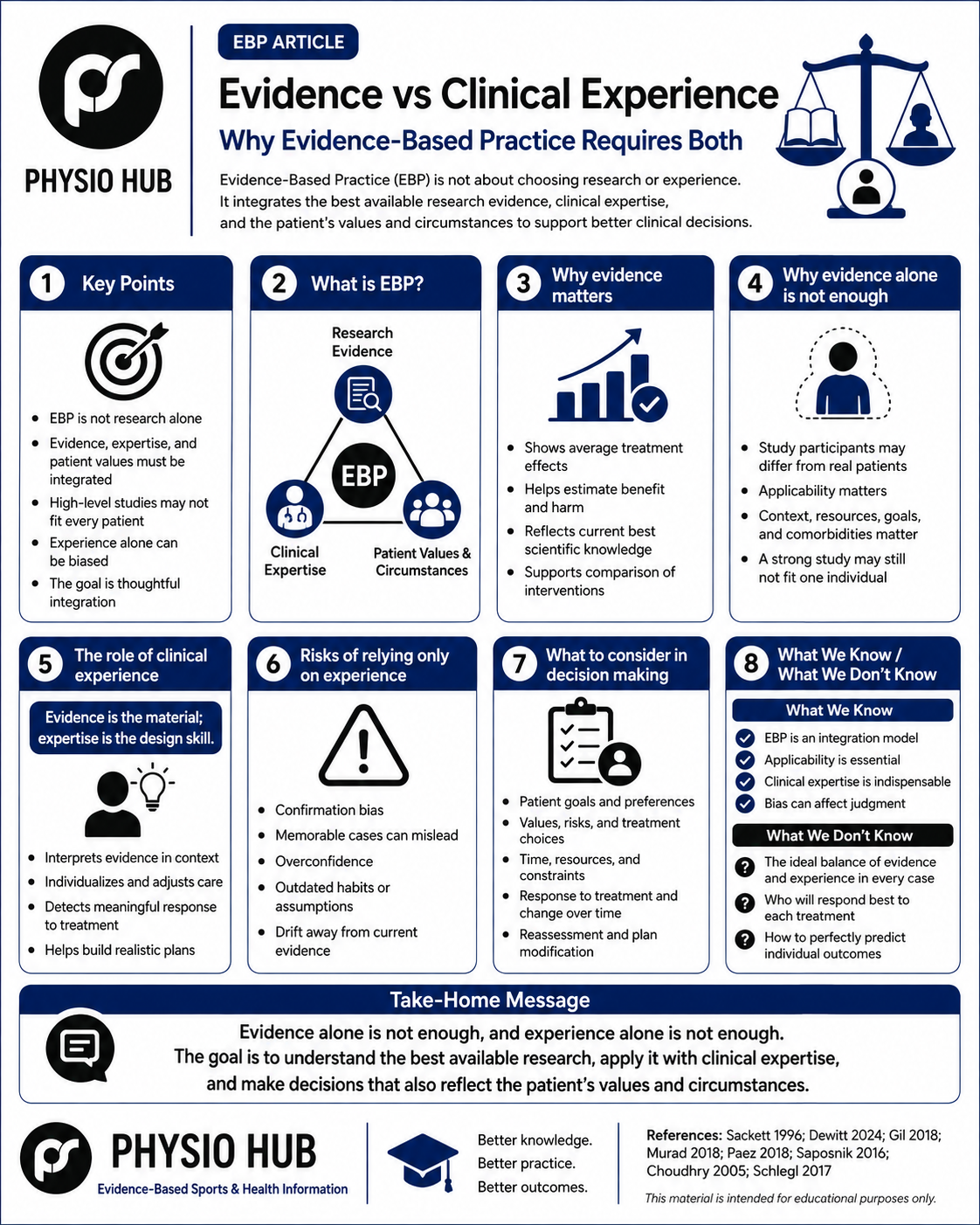
- Evidence-Based Practice (EBP) does not mean blindly following research.
- EBP integrates the best available research evidence, clinical expertise, and the patient’s values and circumstances.¹
- A study can provide high-quality evidence and still have limited applicability to a particular patient.
- Clinical experience is essential for interpreting and applying evidence, but experience alone can also be affected by cognitive bias.
- The goal is not to choose evidence or experience. Good clinical decisions require the thoughtful integration of both.
Evidence-Based Practice Is More Than “Following the Research”
The rise of evidence-based healthcare has transformed medicine and rehabilitation.
Clinicians are expected to read research, use clinical practice guidelines, and choose interventions supported by scientific evidence.
That is a major improvement over relying solely on tradition or opinion.
But EBP was never intended to mean:
“Find the highest-level study and do exactly what it says.”
In one of the foundational descriptions of evidence-based medicine, Sackett and colleagues emphasized the integration of the best available external evidence with individual clinical expertise.¹
Patient values, preferences, goals, and circumstances are also fundamental to modern evidence-based decision making.
A useful way to think about EBP is:
Research Evidence
+
Clinical Expertise
+
Patient Values & Circumstances

Healthcare Professionals Tend to Place High Value on Science
A 2024 survey examined beliefs about scientific knowledge and personal clinical experience among 1,627 Swedish healthcare professionals, including physicians, nurses, occupational therapists, dentists, and dental hygienists.²
Overall, participants rated scientific knowledge as more important to decision making, more certain, and more systematic than their own clinical experience. Physicians showed the largest difference between the two forms of knowledge.²
This reflects an important development in modern healthcare: clinical decisions should be informed by science.
But there is an equally important distinction:
Valuing scientific evidence does not mean that research results can simply be copied and applied identically to every patient.
“Higher-Level Evidence” Does Not Automatically Mean “Right for This Patient”
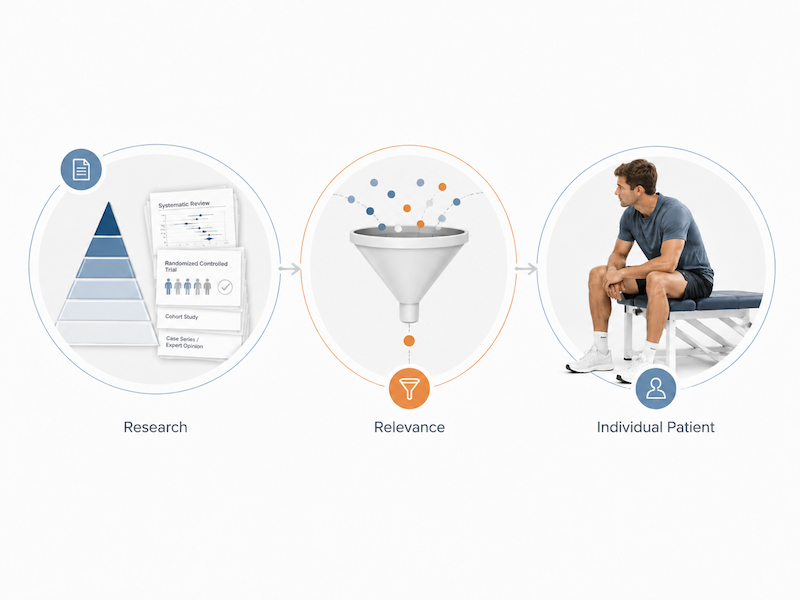
Evidence hierarchies are useful.
Randomized controlled trials and systematic reviews are particularly valuable for answering many treatment questions because their designs can reduce important forms of bias.
However, research should not be judged only by its position on a pyramid.
Clinicians also need to consider:
- Study design
- Risk of bias
- Consistency of findings
- Precision
- Participants studied
- Intervention and comparison
- Outcomes measured
- Relevance to the clinical question
- Applicability to the individual patient
These factors influence how useful a study actually is in practice.³
The “best” study design also depends on the question. A randomized trial may be ideal for many intervention questions, while prognosis, diagnosis, and risk-factor questions often require different research designs.
An evidence hierarchy is a tool for appraisal—not a clinical answer key.
Good Research May Still Not Fit the Patient in Front of You
Clinical studies necessarily examine defined groups of participants.
Your patient, however, may differ from those participants in important ways:
- Age
- Comorbidities
- Symptom severity
- Athletic demands
- Occupation
- Psychosocial factors
- Available resources
- Goals and preferences
This creates the question of applicability: can the conclusions drawn from the study reasonably be used for this particular patient?⁴
A well-designed study may provide a reliable estimate of what happened on average in the population studied.
It does not guarantee exactly what will happen to one individual.
That gap between research and the individual patient is where clinical reasoning becomes essential.

What Is the Role of Clinical Experience?
Clinical expertise should not be treated simply as a weaker version of scientific evidence.
Its role is different.
Paez proposed an “architect analogy” for EBP.⁵
In this model, research evidence is similar to building material.
Clinical expertise is the ability to determine:
- Which evidence is relevant
- Whether it fits the patient’s circumstances
- How to implement it
- What should be modified
- Whether the patient is responding
- When the plan needs to change
The clinician is therefore not replacing evidence with experience.
Clinical expertise is the skill required to interpret, apply, and continually reassess evidence in the context of an individual person.

Experience Alone Can Also Mislead Us
Clinical experience is valuable—but it is not automatically correct.
Human decision making can be influenced by cognitive biases such as:
- Confirmation bias: favoring information that supports an existing belief
- Anchoring: relying too heavily on an initial impression
- Availability bias: overestimating memorable cases
- Overconfidence: placing excessive confidence in one’s judgment
A systematic review of physician decision making found that several cognitive biases were associated with diagnostic inaccuracies or suboptimal management, although the underlying evidence had important limitations.⁶
Years of practice alone also do not guarantee better decisions.
A systematic review examining physicians found that greater time in practice was not consistently associated with better knowledge or quality of care, and many included studies reported lower performance with increasing years since training.⁷
This does not mean that experience is harmful.
It means that:
Experience becomes expertise only when it is continually examined, updated, and corrected.
Patient Values Are Part of the Evidence-Based Decision
Imagine two athletes with the same injury and the same treatment options.
One prioritizes returning to competition as quickly as reasonably possible.
The other prioritizes minimizing the chance of recurrence, even if rehabilitation takes longer.
The research evidence may be identical.
The best decision may not be.
Patient goals, preferences, acceptable risk, resources, and circumstances influence which option makes the most sense.¹˒⁸
This is why a treatment can be scientifically supported without automatically being the best choice for every person.
Evidence and Experience Have Different Jobs
Research Evidence Helps Answer:
- What tends to work?
- How large might the benefit be?
- What harms or risks have been observed?
- How certain are we?
- What remains unknown?
Clinical Expertise Helps the Clinician:
- Determine whether the evidence applies
- Assess the individual’s presentation
- Select and adapt an intervention
- Monitor response
- Modify the plan when appropriate
Patient Values Help Determine:
- What outcome matters most?
- What trade-offs are acceptable?
- What risks are acceptable?
- What is practical and realistic?
- What does success mean to this person?
Evidence-Based Practice occurs when these elements are integrated rather than placed in competition.
What We Know
Current evidence supports several important principles:
- EBP is not research evidence alone.¹
- Healthcare professionals recognize scientific evidence and personal experience as different forms of knowledge.²
- Study design alone does not determine how useful evidence is for clinical care.³
- Even valid research must be assessed for applicability to an individual patient.⁴
- Clinical expertise plays an important role in translating research into individual care.⁵
- Clinical judgment can be affected by cognitive biases.⁶
What We Still Don’t Know
There are no universal answers to questions such as:
- Exactly how much weight should research evidence and clinical experience each receive?
- How many years of experience are required before someone has sufficient “expertise”?
- When research and clinical experience conflict, which should always win?
- How accurately can an average treatment effect predict the response of one individual patient?
The answer depends on the clinical question, the quality and relevance of the evidence, the patient’s situation, and the consequences of the decision.
That is why clinical reasoning remains necessary even in an evidence-based system.
What Healthcare Professionals and Trainers Should Remember
Evidence-Based Practice is neither:
“Do whatever the research says.”
nor:
“Trust your experience.”
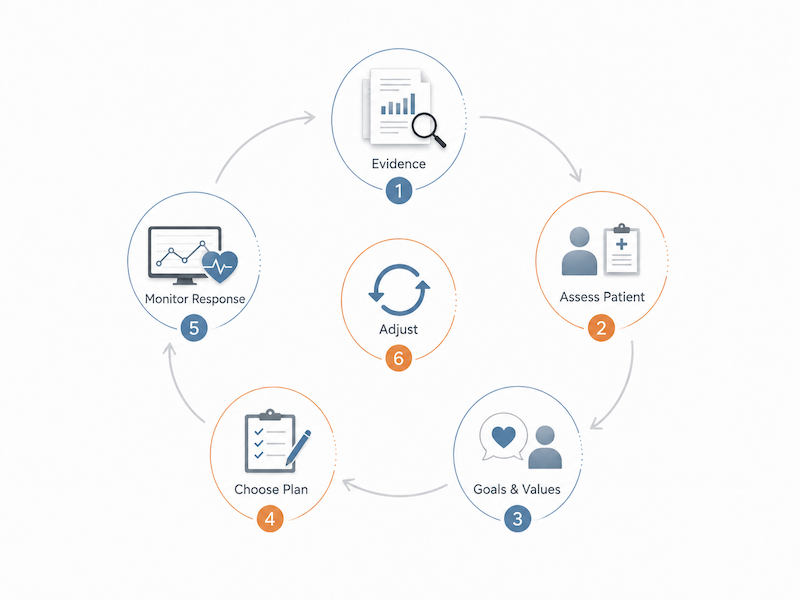
A better process is:
Understand the best available evidence.
Determine whether it applies to the person in front of you.
Use clinical expertise to assess and implement it appropriately.
Include the patient’s goals and preferences in the decision.
Observe what happens.
Then update the plan when the patient’s response or new evidence requires it.
< Take-Home Message >
Evidence and clinical experience are not competitors.
Evidence provides the scientific foundation for clinical decisions.
Clinical expertise helps translate that evidence to the individual patient.
Patient values and circumstances complete the decision.
Evidence alone is not enough.
Experience alone is not enough.
The goal of Evidence-Based Practice is to understand the evidence, apply it with expertise, and make decisions together with the patient.
<PDF file>
Read More



< Reference >
- Sackett DL, Rosenberg WMC, Gray JAM, Haynes RB, Richardson WS. Evidence based medicine: what it is and what it isn’t. BMJ. 1996;312(7023):71-72. doi:10.1136/bmj.312.7023.71.
- Dewitt B, Persson J, Wallin A. Perceptions of clinical experience and scientific evidence in medical decision making: a survey of a stratified random sample of Swedish health care professionals. Med Decis Making. 2024;44(3):335-345. doi:10.1177/0272989X241234318.
- Gil AB, Piva SR, Irrgang JJ. Considerations for assessment and applicability of studies of intervention. Clin Sports Med. 2018;37(3):427-440. doi:10.1016/j.csm.2018.03.008.
- Murad MH, Katabi A, Benkhadra R, Montori VM. External validity, generalisability, applicability and directness: a brief primer. BMJ Evid Based Med. 2018;23(1):17-19. doi:10.1136/ebmed-2017-110800.
- Paez A. The “architect analogy” of evidence-based practice: reconsidering the role of clinical expertise and clinician experience in evidence-based health care. J Evid Based Med. 2018;11(4):219-226. doi:10.1111/jebm.12321.
- Saposnik G, Redelmeier D, Ruff CC, Tobler PN. Cognitive biases associated with medical decisions: a systematic review. BMC Med Inform Decis Mak. 2016;16(1):138. doi:10.1186/s12911-016-0377-1.
- Choudhry NK, Fletcher RH, Soumerai SB. Systematic review: the relationship between clinical experience and quality of health care. Ann Intern Med. 2005;142(4):260-273. doi:10.7326/0003-4819-142-4-200502150-00008.
- Schlegl E, Ducournau P, Ruof J. Different weights of the evidence-based medicine triad in regulatory, health technology assessment, and clinical decision making. Pharmaceut Med. 2017;31(4):213-216. doi:10.1007/s40290-017-0197-3.
Stay Informed with Physio Hub
Unlock a world of knowledge with our expertly curated articles on fitness, rehabilitation, and health & diet. Stay ahead with the latest evidence-based insights and practical advice. Subscribe now to receive updates and never miss out on new content!