Physio Hub:
Evidence-Based Article
Dynamic Knee Valgus
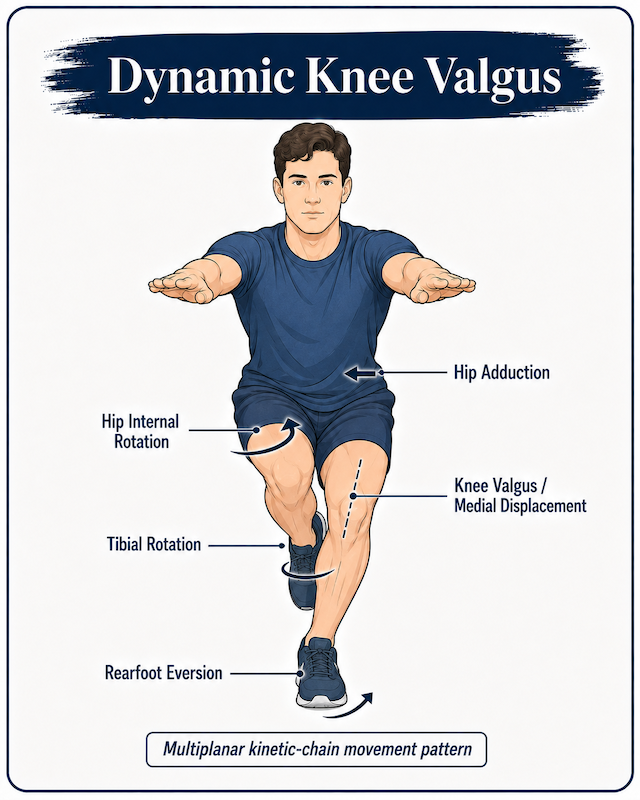
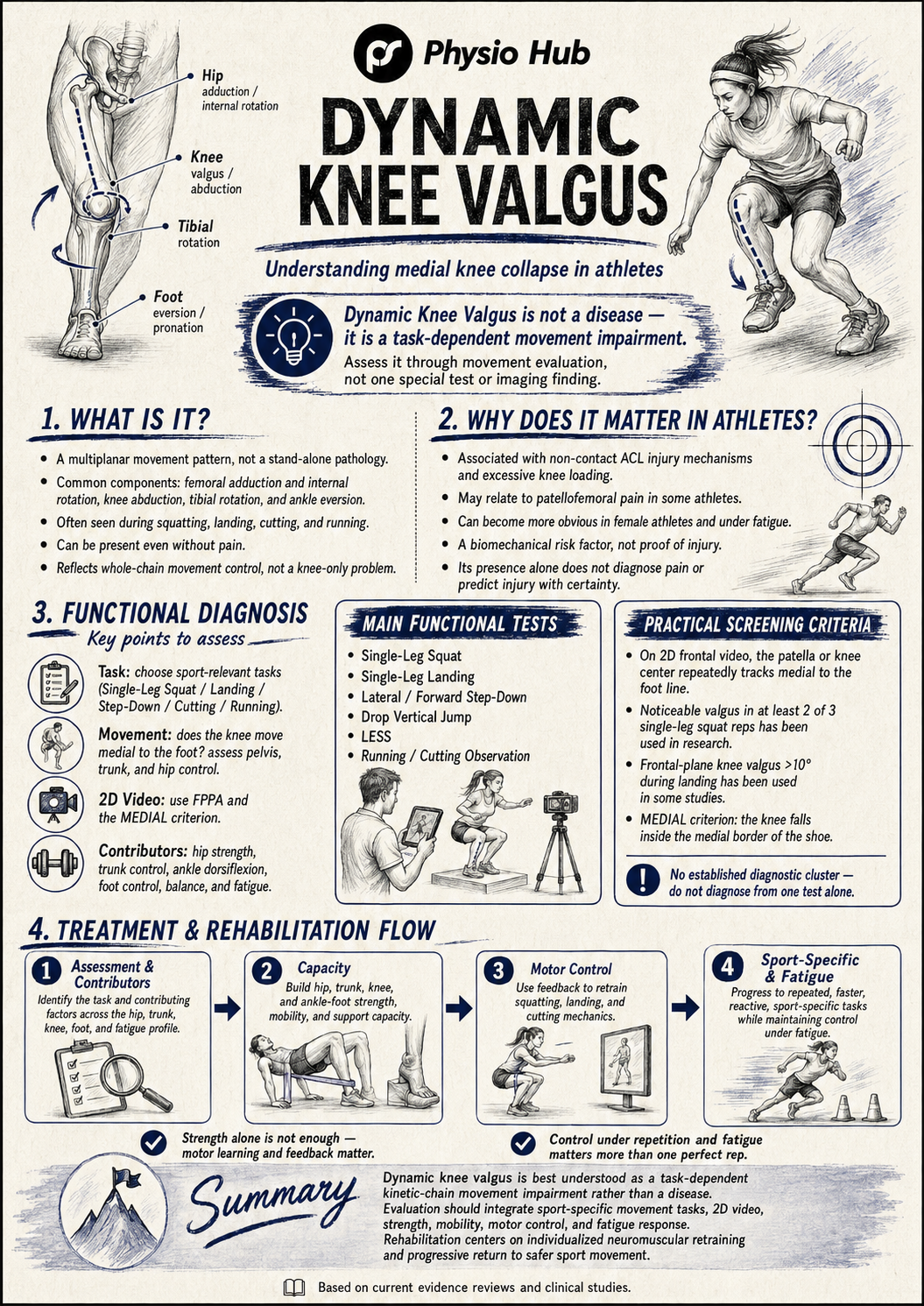
Dynamic knee valgus (DKV) describes a multiplanar movement pattern in which the knee appears to collapse medially during movements such as squatting, landing, cutting, and running.¹⁻⁴
Importantly, dynamic knee valgus is not a tissue injury or disease by itself.
It is better understood as a task-dependent functional movement impairment resulting from interactions among the hip, knee, tibia, ankle-foot complex, trunk, and neuromuscular control system.¹,²
What Is Dynamic Knee Valgus?
Dynamic knee valgus is more complex than simply seeing the knee move inward.
The movement may involve a combination of:
- Femoral adduction
- Femoral internal rotation
- Knee abduction
- Tibial rotation
- Ankle or rearfoot eversion¹⁻⁵
Together, these movements produce the visible appearance of medial knee collapse.
Therefore:
Dynamic knee valgus is not simply a knee problem.
It represents a kinetic-chain movement strategy involving multiple body segments.
Does Dynamic Knee Valgus Cause Symptoms?
DKV does not have a characteristic symptom pattern of its own.
An athlete can demonstrate considerable dynamic valgus and have no pain at all.
This is an important clinical distinction.
The presence of valgus should therefore not automatically be interpreted as the source of an athlete’s symptoms.
However, DKV has been studied as a biomechanical factor associated with conditions including:
- Noncontact ACL injury
- Patellofemoral pain
- Other knee loading disorders¹,³,⁴
It should therefore be interpreted primarily as information about how an athlete controls load and movement, rather than as a painful diagnosis by itself.
Why Is It Important in Athletes?
One of the primary reasons dynamic knee valgus receives clinical attention is its relationship with ACL injury mechanisms.
During some noncontact ACL injuries, athletes demonstrate a combination of:
- Hip adduction and internal rotation
- Knee abduction
- Tibial rotation
- Limited knee-flexion strategies¹,⁴,⁹
However, identifying DKV does not mean that an athlete will sustain an ACL injury.
Dynamic valgus is only one component of a much larger injury-risk profile that may include strength, workload, fatigue, previous injury, anatomical characteristics, and neuromuscular control.
Female Athletes
Greater dynamic valgus mechanics have been reported in female athletes in several sporting and rehabilitation contexts.¹⁰
This should not be reduced to the simplistic idea that female athletes develop knee valgus for one isolated reason.
Potential contributors include interactions among:
- Neuromuscular factors
- Strength
- Anatomy
- Growth and development
- Hormonal factors
- Sport demands
Individual assessment remains essential.
Fatigue Matters
DKV is also not necessarily a fixed characteristic.
Fatigue can alter landing biomechanics, balance, proprioception, and frontal-plane knee control.⁸
An athlete may therefore demonstrate acceptable mechanics during the first several repetitions but lose control later in training or competition.
For athletes, fatigue-resistant movement control may be more relevant than the appearance of one perfect repetition.
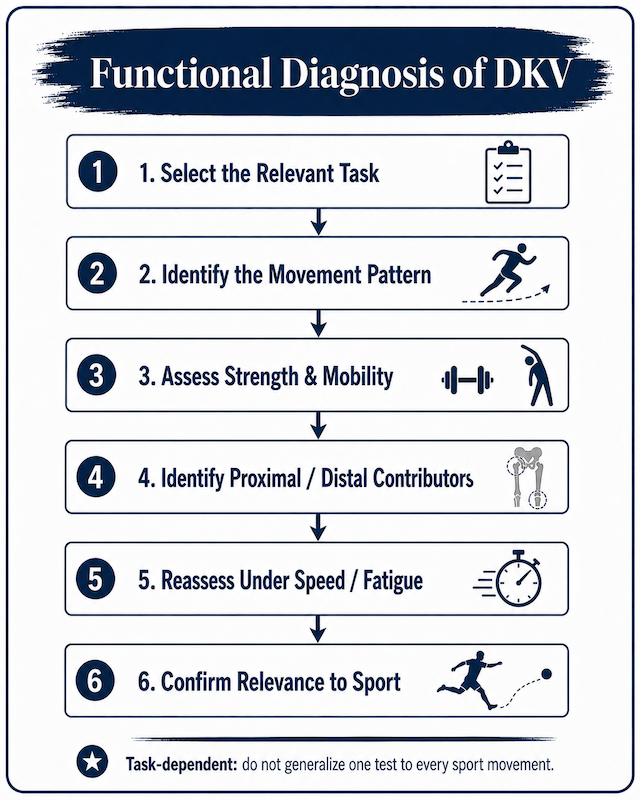
Functional Diagnosis of Dynamic Knee Valgus
There is no pathognomonic orthopedic special test for DKV.
Dynamic knee valgus is better understood as a functional movement pattern than as a pathological diagnosis. Therefore, functional diagnosis should not simply determine whether the knee moves medially.
Instead, the assessment should answer four broader questions:
- During which task does DKV occur?
- What movement pattern is actually occurring?
- What physical or neuromuscular factors may contribute to that pattern?
- Is the finding clinically relevant to the athlete’s sport, symptoms, or injury history?
This requires movement assessment and clinical reasoning rather than a single positive test.¹,⁴
Step 1: Choose the Right Task
Task selection is one of the most important parts of DKV assessment.
Dynamic valgus is task dependent.
An athlete who demonstrates valgus during one task may not demonstrate the same movement pattern during another.³,⁵,¹⁶
Examples include:
- Runners: Running / Step-Down
- Basketball athletes: Landing / Cutting
- Volleyball athletes: Jump Landing
- Soccer athletes: Single-Leg Landing / Cutting
- Athletes after ACL reconstruction: Single-Leg Squat / Hop Landing
The selected task should therefore resemble the athlete’s Primary Function or the movement that is clinically problematic.
Research has shown that valgus identified during a lateral step-down does not necessarily correlate well with valgus during running.³
Clinicians should therefore avoid assuming that one screening task represents every athletic movement.
Step 2: Identify the Movement Pattern
Once the appropriate task has been selected, the clinician should determine how the entire kinetic chain is moving, rather than observing the knee in isolation.
Important variables may include:
- Pelvic position
- Hip adduction
- Hip internal rotation
- Medial knee displacement
- Knee-flexion strategy
- Tibial rotation
- Rearfoot and foot movement
- Trunk position and lean
The objective is to determine whether the visible knee valgus is part of a broader multiplanar movement strategy involving the trunk, pelvis, hip, knee, tibia, ankle, and foot.
The relevant movement variables may also differ according to the task.
For example, the pattern observed during a controlled single-leg squat may differ considerably from the pattern that emerges during a high-speed cutting maneuver.
Step 3: Assess Strength, Mobility, and Physical Capacity
If DKV is identified, the next step is to evaluate physical qualities that may contribute to the athlete’s movement strategy.
Potential areas include:
- Hip abductor strength
- Hip extensor strength
- Hip external-rotator strength
- Quadriceps and hamstring capacity
- Trunk strength and control
- Ankle dorsiflexion
- Foot mobility
- Balance
- Proprioception¹,⁵,⁷,⁹
However, finding a strength or mobility deficit does not automatically establish causation.
For example:
DKV present → weak gluteus medius → strengthen the hip
is too simplistic.
A physical impairment should become a rehabilitation target only when it appears meaningfully related to the athlete’s movement pattern and functional limitation.
Step 4: Identify Proximal and Distal Contributors
Because DKV is a kinetic-chain movement pattern, factors both above and below the knee should be considered.
Proximal Factors
Assessment may include:
- Hip strength
- Pelvic control
- Hip adduction and rotation strategy
- Trunk position
- Trunk lean
- Lumbopelvic control
Distal Factors
Assessment may include:
- Ankle dorsiflexion
- Rearfoot eversion
- Midfoot mobility
- Foot progression angle
- Foot stability¹,⁵,⁷,⁹
The goal is not to identify as many “abnormalities” as possible.
The goal is to determine which modifiable contributors may actually influence the athlete’s Primary Function.
Step 5: Reassess Under Speed, Repetition, and Fatigue
DKV is not necessarily a fixed characteristic.
Movement quality may change as task intensity increases.
The clinician may therefore progress the assessment by adding:
- Faster movement
- Repeated landings
- Repeated cutting
- Reactive tasks
- Decision-making demands
- Fatigue
An athlete may demonstrate good control during the first few repetitions but progressively lose frontal-plane control after repeated loading.
This may indicate that the primary limitation is not simply maximal strength or movement knowledge, but the ability to maintain neuromuscular control under repeated athletic demand.
Because fatigue may alter landing biomechanics, balance, proprioception, and DKV, assessment in athletes should not necessarily end with a single non-fatigued repetition.⁸
Step 6: Determine Sport-Specific Relevance
The final and most important question is:
Is this movement pattern actually meaningful for this athlete?
The presence of DKV alone does not automatically mean that it must be corrected.
For example, an athlete may demonstrate valgus during a single-leg squat but have:
- No pain
- No functional limitation
- Good landing control
- Good running mechanics
- No difficulty tolerating sport-specific loading
In that situation, the isolated valgus finding may have limited clinical importance.
In contrast, the finding may be more relevant when DKV:
- Appears during the athlete’s problematic sport movement
- Increases with speed or fatigue
- Occurs simultaneously with symptoms
- Appears during return-to-sport testing after ACL reconstruction
- Is associated with reduced performance or movement control
Therefore, the objective of functional diagnosis is not simply to eliminate visible knee valgus.
It is to determine whether the movement pattern contributes meaningfully to the athlete’s symptoms, injury context, performance limitations, or sport demands.
Functional Diagnosis Framework
Task Selection
↓
Movement Analysis
↓
Strength & Mobility Assessment
↓
Proximal / Distal Contributors
↓
Speed / Fatigue Testing
↓
Sport-Specific Relevance
DKV is task dependent. One movement test should not automatically be generalized to every athletic task.
Main Functional Tests
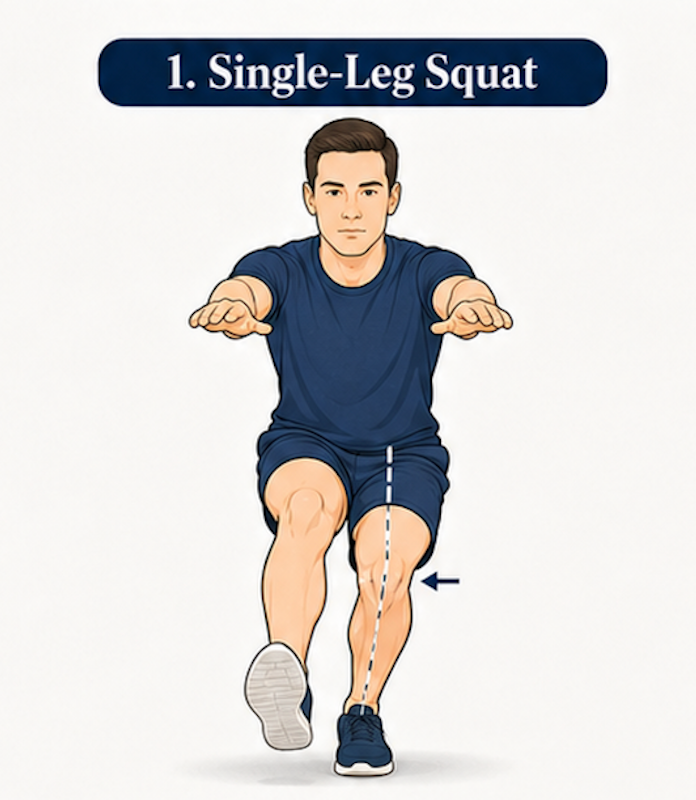
Single-Leg Squat
The single-leg squat is one of the most frequently used clinical screening tasks for dynamic knee valgus.¹,⁵,¹⁴
From a frontal view, the clinician observes the relationship among the:
- Pelvis
- Femur
- Knee
- Tibia
- Foot
A practical visual approach is to determine whether the patella or knee center repeatedly moves excessively medially relative to the foot.
Dadfar and colleagues classified athletes as demonstrating DKV when noticeable valgus was observed in at least 2 of 3 single-leg squat repetitions.⁵
This should be interpreted as a research classification method rather than a universal diagnostic threshold.
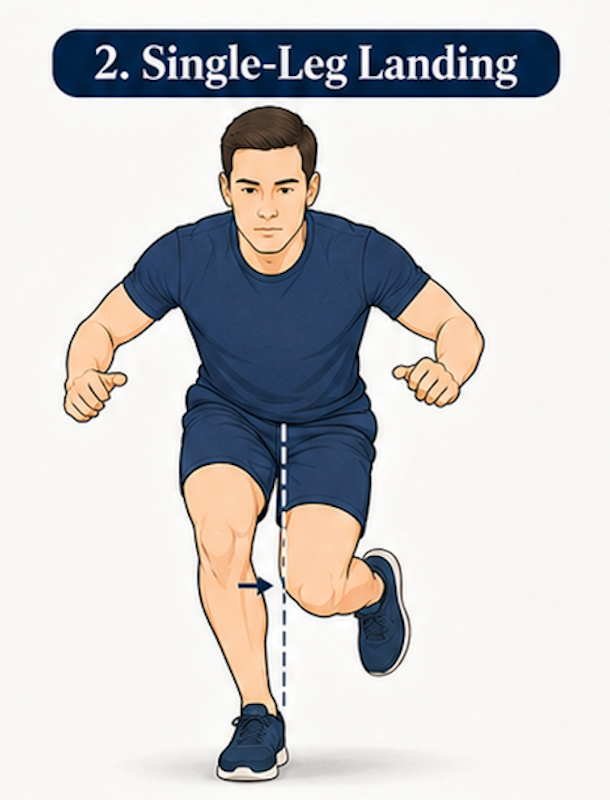
Single-Leg Landing
A single-leg landing adds greater velocity, impact, and control demands compared with a squat.
Important observations include:
- Initial-contact position
- Peak knee-flexion position
- Medial knee displacement
- Hip control
- Pelvic control
- Foot position
- Ability to stabilize after landing
A frontal-plane valgus angle greater than 10° has been used as a screening or inclusion criterion in research involving athletes with DKV.¹³
However, 10° should not be interpreted as a universal injury cutoff applicable to every athlete or sport.
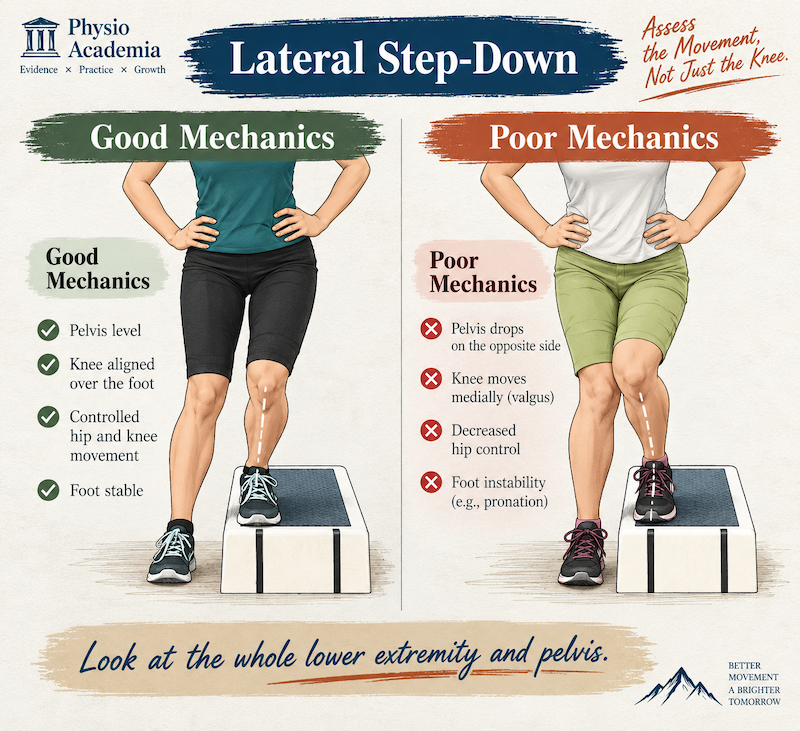
Lateral Step-Down / Forward Step-Down
Step-down testing provides a clinically simple method for observing:
- Pelvic control
- Hip adduction
- Knee position
- Foot control
- Trunk strategy³
However, performance during a step-down should not automatically be assumed to represent running, landing, or cutting mechanics.
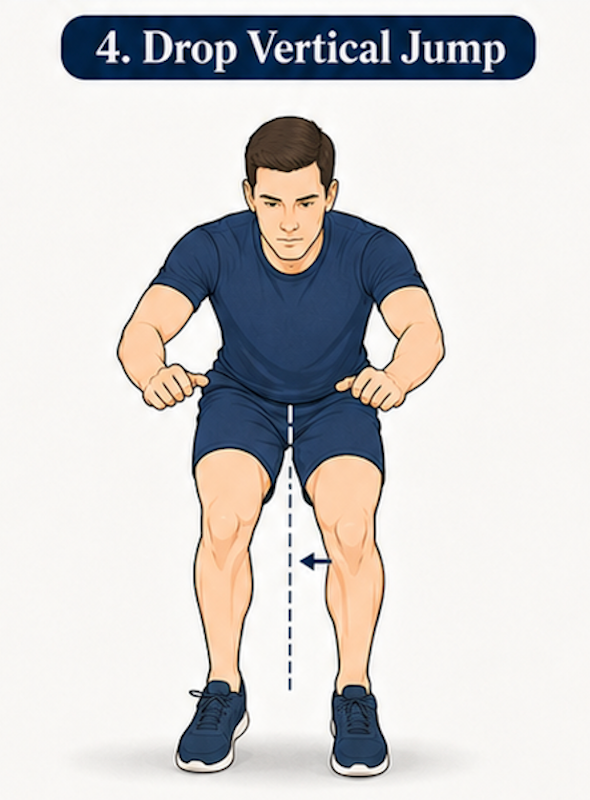
Drop Vertical Jump
The drop vertical jump is useful when evaluating athletes involved in jumping and landing sports.
The clinician can observe:
- Frontal-plane knee position
- Landing symmetry
- Trunk control
- Hip- and knee-flexion strategies¹¹
It is commonly relevant in ACL injury-prevention and return-to-sport settings.
Landing Error Scoring System
The Landing Error Scoring System (LESS) evaluates more than a single knee valgus angle.
It assesses multiple errors within the landing strategy and therefore provides information about whole-body landing control, rather than simply whether the knee moves medially.¹¹,¹²
2D Video Analysis
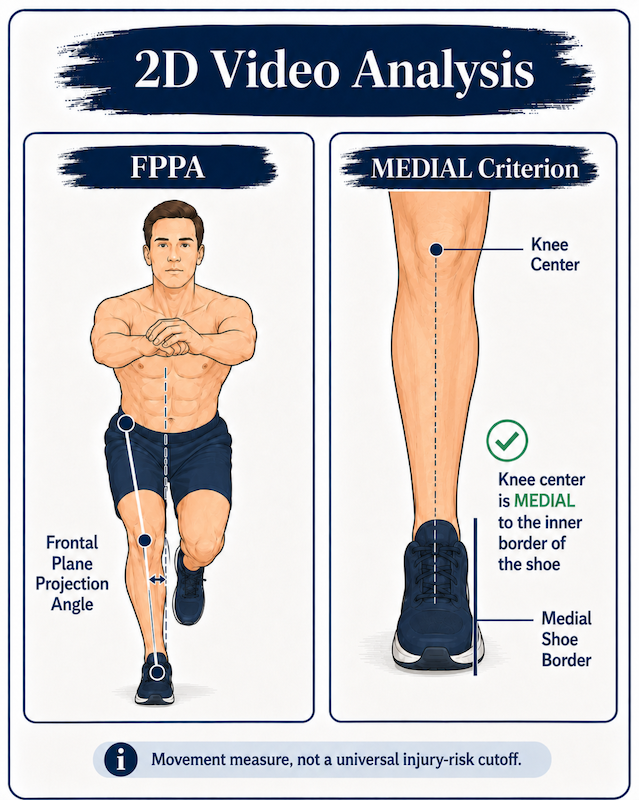
Two-dimensional frontal-plane video is commonly used clinically because it is inexpensive, accessible, and easy to repeat.
One frequently used measurement is the:
Frontal Plane Projection Angle (FPPA).
Markers around the hip, knee, and ankle are used to quantify frontal-plane knee position during functional movement.¹,³,⁴
Three-dimensional motion capture provides more complete biomechanical information and remains the laboratory reference standard, but 2D video can be highly useful for field and clinical screening.
The MEDIAL Criterion
Erdman and colleagues evaluated a particularly practical 2D criterion:
**Does the knee joint center move inside the medial border of the shoe?**⁶
This MEDIAL criterion demonstrated meaningful associations with several 3D biomechanical measures, including:
- Pelvic obliquity
- Hip adduction
- Ankle eversion
- Foot progression⁶
This makes it a potentially practical visual screen when sophisticated motion-capture equipment is unavailable.
Is There a Diagnostic Cluster?
At present, there is no well-established diagnostic cluster for dynamic knee valgus comparable with clinical prediction rules used for some orthopedic diagnoses.¹,⁴
In other words, there is no validated rule such as:
“Three out of five tests positive = DKV.”
Instead, functional assessment should integrate several domains:
Movement
Single-leg squat, landing, step-down, cutting, or running.
Proximal Factors
Hip abductor, extensor, and external-rotator strength; trunk and pelvic control.
Knee Factors
Quadriceps-hamstring strategy, knee-flexion mechanics, and dynamic balance.
Distal Factors
Ankle dorsiflexion, rearfoot motion, and foot mobility.
Sport Factors
Speed, repetition, reaction, fatigue, and specific competitive demands.¹,⁵,⁷⁻⁹
The key clinical question is therefore not simply:
“Does this athlete have knee valgus?”
It is:
“Why does this movement appear during this particular task, and does it matter for this athlete’s function or injury profile?”
Potential Contributors to Dynamic Knee Valgus
Research suggests that DKV cannot be explained by weakness of one muscle.
Potential contributors include:
- Reduced hip-abductor strength
- Reduced hip-extensor strength
- Reduced hip external-rotator strength
- Altered gluteal activation
- Trunk-control deficits
- Hamstring-quadriceps balance
- Limited ankle dorsiflexion
- Rearfoot eversion
- Greater midfoot mobility¹,⁵,⁷,⁹
Muscle-activation research also suggests that individuals with DKV may demonstrate greater activity of the adductor magnus, vastus medialis, vastus lateralis, biceps femoris, and tibialis anterior during squat tasks.²
This may reflect a different or compensatory neuromuscular strategy, rather than simply generalized weakness.
Therefore, the common reasoning:
“The knee moves inward → the gluteus medius is weak → strengthen the gluteus medius”
may be too simplistic for many athletes.
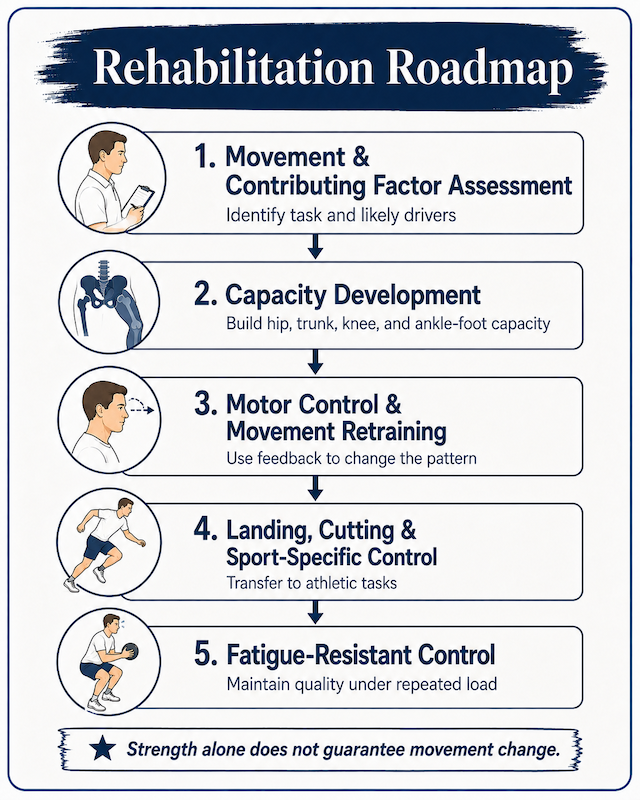
Treatment and Rehabilitation Overview
Rehabilitation should not focus exclusively on forcing the knee outward.
The goal is to identify the modifiable factors contributing to the athlete’s movement strategy and then improve control during the activities that matter for sport.¹,⁷,⁹
Phase 1: Movement and Contributing-Factor Assessment
First determine during which tasks excessive valgus appears.
Then assess potentially relevant contributors, including:
- Hip strength
- Trunk control
- Knee strategy
- Ankle mobility
- Foot mechanics
- Balance
- Proprioception
Treatment should be based on the individual athlete’s findings rather than the appearance of valgus alone.
Phase 2: Capacity Development
When deficits are present, rehabilitation may address capacity of the:
- Hip musculature
- Trunk
- Knee extensors and flexors
- Ankle-foot complex¹,⁷,⁹
However, increasing strength does not automatically change movement behavior.
Studies using relatively short strengthening or functional-training blocks have found small or nonsignificant changes in valgus angle despite some favorable trends.¹⁴,¹⁵
This suggests that training dose, task specificity, and motor learning matter.
Phase 3: Motor Control and Movement Retraining
The next goal is to teach the athlete how to use newly developed physical capacity during functional movement.
Research supports the potential value of:
- Real-time feedback
- Video instruction
- Visual feedback
- Verbal cueing
- Attentional-focus strategies¹²,¹³
The athlete therefore needs more than stronger muscles.
The athlete must learn to apply that capacity to squatting, landing, deceleration, and cutting.
Phase 4: Landing, Cutting, and Sport-Specific Control
Rehabilitation should progressively return the athlete to:
- Landing
- Jumping
- Deceleration
- Cutting
- Single-leg tasks
- Sport-specific movement
Combined neuromuscular approaches and structured warm-up programs have demonstrated improvements in landing and lumbopelvic measures in athletic populations.¹¹
The consistent concept is that rehabilitation should combine:
strength + balance + proprioception + movement training + feedback
rather than relying on isolated strengthening alone.
Phase 5: Fatigue-Resistant Control
One technically good landing is not enough for sport.
Athletes must repeat high-demand movements throughout practices and competition.
Rehabilitation should therefore eventually evaluate control during:
- Repeated landings
- Higher speeds
- Reactive situations
- Decision-making tasks
- Sport-specific fatigue
Because fatigue can worsen DKV and landing mechanics, maintaining movement quality under fatigue may be an important final component of return-to-sport assessment.⁸
< Summary >
Dynamic knee valgus is not simply a knee problem and is not a stand-alone disease.
It is a task-dependent, multiplanar movement pattern produced through interactions among the hip, knee, tibia, ankle-foot complex, trunk, and neuromuscular system.
Its presence alone cannot predict ACL injury or prove the cause of pain.
Functional diagnosis should therefore integrate:
task selection → movement analysis → strength and mobility → proximal and distal contributors → fatigue → sport-specific function.
There is currently no single pathognomonic special test or validated diagnostic cluster.
Single-leg squatting, landing, step-down testing, sport-specific movement, and 2D video analysis should instead be selected according to the movement being investigated.
Rehabilitation should not simply teach an athlete to “push the knee out.”
The goal is to develop the physical capacity required for sport, teach the athlete to express that capacity through better neuromuscular control, and maintain that control under speed, repetition, reaction, and fatigue.
<PDF file>
Read More



< Reference >
- Wilczyński B, Zorena K, Ślęzak D. Dynamic knee valgus in single-leg movement tasks: potentially modifiable factors and exercise training options. A literature review. Int J Environ Res Public Health. 2020;17(21):8208. doi:10.3390/ijerph17218208.
- Bakhtiari Khou S, Saki F, Tahayori B. Muscle activation in the lower limb muscles in individuals with dynamic knee valgus during single-leg and overhead squats: a meta-analysis study. BMC Musculoskelet Disord. 2024;25(1):652. doi:10.1186/s12891-024-07759-6.
- de Vasconcelos DP, Aidar FJ, Lima TB, et al. Assessment of dynamic knee valgus between lateral step-down test and running in female runners with and without patellofemoral pain using two-dimensional video analysis. Clin Pract. 2022;12(3):425-435. doi:10.3390/clinpract12030047.
- Uhlár Á, Ambrus M, Kékesi M, et al. Kinect Azure-based accurate measurement of dynamic valgus position of the knee—a corrigible predisposing factor of osteoarthritis. Appl Sci. 2021;11(12):5536. doi:10.3390/app11125536.
- Dadfar M, Sheikhhoseini R, Jafarian M, Esmaeili A. Lower extremity kinematic coupling during single and double leg landing and gait in female junior athletes with dynamic knee valgus. BMC Sports Sci Med Rehabil. 2021;13(1):152. doi:10.1186/s13102-021-00385-y.
- Erdman A, Loewen A, Dressing M, et al. A 2D video-based assessment is associated with 3D biomechanical contributors to dynamic knee valgus in the coronal plane. Front Sports Act Living. 2024;6:1352286. doi:10.3389/fspor.2024.1352286.
- Crowell KR, Nokes RD, Cosby NL. Weak hip strength increases dynamic knee valgus in single-leg tasks of collegiate female athletes. J Sport Rehabil. 2021;30(8):1220-1223. doi:10.1123/jsr.2021-0043.
- Abbasi S, Rahmatzadeh D, Minoonejad H, Mousavi SH. The effect of fatigue on dynamic knee valgus during landing tasks: a systematic review and meta-analysis. BMC Sports Sci Med Rehabil. 2025;17:166. doi:10.1186/s13102-025-01205-3.
- Granger A, Patel AJ, Bonfim SK, de Silva C. Factors influencing excessive dynamic genu valgum and the effect on post-landing movement patterns: a cross-discipline narrative review. J Funct Morphol Kinesiol. 2026;11(1):69. doi:10.3390/jfmk11010069.
- Gaugg F, Bierke S, Hees T, Siemßen K, Wolfarth B, Petersen W. Increased contralateral dynamic valgus in female athletes following ACL reconstruction. Knee Surg Sports Traumatol Arthrosc. 2026;34(6):2057-2066. doi:10.1002/ksa.70291.
- Rostami M, Sedaghati P, Daneshmandi H. Effects of a warm-up program on jump-landing pattern and lumbopelvic function in female basketball players with dynamic knee valgus. Sci Rep. 2025;15:27918. doi:10.1038/s41598-025-13817-3.
- Tamgüç B, Pişirici P. The effect of verbal combined focus of attention and video instruction training on knee valgus and landing technique in semiprofessional female athletes. Orthop J Sports Med. 2025;13(4):23259671251326454. doi:10.1177/23259671251326454.
- Gheibi T, Firouzjah EMAN, Ghanati HA, Almonroeder TG. Immediate effects of real time feedback and kinesiotaping on kinematics and muscle activity in athletes with dynamic knee valgus. Sci Rep. 2026;16:11468. doi:10.1038/s41598-026-41823-6.
- Wilczyński B, Wąż P, Zorena K. Impact of three strengthening exercises on dynamic knee valgus and balance with poor knee control among young football players: a randomized controlled trial. Healthcare (Basel). 2021;9(5):558. doi:10.3390/healthcare9050558.
- Tovar O, Molnár D, Soussi B, Uhlár Á, Horváth T, Ambrus M. The effect of functional training on dynamic knee valgus of youth soccer players: a pilot study. Int J Exerc Sci. 2025;18(7):561-574. doi:10.70252/IIMQ1487.
- Fukuda W, Yokoyama S, Kataoka Y, Kawakami S, Gomi N. Kinematic association between single-leg squat and hop landing in female athletes following anterior cruciate ligament reconstruction. Knee Surg Sports Traumatol Arthrosc. Published online December 26, 2025. doi:10.1002/ksa.70246.
Stay Informed with Physio Hub
Unlock a world of knowledge with our expertly curated articles on fitness, rehabilitation, and health & diet. Stay ahead with the latest evidence-based insights and practical advice. Subscribe now to receive updates and never miss out on new content!