Physio Hub:
Evidence-Based Article
Ankle Osteoarthritis in Athletes
Why an “Old Ankle Sprain” May Matter More Than You Think
Key Points
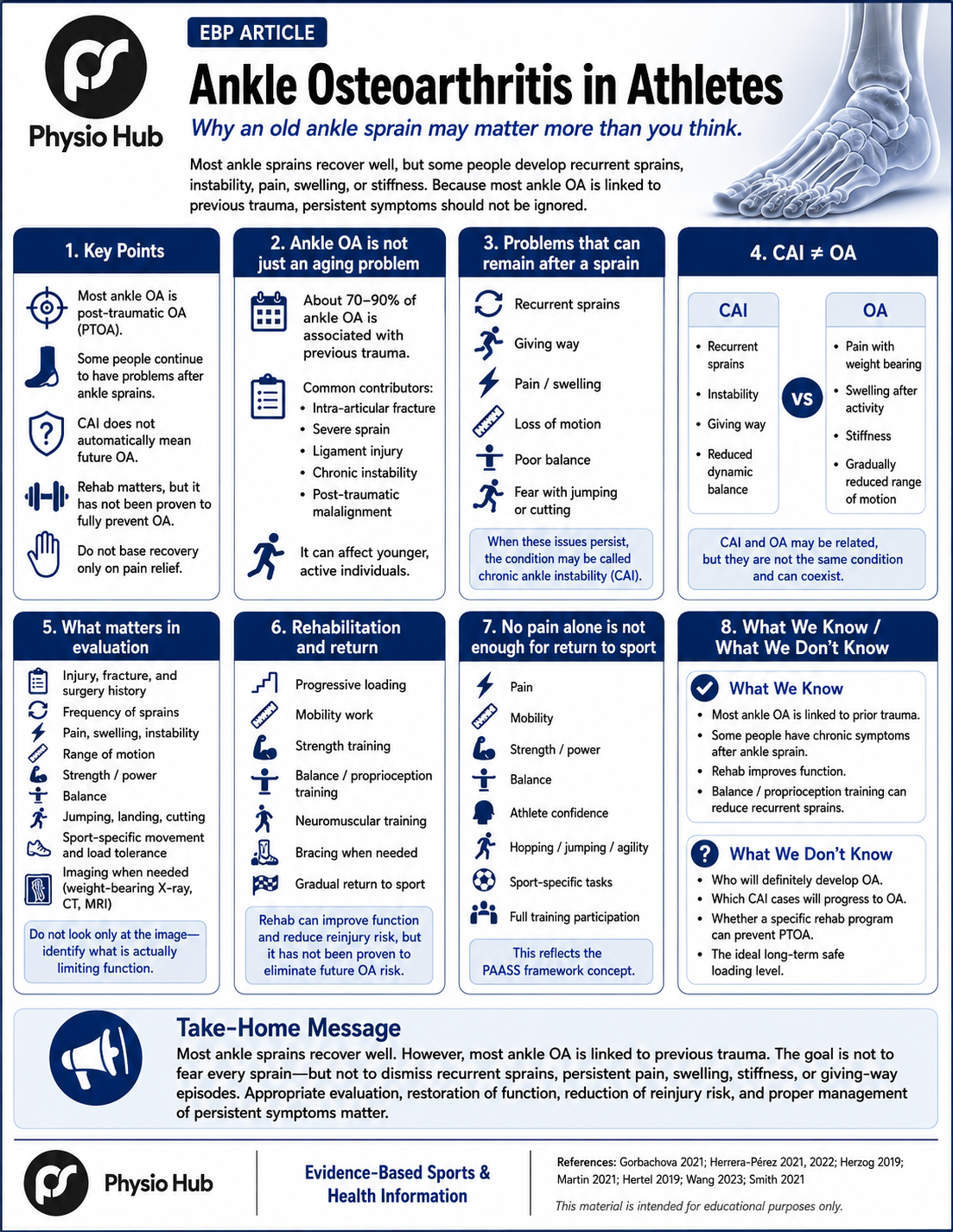
- Most ankle osteoarthritis (OA) is associated with previous joint trauma, rather than aging alone.
- Most ankle sprains recover well, but some people continue to experience recurrent sprains, instability, pain, swelling, or loss of motion.
- Chronic ankle instability (CAI) does not mean that an athlete will inevitably develop osteoarthritis.
- Rehabilitation is important for restoring function and reducing recurrent ankle injuries, but it has not been proven to completely prevent future ankle OA.
- Return to sport should involve more than simply waiting for pain to disappear. Strength, mobility, balance, sport-specific function, and athlete confidence also matter.
Ankle Osteoarthritis Is Not Just an “Aging” Problem
When most people hear the term osteoarthritis, they think of age-related “wear and tear.”
The ankle is somewhat different.
Approximately 70% to 90% of ankle osteoarthritis is associated with previous trauma.¹
Common contributing factors include:
- Intra-articular fractures
- Severe ankle sprains
- Ligament injuries
- Chronic joint instability
- Post-traumatic changes in joint alignment
These factors can alter the mechanical environment of the ankle and contribute to progressive joint changes over time.²˒³
Because of this strong relationship with previous injury, ankle OA can affect relatively young and active individuals—including former and current athletes.
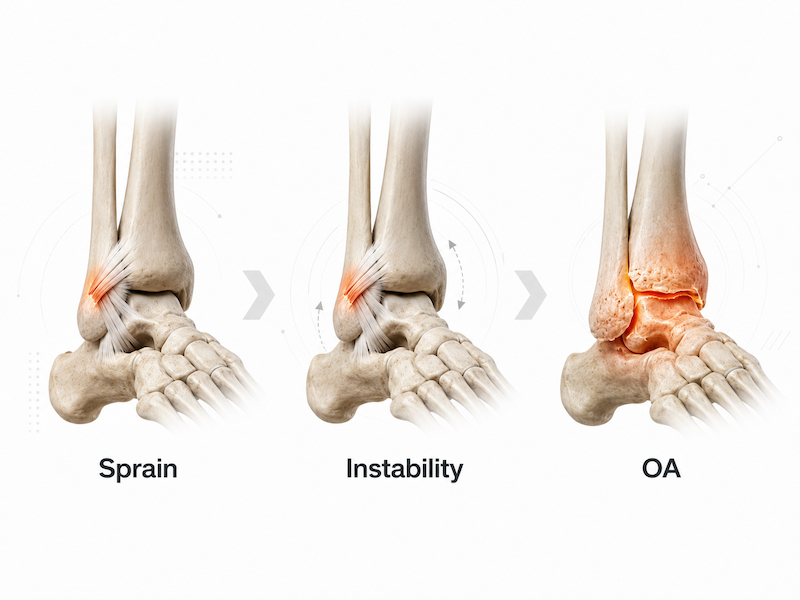
Some Ankle Sprains Have Long-Term Consequences
Ankle sprains are among the most common injuries in sports.
Fortunately, most athletes recover well.
However, some continue to experience problems such as:
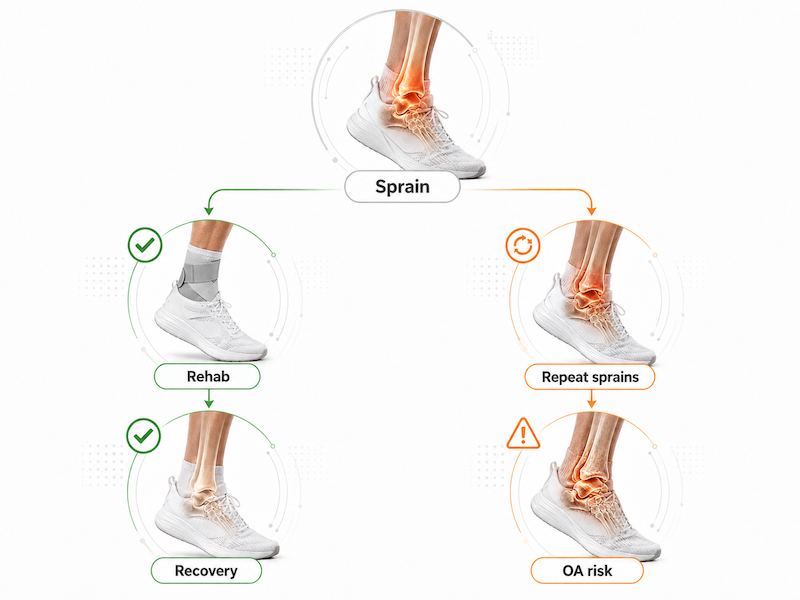
- Recurrent ankle sprains
- A sensation that the ankle “gives way”
- Persistent pain or swelling
- Limited ankle mobility
- Poor balance
- Difficulty jumping, landing, or changing direction
- Reduced confidence during sport
These persistent problems may develop into chronic ankle instability (CAI).⁴˒⁵
CAI is also more complicated than simply having a “loose ligament.”
Research suggests that CAI can involve several interacting factors, including:
- Joint and ligament impairments
- Strength deficits
- Reduced mobility
- Sensorimotor dysfunction
- Balance and movement-control deficits
- Athlete perception and confidence
This is why two athletes with the same history of ankle sprain may experience very different long-term problems.⁶
Does Chronic Ankle Instability Cause Osteoarthritis?
Not necessarily.
Having chronic ankle instability does not mean that an athlete will eventually develop ankle OA.
However, repeated injuries, persistent instability, abnormal alignment, and changes in joint loading may contribute to an environment that increases the risk of long-term joint degeneration.²
Post-traumatic osteoarthritis is also not simply the result of “using the ankle too much.”
Several processes may contribute, including:
Initial joint tissue damage
+
Changes in joint mechanics after the injury
+
Biological and inflammatory responses
Together, these changes may affect cartilage and other joint tissues over many years.
The important message is therefore:
An ankle sprain does not guarantee future arthritis—but recurrent injuries and persistent dysfunction should not automatically be dismissed as harmless.
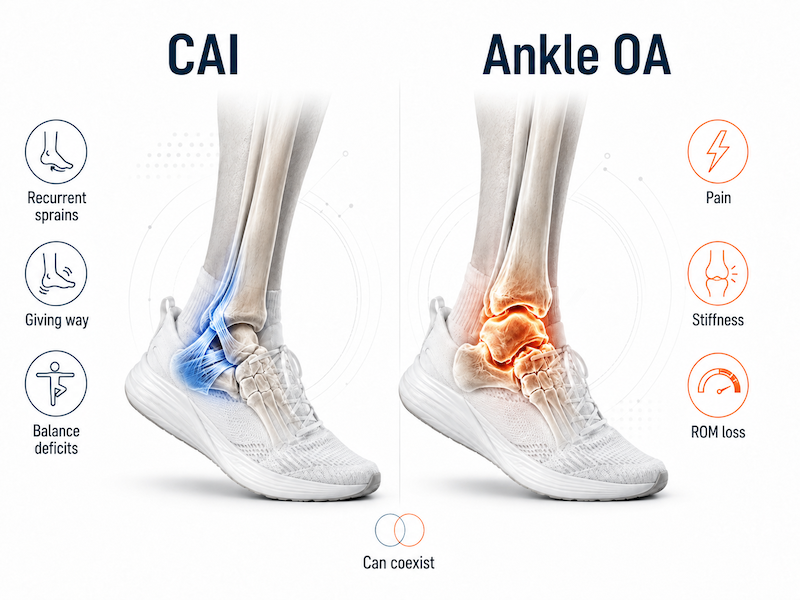
Chronic Ankle Pain Is Not Always “Instability”
When an athlete has a history of ankle sprains and develops persistent ankle pain, it can be tempting to assume that instability is the cause.
But chronic ankle symptoms can have many possible explanations, including:
- Chronic ankle instability
- Osteochondral lesions
- Ankle impingement
- Tendon disorders
- Post-traumatic deformity
- Ankle osteoarthritis
- Other intra-articular conditions
Features that may occur with chronic ankle instability
- Recurrent sprains
- Giving-way episodes
- Subjective instability
- Reduced dynamic balance
- Difficulty with jumping or cutting
Features that may occur with ankle OA
- Pain with weight bearing
- Pain or swelling after activity
- Joint stiffness
- Gradually decreasing range of motion
- Symptoms with prolonged walking or running
These findings are not diagnostic criteria, however.
CAI and osteoarthritis can also exist at the same time.
For athletes with persistent symptoms, the goal should therefore be to determine what is actually limiting function, rather than assuming every chronic ankle problem is caused by instability.
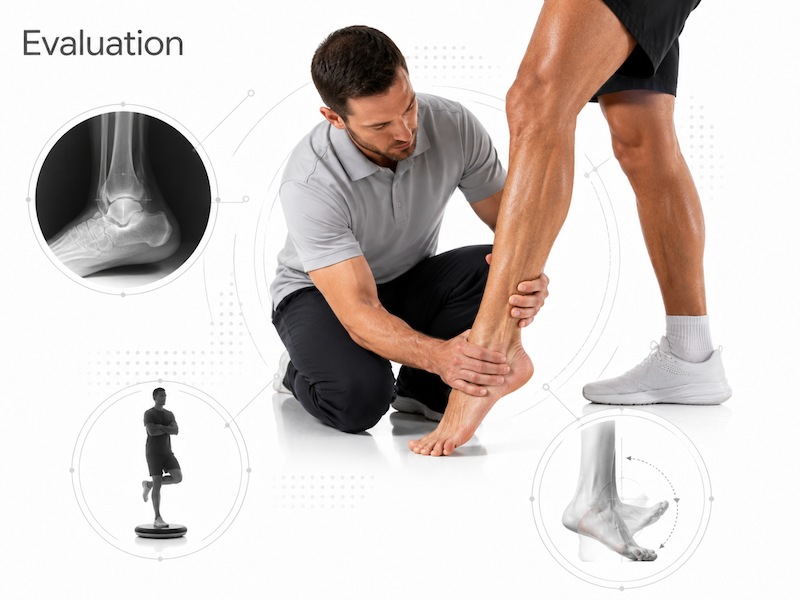
What Should Be Evaluated?
A comprehensive ankle assessment may consider:
- Previous ankle injuries, fractures, and surgeries
- Frequency of recurrent sprains
- Pain, swelling, and instability
- Ankle range of motion
- Strength and power
- Balance
- Jumping, landing, and cutting ability
- Running and sport-specific movement
- Training-load tolerance
- Athlete confidence and perceived stability
Imaging may also be appropriate when osteoarthritis or other intra-articular pathology is suspected.
For ankle OA, weight-bearing radiographs are commonly used as an initial imaging method. CT or MRI may be considered when more detailed information about bone, cartilage, osteochondral lesions, alignment, or surrounding tissues is needed.¹
Importantly, imaging should not be interpreted in isolation.
The question is not only “What does the scan show?” but also “What is actually limiting this athlete’s function?”
Rehabilitation After an Ankle Sprain
Current clinical practice guidelines support several rehabilitation strategies following lateral ankle sprain and in people with chronic ankle instability.⁵
These may include:
- Progressive weight bearing
- Range-of-motion exercises
- Strength training
- Balance and proprioceptive training
- Neuromuscular training
- Bracing when appropriate
- Gradual return to sport
Balance and proprioceptive exercise programs may also help reduce the risk of future ankle sprains and recurrent injuries.⁷
However, there is an important distinction.
Rehabilitation Helps Reduce Reinjury—but Does It Prevent Arthritis?
We currently have evidence that rehabilitation can:
- Improve ankle function
- Improve balance and neuromuscular control
- Help manage chronic ankle instability
- Reduce recurrent ankle-sprain risk
What we do not currently have is strong evidence showing that a specific rehabilitation program will prevent ankle osteoarthritis 10, 20, or 30 years later.
Those are two different scientific questions.
For now, the most reasonable strategy is to address factors we can modify:
- Restore mobility
- Restore strength
- Improve balance and movement control
- Gradually rebuild sport capacity
- Reduce recurrent injuries
- Evaluate symptoms that fail to resolve
“No Pain” Does Not Automatically Mean “Ready to Play”
Return-to-sport decisions after an ankle sprain should not be based only on:
“It has been three weeks.”
or
“It doesn’t hurt anymore.”
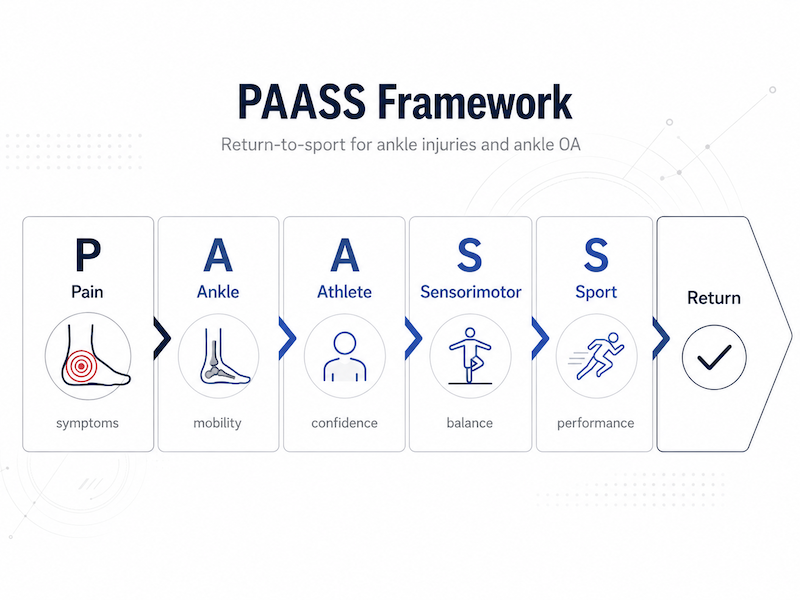
An international expert consensus proposed the PAASS framework to help organize return-to-sport decision making.⁸
It includes:
Pain
Pain during sport and during the previous 24 hours.
Ankle Impairments
Range of motion, strength, endurance, and power.
Athlete Perception
Confidence, perceived stability, and psychological readiness.
Sensorimotor Control
Proprioception, balance, and postural control.
Sport/Functional Performance
Hopping, jumping, agility, sport-specific tasks, and the ability to complete full training.
PAASS does not provide one universal score that guarantees safe return to sport.
Instead, it reinforces an important idea:
Pain resolution is part of recovery—not the entire definition of recovery.
What We Know
Current evidence provides relatively strong support for several points:
- Most ankle OA is associated with previous trauma.
- Some athletes develop recurrent injury or persistent symptoms after ankle sprain.
- Chronic ankle instability involves more than ligament laxity alone.
- Rehabilitation is important for restoring ankle function.
- Balance and proprioceptive training can help reduce recurrent ankle sprains.
- Return-to-sport decisions should consider multiple aspects of function rather than pain alone.
What We Still Don’t Know
Important questions remain unanswered:
- Which athletes will eventually develop ankle OA?
- Which people with chronic ankle instability are most likely to experience progressive joint degeneration?
- Can a specific rehabilitation program actually prevent post-traumatic ankle OA?
- What amount of long-term sports loading is optimal for an athlete with previous ankle trauma?
Recognizing the difference between what research supports and what remains uncertain is an important part of evidence-based practice.
What Athletes, Parents, Coaches, and Trainers Should Know
There is no reason to become afraid of every ankle sprain.
Most ankle sprains recover well.
At the same time, it may be a mistake to assume:
“Ankle sprains are common, so it isn’t a big deal.”
“They can walk, so the ankle is healed.”
“The pain is gone, so they are ready for competition.”
Consider further evaluation when an athlete experiences:
- Recurrent ankle sprains
- Persistent pain or swelling
- Progressive ankle stiffness
- Repeated giving-way episodes
- Difficulty returning to previous performance
- Symptoms that continually return with training
< Take-Home Message >
Most ankle sprains recover without major long-term problems.
However, ankle osteoarthritis is unusual compared with many other forms of OA because most cases are associated with previous joint trauma.
The goal is therefore not to make athletes afraid that:
“One ankle sprain will eventually cause arthritis.”
It is to avoid the opposite assumption:
“It’s just an ankle sprain, so it doesn’t matter.”
Appropriate evaluation, restoration of function, reduction of recurrent injuries, progressive return to sport, and proper assessment of persistent symptoms are the most practical strategies supported by current evidence.
<PDF file>
Read More
< Reference >
- Gorbachova T, Melenevsky YV, Latt LD, Weaver JS, Taljanovic MS. Imaging and treatment of posttraumatic ankle and hindfoot osteoarthritis. J Clin Med. 2021;10(24):5848. doi:10.3390/jcm10245848.
- Herrera-Pérez M, González-Martín D, Vallejo-Márquez M, Godoy-Santos AL, Valderrabano V, Tejero S. Ankle osteoarthritis aetiology. J Clin Med. 2021;10(19):4489. doi:10.3390/jcm10194489.
- Herrera-Pérez M, Valderrabano V, Godoy-Santos AL, de Cesar Netto C, González-Martín D, Tejero S. Ankle osteoarthritis: comprehensive review and treatment algorithm proposal. EFORT Open Rev. 2022;7(7):448-459. doi:10.1530/EOR-21-0117.
- Herzog MM, Kerr ZY, Marshall SW, Wikstrom EA. Epidemiology of ankle sprains and chronic ankle instability. J Athl Train. 2019;54(6):603-610. doi:10.4085/1062-6050-447-17.
- Martin RL, Davenport TE, Fraser JJ, et al. Ankle stability and movement coordination impairments: lateral ankle ligament sprains revision 2021. J Orthop Sports Phys Ther. 2021;51(4):CPG1-CPG80. doi:10.2519/jospt.2021.0302.
- Hertel J, Corbett RO. An updated model of chronic ankle instability. J Athl Train. 2019;54(6):572-588. doi:10.4085/1062-6050-344-18.
- Wang F, Guan Y, Bamber Z, et al. Preventive interventions for lateral ankle sprains: a systematic review and meta-analysis. Clin Rehabil. 2023;37(5):585-602. doi:10.1177/02692155221137640.
- Smith MD, Vicenzino B, Bahr R, et al. Return to sport decisions after an acute lateral ankle sprain injury: introducing the PAASS framework—an international multidisciplinary consensus. Br J Sports Med. 2021;55(22):1270-1276. doi:10.1136/bjsports-2021-104087.
Stay Informed with Physio Hub
Unlock a world of knowledge with our expertly curated articles on fitness, rehabilitation, and health & diet. Stay ahead with the latest evidence-based insights and practical advice. Subscribe now to receive updates and never miss out on new content!