Physio Hub:
Evidence-Based Article
Achilles Tendinopathy in Athletes
Achilles tendinopathy is a load-related disorder of the Achilles tendon characterized by localized pain, stiffness, swelling or thickening, and impaired function during tendon-loading activities.¹⁻⁵
It is particularly relevant in running and jumping athletes because the Achilles tendon must repeatedly tolerate and transfer substantial forces during running, sprinting, jumping, acceleration, and deceleration.³
A key clinical principle is that Achilles tendinopathy is primarily a clinical load-intolerance syndrome—not an imaging diagnosis.
What Is Achilles Tendinopathy?
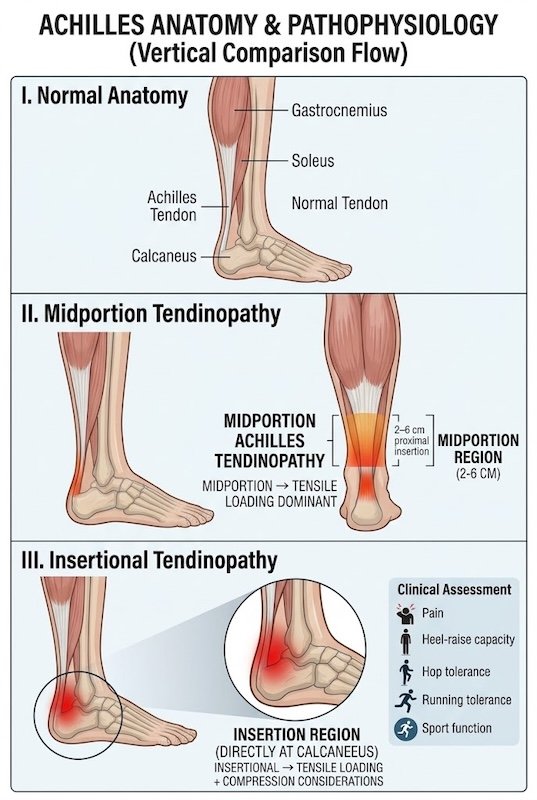
The Achilles tendon transfers force from the gastrocnemius and soleus to the calcaneus and plays a major role in:
- Walking
- Running
- Sprinting
- Jumping
- Energy storage and release
When repeated tendon loading exceeds the tendon-muscle system’s current capacity to adapt and recover, pain and functional impairment can develop.¹,³
Changes in tendon structure and mechanical properties may also occur, but these findings do not completely explain an athlete’s symptoms or functional capacity.³
Midportion vs Insertional Tendinopathy
Clinically, an important distinction is made between two presentations.
Midportion Achilles Tendinopathy
Symptoms are typically localized approximately 2 to 6 cm proximal to the calcaneal insertion.⁴
Insertional Achilles Tendinopathy
Symptoms are localized around the tendon’s insertion onto the calcaneus.
This distinction matters because insertional tendinopathy may be influenced by compressive loading between the tendon and calcaneus during greater ankle dorsiflexion.¹⁰
The two presentations should therefore not automatically receive identical loading strategies.
Typical Symptoms
Athletes may report:
- Localized Achilles pain
- Morning stiffness
- Pain when beginning activity
- Pain during running or jumping
- Pain with calf raises
- Tenderness to palpation
- Tendon thickening or swelling
- Reduced tolerance to prolonged or high-intensity loading¹⁻⁵
The important question is not simply whether the tendon hurts.
It is:
How much loading can the tendon currently tolerate before symptoms or performance limitations appear?
Why Is It Important in Athletes?
Running and jumping sports repeatedly expose the Achilles tendon to substantial loads.
Achilles tendinopathy may therefore contribute to:
- Reduced running volume
- Reduced sprint capacity
- Reduced jumping performance
- Reduced reactive strength
- Increasing symptoms later in training
- Inability to complete normal practice
- Delayed return to competition³
Recovery can also be prolonged.
An athlete may experience substantial pain reduction while the tendon and calf complex still lack the capacity required for full sport participation.
Therefore:
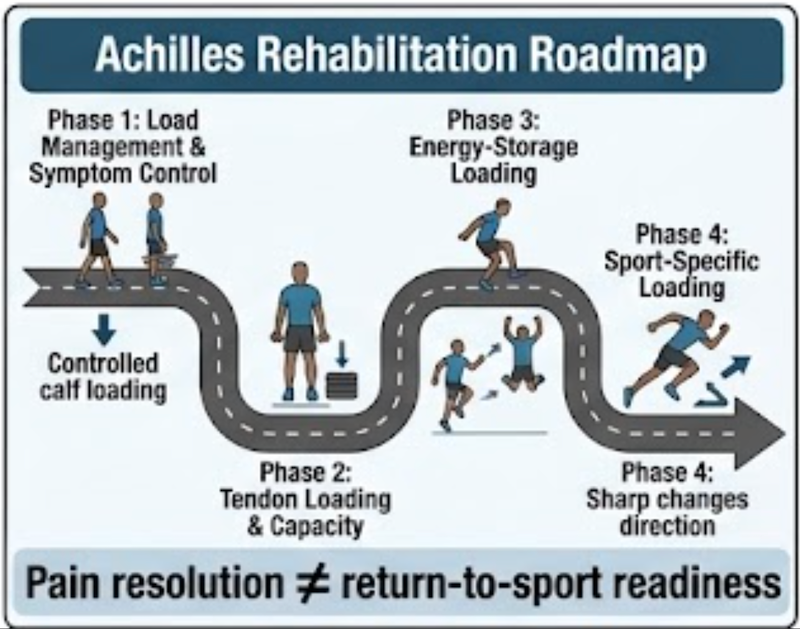
pain reduction does not automatically equal return-to-sport readiness.
Rapidly restoring high running or jumping loads before adequate capacity has returned may contribute to symptom recurrence.¹,³
Functional Diagnosis
Achilles tendinopathy is primarily a clinical diagnosis.¹,²,⁵
A typical diagnostic pattern includes:
**localized tendon pain
- pain on palpation
- pain with tendon loading
- functional limitation.**
Imaging may assist when clinically indicated, but it should not replace history and physical examination.
Step 1: Identify the Pain Location
First determine whether the presentation is midportion or insertional.
For midportion tendinopathy, symptoms are typically located approximately 2 to 6 cm proximal to the calcaneal insertion.⁴
Insertional symptoms occur around the calcaneal attachment.
This distinction should subsequently influence rehabilitation planning.
Step 2: Palpation
The symptomatic tendon should be assessed for:
- Local tenderness
- Thickening
- Swelling
- Reproduction of familiar symptoms¹,²
Pain location combined with pain on palpation can provide useful diagnostic information.
However, palpation should be interpreted with loading tests and the overall clinical presentation rather than used as a stand-alone diagnosis.
Step 3: Load Provocation
Functional tendon-loading tasks are particularly important.
These may include:
- Single-leg heel raises
- Repeated heel raises
- Hopping
- Jumping
- Running²,³,⁵
An athlete may tolerate a basic heel raise yet still develop symptoms when the tendon is challenged with faster energy-storage tasks.
Functional diagnosis should therefore eventually test the level of loading that matters for the athlete’s sport.
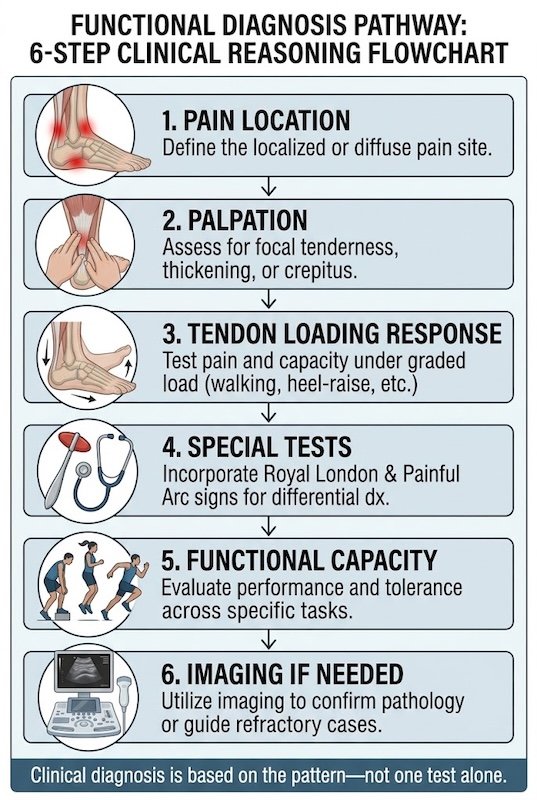
Main Special Tests
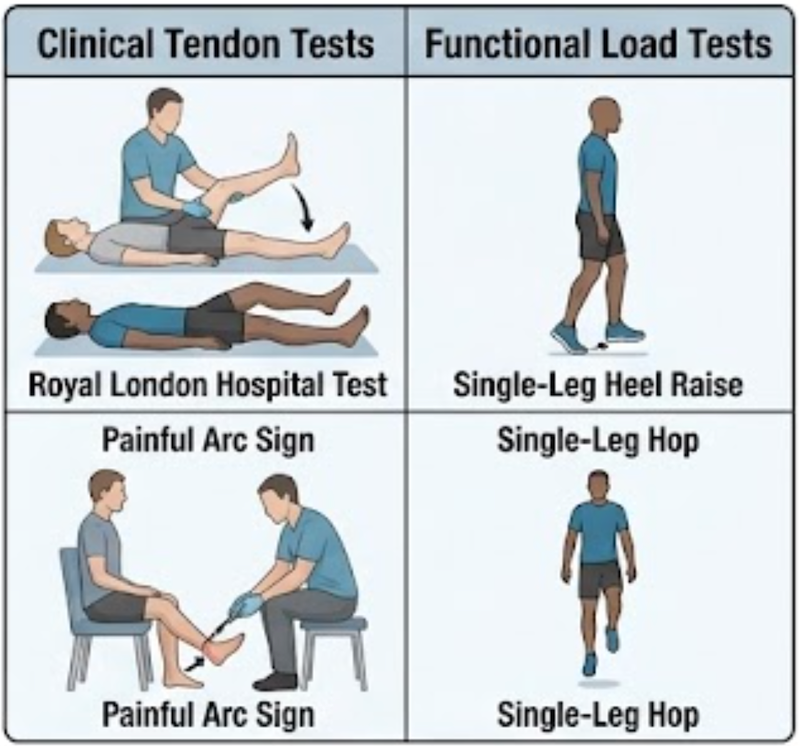
Royal London Hospital Test
The clinician palpates the painful tendon region and then reassesses tenderness while the patient actively dorsiflexes the ankle.
The test is considered positive when palpation pain decreases in dorsiflexion.²,⁵
It can assist with the clinical diagnosis of midportion Achilles tendinopathy.
Painful Arc Sign
A tender or thickened area of the tendon is identified and observed during ankle movement.
Movement of the abnormal area with the tendon may help distinguish intratendinous pathology from surrounding paratendinous disorders.²,⁵
Functional Loading Tests
For Achilles tendinopathy, loading tests are often as clinically useful as traditional named special tests.
Examples include:
- Single-leg heel raise
- Repeated heel raise
- Single-leg hopping
- Repeated hopping
The clinician should document both performance and symptom response.
Functional Assessment
Functional assessment helps determine severity, monitor progress, and guide return to sport.
VISA-A
The Victorian Institute of Sport Assessment–Achilles questionnaire is one of the most frequently used patient-reported measures for Achilles tendinopathy.²,⁵
It provides information about symptoms, function, and activity limitations.
Heel-Raise Capacity
Assessment may consider:
- Strength
- Repetitions
- Endurance
- Limb asymmetry
- Symptom response
Hop and Jump Performance
Patients with Achilles tendinopathy have demonstrated poorer performance in tests including:
- Single-leg hop
- Figure-of-eight hop
- Lower Extremity Functional Test⁷
In contrast, measures such as the weight-bearing lunge and Y-Balance Test did not clearly distinguish affected participants from controls in the same study.⁷
This suggests that explosive energy-storage tasks may reveal impairments that lower-demand tests do not.
Pain During Loading Can Also Inform Prognosis
Pain provocation testing may have value beyond diagnosis.
Mulder and colleagues found that lower baseline pain during:
- Tendon palpation
- A 10-hop test
was associated with greater improvement after 24 weeks of progressive calf exercise.⁶
Pain during loading can therefore be monitored as a continuous measure of severity and recovery rather than simply classified as positive or negative.
Role of Imaging
Ultrasound and MRI may assist with:
- Tendon morphology
- Thickening
- Tendon integrity
- Differential diagnosis¹,²
However:
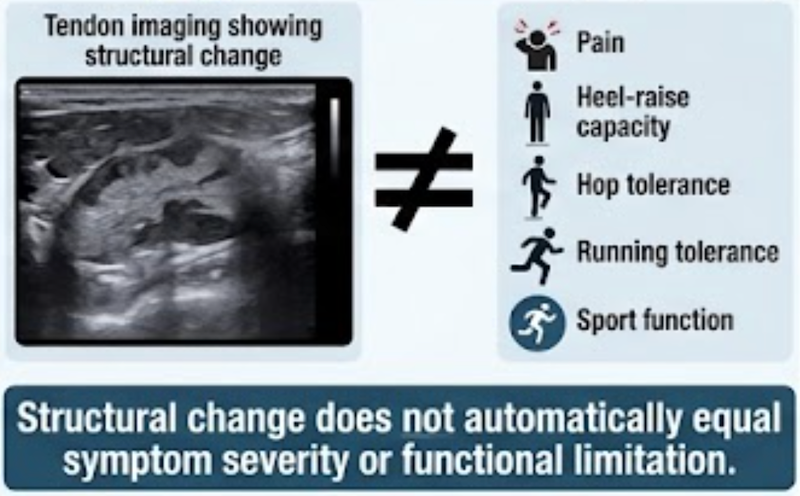
imaging supports the clinical diagnosis—it does not replace it.
Structural abnormalities and the athlete’s pain or function may not change at the same rate.
Treatment decisions should therefore not be made from imaging findings alone.
Treatment and Rehabilitation Overview
**Conservative treatment is generally first-line care.**¹,³
The central framework is:
Education + Load management + Progressive tendon loading
Guidelines support calf-muscle exercise therapy as a central treatment strategy, typically requiring at least several months rather than a rapid short-term intervention.¹
Phase 1: Load Management and Symptom Control
The goal is usually not complete rest.
Instead, identify which running, jumping, sprinting, or sport loads currently exceed the athlete’s tendon capacity and modify them.
Pain-guided activity modification allows the athlete to maintain tolerable activity while excessive loading is temporarily reduced.³
Phase 2: Tendon Loading and Capacity Development
Progressive loading is the foundation of rehabilitation.
Approaches may include:
- Isometric loading
- Concentric strengthening
- Eccentric strengthening
- Combined concentric-eccentric loading
- Heavy resistance loading³,⁹
Current evidence does not demonstrate that one loading model is universally superior for every athlete.
The important principle is progressive, appropriately dosed loading that increases tendon and calf capacity over time.
Phase 3: Energy-Storage Loading
Strength restoration alone is not enough for an athlete returning to running or jumping.
Rehabilitation should eventually restore the ability to tolerate faster stretch-shortening-cycle loads through activities involving hopping, jumping, and landing.⁹
This begins the transition from general calf capacity toward athletic tendon function.
Phase 4: Sport-Specific Loading
Later rehabilitation progresses toward the actual demands of sport, potentially including:
- Running volume
- Sprinting
- Acceleration and deceleration
- Cutting
- Jumping
- Repeated sport-specific loading
There is currently no single validated return-to-sport cutoff.³,⁸
Return decisions should therefore integrate:
Symptoms + Calf Capacity + Hop/Jump Function + Repeated-load Tolerance + Sport Demands.
Insertional Tendinopathy Requires Different Loading Considerations
Insertional Achilles tendinopathy deserves specific attention because tendon compression may be clinically important.
A 2025 randomized clinical trial compared rehabilitation strategies and found greater improvement when tendon compression was reduced by limiting excessive dorsiflexion, removing calf stretching, and incorporating heel lifts, compared with a higher-compression approach.¹⁰
This supports an important clinical principle:
do not automatically apply a midportion Achilles loading strategy to an insertional presentation.
Consider the Athlete Beyond the Tendon
Recovery is not determined solely by tendon structure or calf strength.
Research has identified clinically different Achilles tendinopathy profiles characterized by combinations of:
- Activity limitations
- Functional deficits
- Psychosocial factors
- Tendon structure¹¹,¹²
Athletes with stronger psychosocial barriers may experience different recovery trajectories.
This reinforces the need for individualized rehabilitation rather than treating every athlete with the same protocol.
< Summary >
Achilles tendinopathy is best understood as a clinical load-intolerance syndrome of the Achilles tendon.
Functional diagnosis should integrate:
pain location → palpation → response to tendon loading → selected special tests → functional capacity → imaging when indicated.
There is no single gold-standard special test or universally validated diagnostic cluster.
Rehabilitation generally progresses through:
load management → progressive tendon loading → energy-storage loading → sport-specific loading.
Midportion and insertional presentations should also be distinguished because their mechanical loading environments differ.
For athletes, the ultimate objective is not simply to create a pain-free Achilles tendon.
It is to restore a tendon-calf system capable of running, jumping, accelerating, and repeatedly tolerating the loads required by sport.
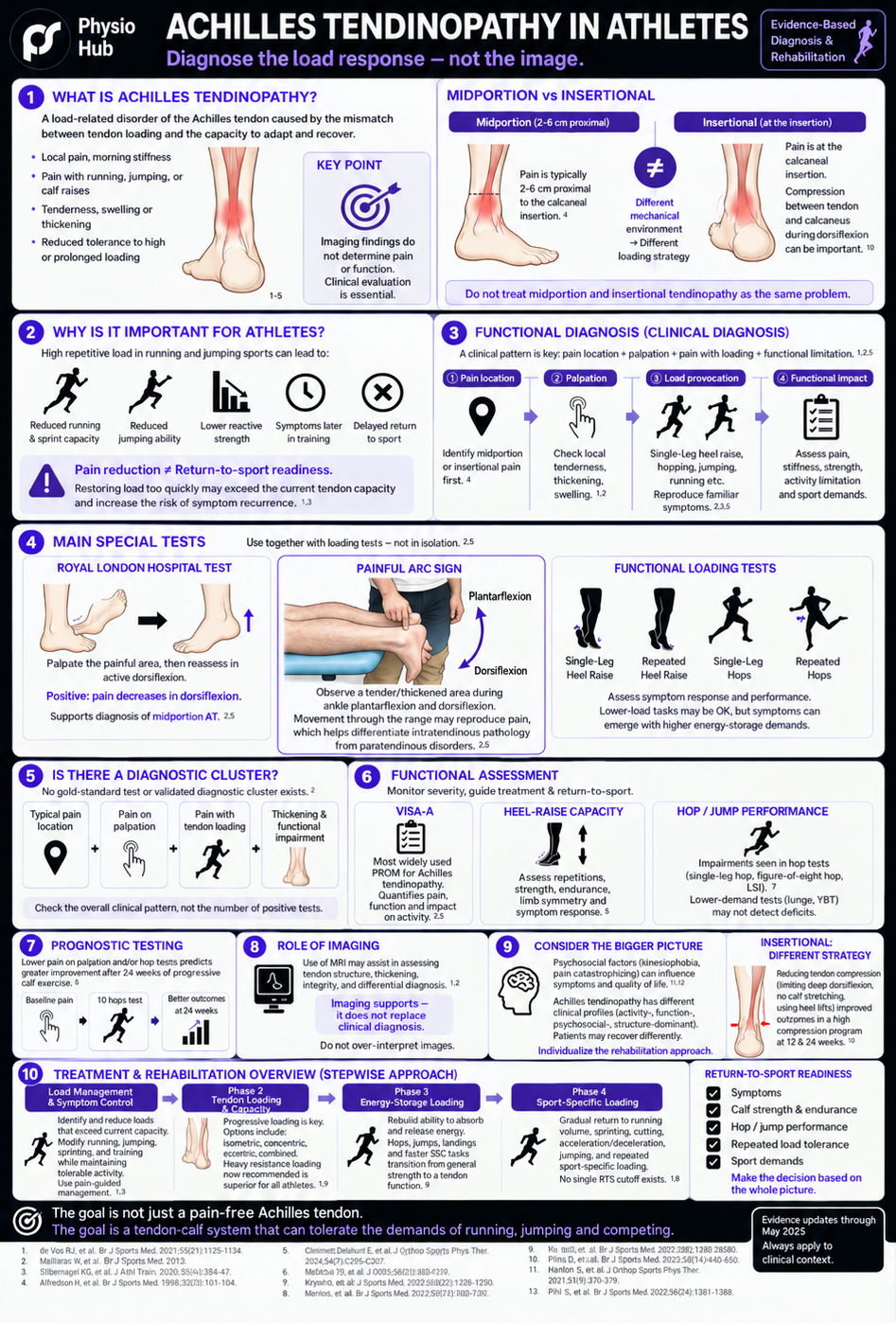
<PDF file>
Read More



< Reference >
- de Vos RJ, van der Vlist AC, Zwerver J, et al. Dutch multidisciplinary guideline on Achilles tendinopathy. Br J Sports Med. 2021;55(20):1125-1134. doi:10.1136/bjsports-2020-103867.
- Matthews W, Ellis R, Furness J, Hing WA. The clinical diagnosis of Achilles tendinopathy: a scoping review. PeerJ. 2021;9:e12166. doi:10.7717/peerj.12166.
- Silbernagel KG, Hanlon S, Sprague A. Current clinical concepts: conservative management of Achilles tendinopathy. J Athl Train. 2020;55(5):438-447. doi:10.4085/1062-6050-356-19.
- Tarantino D, Mottola R, Gnasso R, et al. Achilles tendinopathy pathogenesis and management: a narrative review. Int J Environ Res Public Health. 2023;20(17):6681. doi:10.3390/ijerph20176681.
- Chimenti RL, Neville C, Houck J, Cuddeford T, Carreira D, Martin RL. Achilles pain, stiffness, and muscle power deficits: midportion Achilles tendinopathy revision—2024. J Orthop Sports Phys Ther. 2024;54(12):CPG1-CPG32. doi:10.2519/jospt.2024.0302.
- Mulder CFL, van der Vlist AC, van Middelkoop M, et al. Do physical tests have a prognostic value in chronic midportion Achilles tendinopathy? J Sci Med Sport. 2023;26(8):421-428. doi:10.1016/j.jsams.2023.06.014.
- Zhang T, Zhao Y, Wang S, et al. Ankle proprioception and functional performance in patients with Achilles tendinopathy. Eur J Sport Sci. 2025;25(1):e12228. doi:10.1002/ejsc.12228.
- Corrigan P, Hornsby S, Pohlig RT, Willy RW, Cortes DH, Silbernagel KG. Tendon loading in runners with Achilles tendinopathy: relations to pain, structure, and function during return-to-sport. Scand J Med Sci Sports. 2022;32(8):1201-1212. doi:10.1111/sms.14178.
- Krogh TP, Jensen TT, Madsen MN, Fredberg U. An isometric and functionally based 4-stage progressive loading program in Achilles tendinopathy: a 12-month pilot study. Transl Sports Med. 2022;2022:6268590. doi:10.1155/2022/6268590.
- Pringels L, Capelleman R, Van den Abeele A, et al. Effectiveness of reducing tendon compression in the rehabilitation of insertional Achilles tendinopathy: a randomised clinical trial. Br J Sports Med. 2025;59(9):640-650. doi:10.1136/bjsports-2024-109138.
- Hanlon SL, Pohlig RT, Silbernagel KG. Beyond the diagnosis: using patient characteristics and domains of tendon health to identify latent subgroups of Achilles tendinopathy. J Orthop Sports Phys Ther. 2021;51(9):440-448. doi:10.2519/jospt.2021.10271.
- Hanlon SL, Pohlig RT, Silbernagel KG. Differences in recovery of tendon health explained by midportion Achilles tendinopathy subgroups: a 6-month follow-up. J Orthop Sports Phys Ther. 2023;53(4):217-234. doi:10.2519/jospt.2023.11330.
Stay Informed with Physio Hub
Unlock a world of knowledge with our expertly curated articles on fitness, rehabilitation, and health & diet. Stay ahead with the latest evidence-based insights and practical advice. Subscribe now to receive updates and never miss out on new content!