
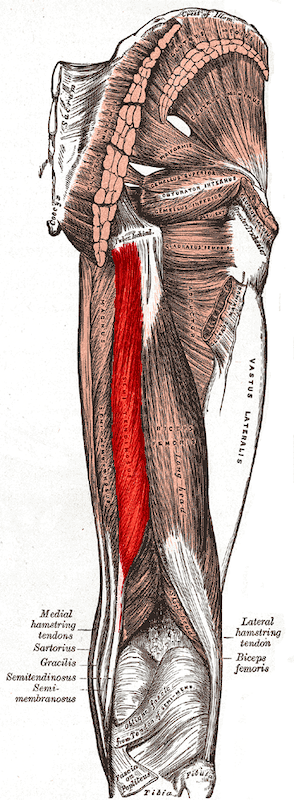
Semitendinosus
A Medial Hamstring for Sprinting, Deceleration, and Dynamic Knee Stability
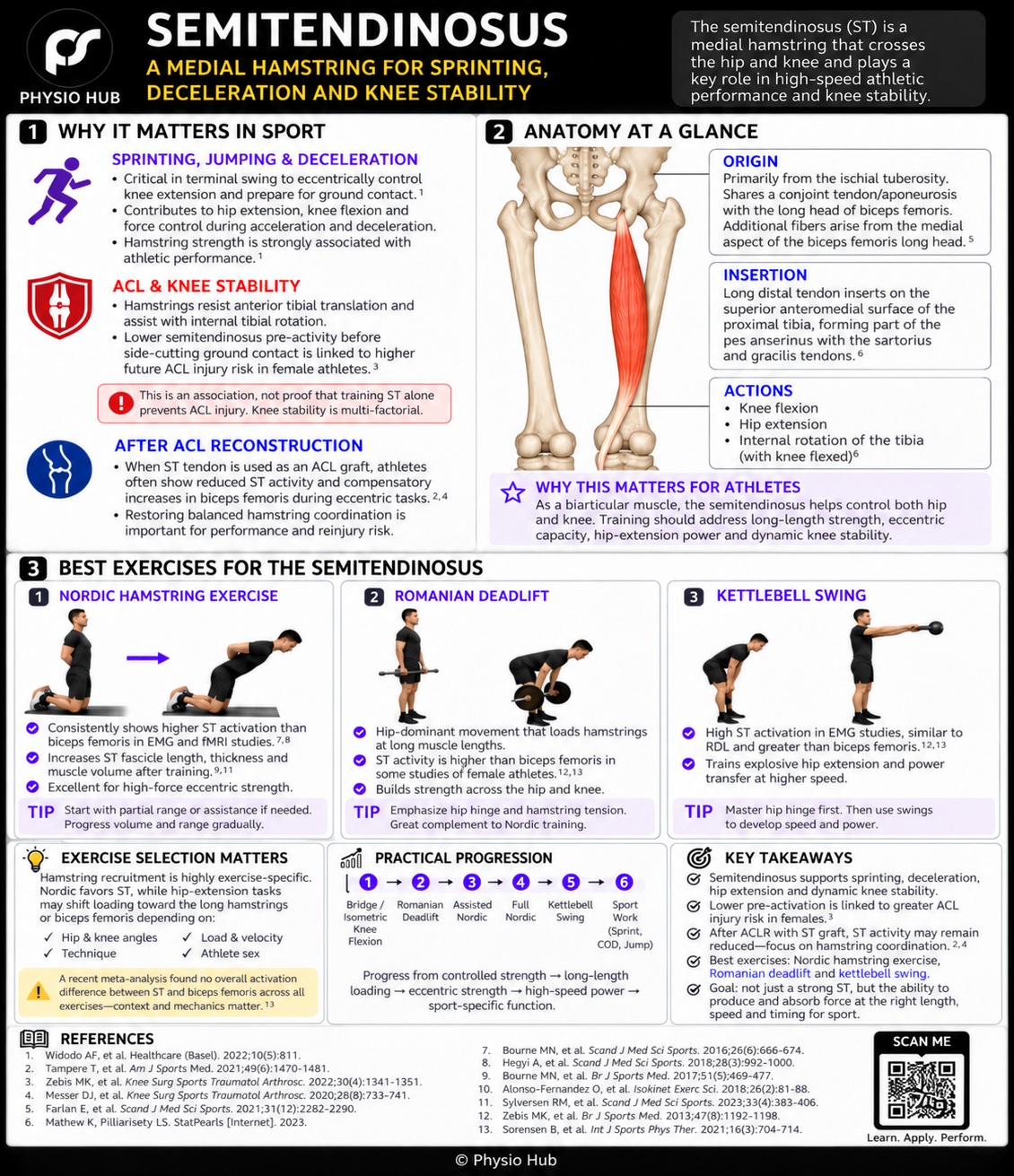
The semitendinosus (ST) is one of the major hamstring muscles and contributes to knee flexion, hip extension, and internal rotation of the tibia.
For athletes, its importance extends well beyond simply bending the knee. The hamstrings play major roles during sprinting, jumping, acceleration, and rapid deceleration, while the semitendinosus often demonstrates substantial recruitment during knee-dominant and eccentric hamstring tasks.¹˒²
The semitendinosus is also clinically relevant because the medial hamstrings contribute to dynamic knee stability, including neuromuscular control during cutting and landing tasks.
Function and Sports Relevance
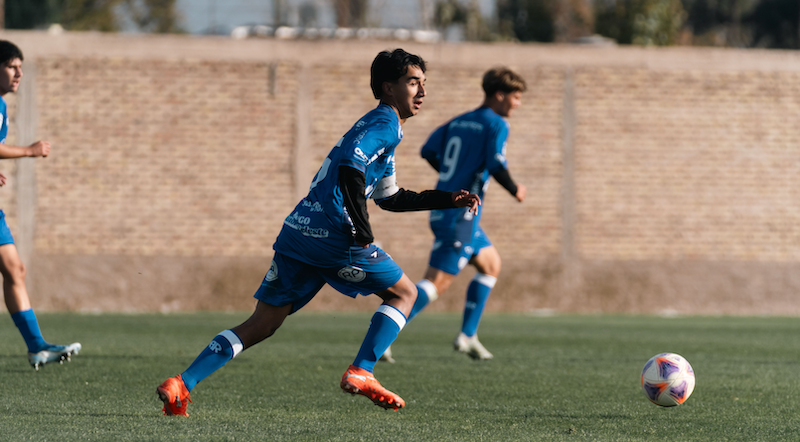
Sprinting and Deceleration
During high-speed running, the hamstrings must manage large forces across both the hip and knee.
During terminal swing, the hamstrings help eccentrically control rapid knee extension and prepare the lower extremity for ground contact.¹
Following contact, the hamstring complex contributes to hip extension, knee flexion, and control of forces transmitted through the lower extremity.
These functions make the semitendinosus relevant not only to sprinters but also to athletes participating in:
- Soccer
- Basketball
- Football
- Rugby
- Handball
- Other cutting and field sports
where repeated sprinting, deceleration, and change of direction are required.
The Semitendinosus and ACL Function
The hamstrings function as dynamic stabilizers of the knee and can oppose anterior translation of the tibia.
Because the semitendinosus is a medial hamstring, it may also contribute to controlling rotational and frontal-plane forces around the knee.
In a prospective study of adolescent female elite soccer and handball players, lower semitendinosus activity during the 50 ms before ground contact in a side-cutting task was associated with a greater subsequent risk of first-time ACL injury.³
This finding should not be interpreted to mean:
“Strengthening the semitendinosus alone prevents ACL injury.”
ACL injury is multifactorial and involves interactions among external loading, joint position, movement strategy, neuromuscular control, and sport context.
A better interpretation is that timely recruitment of the medial hamstrings is one potentially important component of dynamic knee control.
Why It Matters After ACL Reconstruction
The semitendinosus tendon is commonly harvested as an autograft during ACL reconstruction.
Research suggests that athletes who have undergone ACL reconstruction using a semitendinosus graft may demonstrate persistent reductions in semitendinosus size or activation even after returning to sport.
During heavy eccentric hamstring exercise, reduced semitendinosus recruitment may also be accompanied by greater relative biceps femoris activity.²˒⁴
This suggests that rehabilitation after ACL reconstruction may need to consider not only:
“Has hamstring strength returned?”
but also:
“How are the individual hamstring muscles sharing the load?”
Anatomy of the Semitendinosus
Origin
The semitendinosus originates primarily from the:
ischial tuberosity.
Proximally, it shares a conjoint tendinous and aponeurotic relationship with the long head of the biceps femoris.
An anatomical study also found additional semitendinosus muscle fibers arising consistently from the medial aspect of the proximal biceps femoris long head.⁵
This anatomy suggests a mechanical relationship between the two muscles rather than two completely independent structures.
Insertion
Distally, the semitendinosus transitions into a long tendon that inserts onto the:
superior anteromedial surface of the proximal tibia.
Together with the sartorius and gracilis tendons, it forms the:
**pes anserinus.**⁶
Primary Actions
The primary actions of the semitendinosus include:
- Knee flexion
- Hip extension
- Internal rotation of the tibia when the knee is flexed⁶
Why Does This Matter for Athletes?
The semitendinosus crosses both the hip and knee.
It is therefore a biarticular muscle, meaning its function depends on what is occurring at both joints.
During sprinting, for example, the hamstrings may simultaneously experience hip flexion and knee extension before transitioning toward forceful hip extension.
During deceleration and cutting, the muscle must contribute to force absorption while helping control the knee.
For this reason, semitendinosus training should eventually address more than isolated knee flexion.
Athletes need exposure to:
long muscle lengths, eccentric loading, hip-dominant force production, rapid loading, and sport-specific knee control.
Effective Exercises for the Semitendinosus
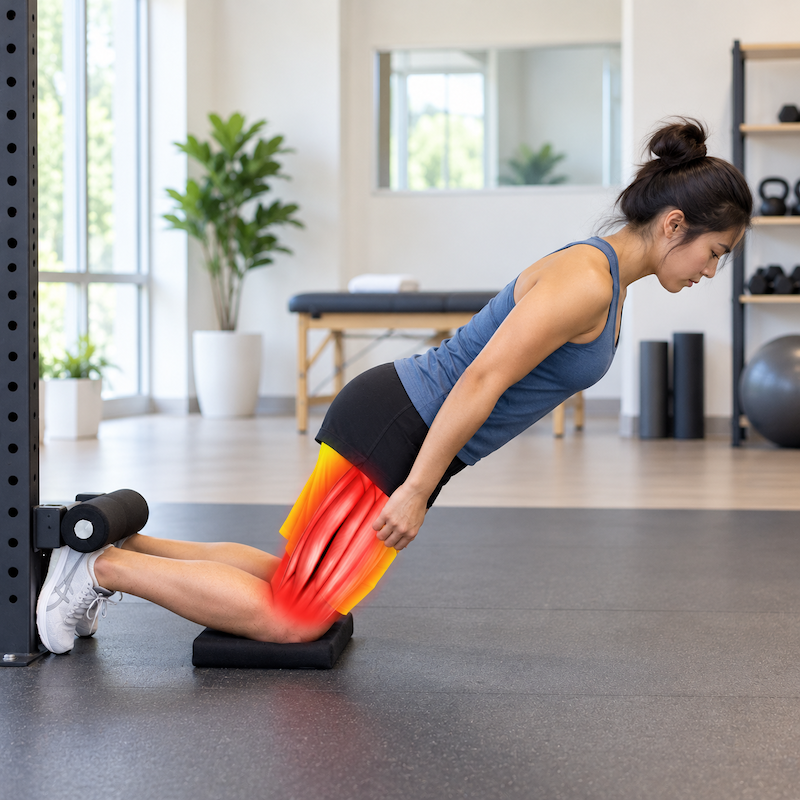
Exercise 1 | Nordic Hamstring Exercise
The Nordic Hamstring Exercise (NHE) is one of the best-supported exercises for targeting the semitendinosus.
The athlete lowers the trunk forward from a kneeling position while using the hamstrings to eccentrically resist knee extension.
Functional MRI and high-density EMG studies have reported particularly high semitendinosus recruitment during the Nordic, including greater activity than the biceps femoris long head under some testing conditions.⁷˒⁸
Why Is It Useful?
The Nordic provides more than acute muscle activation.
Training studies have reported structural adaptation of the semitendinosus, including increases in:
- Fascicle length
- Muscle thickness
- Muscle volume⁹⁻¹¹
This makes it particularly valuable when developing high-force eccentric capacity.
However, the Nordic is demanding. Early rehabilitation or less-trained athletes may require shorter ranges of motion, assistance, or lower-volume exposure before progressing to full repetitions.
Exercise 2 | Romanian Deadlift
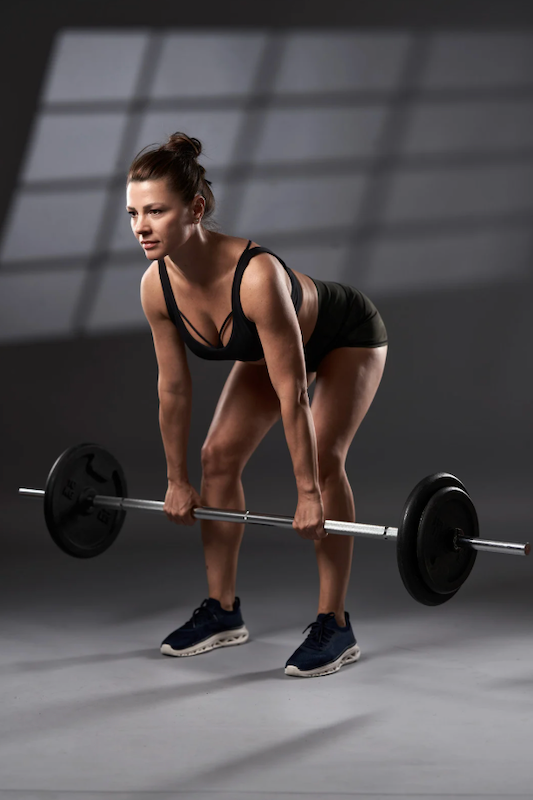
The Romanian Deadlift (RDL) provides a different stimulus by loading the hamstrings primarily through hip flexion and extension.
Studies in female athletes have demonstrated greater semitendinosus than biceps femoris activation during RDL variations.¹²˒¹³
Why Is It Useful?
The Nordic is predominantly a knee-dominant eccentric task, whereas the RDL is much more hip dominant.
Combining the two allows the athlete to train both major functions of the semitendinosus:
knee flexion + hip extension.
The RDL also loads the hamstrings at relatively long muscle lengths, making it useful within strength and return-to-sport programming.
Exercise 3 | Kettlebell Swing
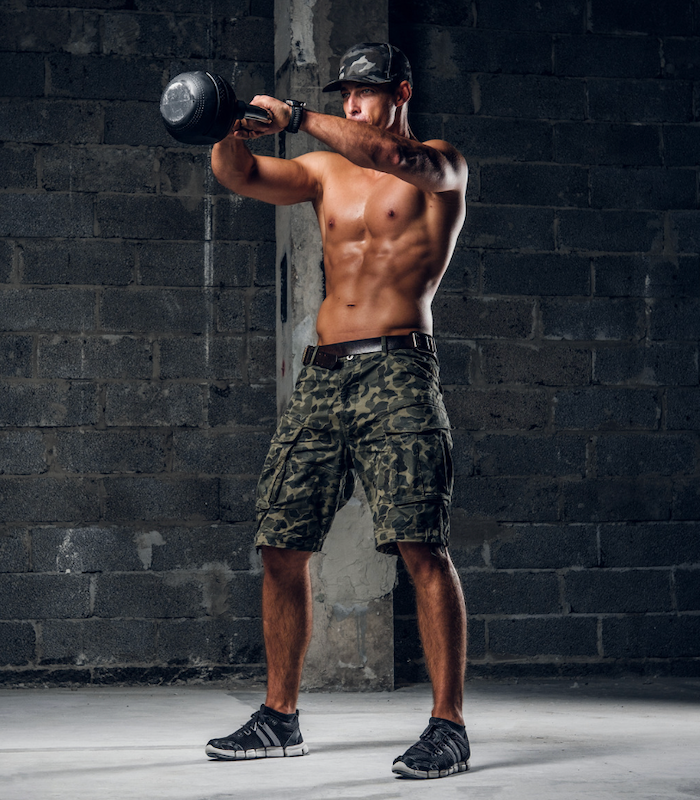
The Kettlebell Swing can also produce substantial semitendinosus activation.
EMG research has found both kettlebell swings and Romanian deadlifts to favor the semitendinosus over the biceps femoris in several athlete populations.¹²˒¹³
The key difference from the RDL is speed.
The kettlebell swing adds a more ballistic hip-extension demand, making it useful later in a progression when the athlete needs to transition from controlled strength toward rapid force production.
Exercise Selection Matters
Hamstring recruitment is highly exercise specific.
The Nordic can strongly favor the semitendinosus, while deadlift and hip-extension variations may create different medial-to-lateral hamstring activity patterns depending on:
- Hip angle
- Knee angle
- Load
- Velocity
- Exercise technique
- Athlete characteristics⁸˒¹³
Therefore, EMG findings should not be interpreted as proof that one exercise is universally “best.”
A more useful strategy is to select exercises that expose the athlete to different mechanical functions of the hamstrings.
Practical Progression
A simple progression may look like:
Bridge / Isometric Knee Flexion
↓
Romanian Deadlift
↓
Assisted Nordic
↓
Full Nordic Hamstring Exercise
↓
Kettlebell Swing
↓
Sprint / Jump / Deceleration / Change of Direction
The progression should gradually move from controlled strength toward:
long-length loading → eccentric force → high-speed force production → sport-specific function.
< Take-Home Message >
The semitendinosus is much more than a knee flexor.
For athletes, it contributes to:
sprinting, deceleration, hip extension, and dynamic control of the knee.
Reduced semitendinosus pre-activation during cutting has been associated with subsequent ACL injury in female athletes,³ and athletes who have undergone ACL reconstruction using a semitendinosus tendon graft may demonstrate persistent changes in semitendinosus recruitment and hamstring coordination.²˒⁴
Evidence-supported exercise options include the:
Nordic Hamstring Exercise, Romanian Deadlift, and Kettlebell Swing.
Rather than searching for a single “best” semitendinosus exercise, training should progressively prepare the muscle to work with the rest of the hamstrings, gluteal muscles, and lower extremity during high-speed athletic movement.
The ultimate goal is not simply a strong semitendinosus.
It is a semitendinosus that can produce and absorb force at the right magnitude, length, and timing for the demands of sport.
< PDF file>
< Reference >
- Widodo AF, Tien CW, Chen CW, Lai SC. Isotonic and isometric exercise interventions improve the hamstring muscles’ strength and flexibility: a narrative review. Healthcare (Basel). 2022;10(5):811. doi:10.3390/healthcare10050811.
- Tampere T, Victor J, Luyckx T, et al. Biceps femoris compensates for semitendinosus after anterior cruciate ligament reconstruction with a hamstring autograft: a muscle functional magnetic resonance imaging study in male soccer players. Am J Sports Med. 2021;49(6):1470-1481. doi:10.1177/03635465211003309.
- Zebis MK, Aagaard P, Andersen LL, et al. First-time anterior cruciate ligament injury in adolescent female elite athletes: a prospective cohort study to identify modifiable risk factors. Knee Surg Sports Traumatol Arthrosc. 2022;30(4):1341-1351. doi:10.1007/s00167-021-06595-8.
- Messer DJ, Shield AJ, Williams MD, Timmins RG, Bourne MN. Hamstring muscle activation and morphology are significantly altered 1-6 years after anterior cruciate ligament reconstruction with semitendinosus graft. Knee Surg Sports Traumatol Arthrosc. 2020;28(3):733-741. doi:10.1007/s00167-019-05374-w.
- Farfán E, Rojas S, Olivé-Vilás R, Rodríguez-Baeza A. Morphological study on the origin of the semitendinosus muscle in the long head of biceps femoris. Scand J Med Sci Sports. 2021;31(12):2282-2290. doi:10.1111/sms.14045.
- Mathew K, Pillarisetty LS. Anatomy, Bony Pelvis and Lower Limb: Thigh Semitendinosus Muscle. In: StatPearls. StatPearls Publishing; 2023. Updated May 29, 2023.
- Bourne MN, Opar DA, Williams MD, Al Najjar A, Shield AJ. Muscle activation patterns in the Nordic hamstring exercise: impact of prior strain injury. Scand J Med Sci Sports. 2016;26(6):666-674. doi:10.1111/sms.12494.
- Hegyi A, Péter A, Finni T, Cronin NJ. Region-dependent hamstrings activity in Nordic hamstring exercise and stiff-leg deadlift defined with high-density electromyography. Scand J Med Sci Sports. 2018;28(3):992-1000. doi:10.1111/sms.13016.
- Bourne MN, Duhig SJ, Timmins RG, et al. Impact of the Nordic hamstring and hip extension exercises on hamstring architecture and morphology: implications for injury prevention. Br J Sports Med. 2017;51(5):469-477. doi:10.1136/bjsports-2016-096130.
- Alonso-Fernández D, Gutiérrez-Sánchez Á, García-Remeseiro T, Garganta R. Effects of the Nordic hamstring exercise on the architecture of the semitendinosus. Isokinet Exerc Sci. 2018;26(2):81-88. doi:10.3233/IES-172196.
- Suskens JJM, Secondulfo L, Kiliç Ö, et al. Effect of two eccentric hamstring exercises on muscle architectural characteristics assessed with diffusion tensor MRI. Scand J Med Sci Sports. 2023;33(4):393-406. doi:10.1111/sms.14283.
- Zebis MK, Skotte J, Andersen CH, et al. Kettlebell swing targets semitendinosus and supine leg curl targets biceps femoris: an EMG study with rehabilitation implications. Br J Sports Med. 2013;47(18):1192-1198. doi:10.1136/bjsports-2011-090281.
- Sørensen B, Aagaard P, Malchow-Møller L, Zebis MK, Bencke J. Medio-lateral hamstring muscle activity in unilateral vs bilateral strength exercises in female team handball players—a cross-sectional study. Int J Sports Phys Ther. 2021;16(3):704-714. doi:10.26603/001c.24150.