
How to Improve Sprint Velocity in Athletes
A Practical Sprint + Strength + Plyometric + Phase-Specific Speed Program
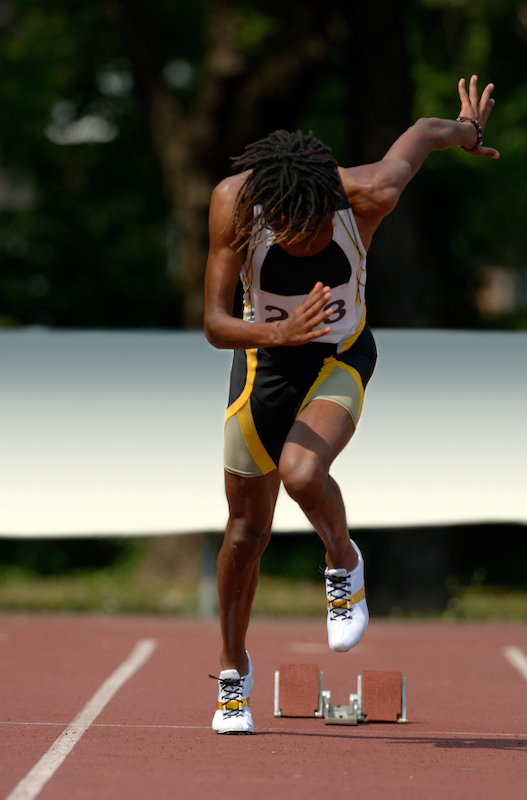
What Is Sprint Velocity, and Why Does It Matter?
Sprint performance is not one single physical quality.
It includes at least two important phases:
Acceleration
→ how rapidly the athlete increases velocity from a stationary or slower position
and
Maximum Velocity
→ the highest running speed the athlete can achieve.
These qualities overlap, but they do not respond identically to training.¹,²
In team and field sports, sprint ability contributes to actions such as:
- Beating an opponent to the ball
- Breakaway running
- Defensive recovery
- Transition play
- Accelerating out of a cut
Track athletes may place greater emphasis on maximum velocity, whereas basketball, soccer, football, and rugby athletes often require repeated acceleration and re-acceleration over shorter distances.
Sprint speed therefore depends on a combination of:
Sprint Skill + Force Production + Strength + Explosive Power + Reactive Ability
The best program should match the athlete’s sport and determine whether the major limitation is acceleration, maximum velocity, or both.
How Can Sprint Velocity Be Improved?
Keep Sprinting as the Foundation
If the goal is to run faster, the athlete must actually practice high-quality sprinting.
Review evidence indicates that specific sprint training has broad benefits across sprint distances. Strength, power, and plyometric methods are useful, but they should support rather than replace sprint practice.²,³
A useful principle is:
Build the physical qualities, then teach the athlete to express them while sprinting.
Use Resisted Sprinting for Acceleration
Early acceleration depends heavily on horizontally directed force.
Useful methods include:
- Sled sprinting
- Resisted acceleration
- Short maximal sprints
Recent reviews support resisted sprint training for improving short-distance acceleration and horizontal-force characteristics, particularly over approximately 10-20 m.¹,⁴
However, resisted sprinting does not consistently outperform well-matched normal sprinting by a large amount.
For most athletes, the practical approach is:
Resisted Sprint + Normal Sprint
rather than choosing only one.
Load also matters. Research has reported effective acceleration adaptations with approximately 10%-13% body-mass sled loads and with resistance producing around a 50% velocity decrement, although optimal loading should still be individualized.⁵
Train Maximum Velocity at Maximum Velocity
Top-speed performance requires exposure to high running velocities.
Useful methods include:
- Build-up runs
- Flying sprints
- Maximum-velocity sprinting
Assisted sprinting and combined uphill-downhill methods may also provide useful supramaximal exposure by influencing step frequency and ground-contact behavior.¹,⁴
These methods are more advanced and should not replace basic high-quality unresisted sprinting.
Build Strength
Resistance training develops the force-producing capacity that supports sprinting.
Useful exercises include:
- Squat
- Romanian Deadlift
- Split Squat
- Other hip-dominant strength exercises
Strength training appears particularly relevant to early acceleration and horizontal-force production.²,⁶
But strength gains need to be transferred to faster movements.
Add Plyometric and Explosive Training
Plyometric training develops:
- Reactive strength
- Stretch-shortening-cycle performance
- Rapid force production
Useful options include:
- Pogo jumps
- Bounds
- Hurdle hops
- Countermovement jumps
- Single-leg hops
Evidence supports plyometric training for sprint-performance development, including maximum-velocity and power-related qualities.⁶
A useful framework is:
Strength → Force Capacity
Plyometrics → Fast / Reactive Force
Sprinting → Specific Expression
Separate Acceleration and Maximum-Velocity Emphasis When Needed
An athlete may have good acceleration but poor top speed—or the opposite.
Programming can therefore include different emphases:
Acceleration Focus
- Sled sprints
- 10-20 m acceleration
- Horizontal power
Maximum-Velocity Focus
- Build-ups
- Flying sprints
- High-speed plyometrics
The training should reflect the athlete’s actual deficit rather than automatically giving every athlete the same sprint program.
Add Repeated Sprinting for Team Sports
Team-sport athletes need to reproduce speed throughout a match.
Repeated-sprint training can improve short-sprint performance and broader conditioning qualities.⁷
However, repeated sprinting is not the same as maximum-speed training.
If every sprint is performed under fatigue, the athlete may rarely experience true maximum velocity.
High-quality speed work should therefore remain part of the program.

Simple Sprint Velocity Training Program
This is an example framework, not one universally optimal program.
- Squat
Goal: Build lower-body force capacity.
- Romanian Deadlift
Goal: Develop hip-extensor and posterior-chain strength.
- Split Squat
Goal: Develop unilateral force production.
- Countermovement Jump
Goal: Improve explosive lower-body power.
- Pogo Jump
Goal: Develop reactive stiffness and rapid ground-contact ability.
- Bounds
Goal: Develop horizontal and elastic power.
- Resisted Sled Acceleration
Goal: Improve horizontally directed force during early acceleration.
- Unresisted 10-20 m Sprint
Goal: Transfer improved force production into actual acceleration.
- Build-Up Sprint
Gradually increase running speed.
Goal: Prepare the athlete for high-speed sprinting.
- Flying Sprint
Accelerate before entering a short maximum-speed zone.
Goal: Develop maximum velocity and high-speed sprint mechanics.
- Optional Assisted Sprint
Examples may include carefully controlled assistance or mild downhill running.
Goal: Provide supramaximal-speed exposure.
This is an advanced option, not a requirement.
- Deceleration → Re-Acceleration
Goal: Develop the ability to transition rapidly between braking and sprinting.
- Reactive Sprint
Accelerate in response to a visual, auditory, partner, or ball cue.
Goal: Connect sprint ability with sport perception and reaction.
- Repeated Sprint
Perform repeated short sprints with structured recovery.
Goal: Develop the ability to reproduce sprint performance during competition.
- Sport-Specific Sprint
Examples:
Soccer
- Jog → accelerate
- Cut → sprint
- Defensive recovery
Basketball
- Shuffle → sprint
- Transition sprint
Football
- Stance → accelerate
- Route-specific sprint
Goal: Transfer improved sprint qualities to competition.
Reassess
Consider monitoring:
- 5-m sprint
- 10-m sprint
- 20-m sprint
- Acceleration splits
- Flying-sprint velocity
- Maximum velocity
- Jump or bound performance
- Sprint mechanics
- Side-to-side differences
- Repeated-sprint performance
- Speed under fatigue
< Take-Home Message >
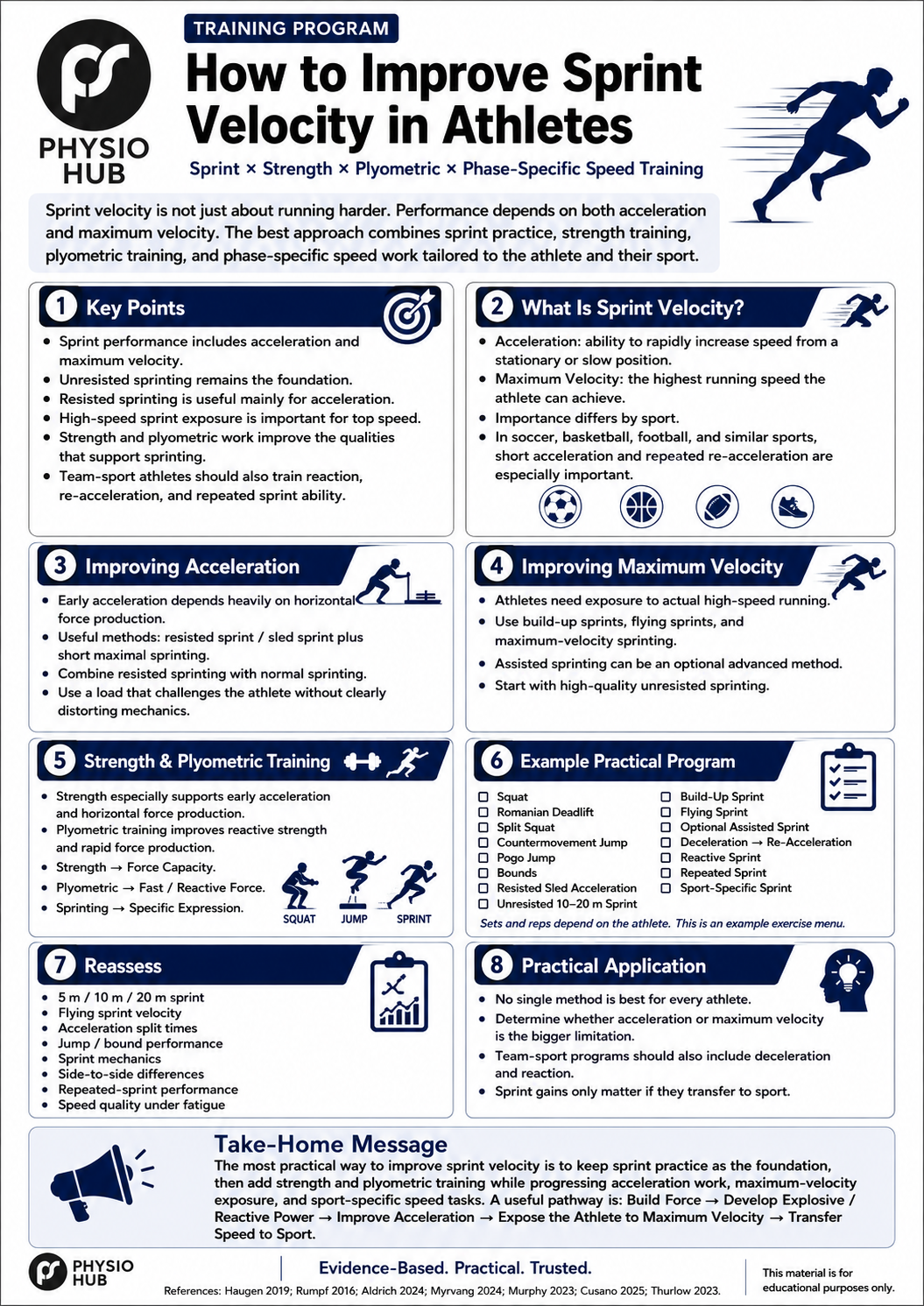
Improving sprint velocity is unlikely to come from one “best” exercise or training method.
A practical evidence-based approach is:
Sprint Practice + Strength + Plyometric/Power Training
Then target the specific phase:
Acceleration → Resisted Sprinting
Maximum Velocity → Flying / High-Speed Sprinting
Team-Sport Speed → Reaction + Re-Acceleration + Repeated Sprinting
The overall progression is:
Build Force
→ Develop Explosive & Reactive Power
→ Improve Acceleration
→ Expose the Athlete to Maximum Velocity
→ Transfer Speed to Sport
The fastest program is therefore not necessarily the one containing the most exercises—it is the one that specifically addresses what is currently limiting that athlete’s speed.
< PDF file>
< Reference >
- Aldrich et al. Resisted, assisted, and combined sprint training approaches for acceleration and maximum-velocity performance. 2024.
- Haugen T, Seiler S, Sandbakk Ø, Tønnessen E. The training and development of elite sprint performance: an integration of scientific and best-practice literature. Sports Med Open. 2019.
- Rumpf MC, Lockie RG, Cronin JB, Jalilvand F. Effect of different sprint training methods on sprint performance over various distances: a brief review. J Strength Cond Res. 2016.
- Myrvang M, van den Tillaar R. Resisted and assisted sprint training for acceleration and maximal sprint speed: review of current evidence. 2024.
- Cusano et al. Effects of sled-load prescription on sprint acceleration, horizontal force production, and power. 2025.
- Murphy et al. Effects of resistance and plyometric training on sprint performance and underlying force-power characteristics. 2023.
- Thurlow et al. Effects of repeated-sprint training on sprint performance and physical fitness in team-sport athletes. 2023.