
How to Improve Hip Mobility After Surgery or Injury for Return to Sport
A Practical Progression From ROM to Strength, Movement Quality, and Sport-Specific Mobility
What Is Hip Mobility, and Why Does It Matter?
Hip mobility is more than passive range of motion.
For sport, the athlete must be able to access, control, and produce force through the available range during tasks such as:
- Walking and running
- Squatting
- Lunging
- Single-leg support
- Acceleration and deceleration
- Cutting
- Rotation
A useful way to think about sport-related hip mobility is:
Available ROM + Strength + Pelvic Control + Movement Quality
After hip surgery or injury, pain, stiffness, weakness, and protective movement can reduce mobility. Athletes may also compensate through the pelvis, lumbar spine, or opposite limb.
These compensations may persist even after pain improves.
One year after THA, asymmetric loading strategies during sit-to-stand have been documented,¹ and deficits in hip ROM and strength can persist well beyond the early postoperative period.²
For return to sport, therefore:
Pain-free motion is not enough—the athlete needs usable mobility under load.
How Can It Be Addressed?
Restore Motion Early—When Allowed
Following surgery, tissue healing and procedure-specific precautions come first.
Within those limits, early controlled motion appears beneficial.
In an RCT after THA, additional mobilization and hip strengthening initiated during the first postoperative week resulted in greater improvements in hip flexion, extension, abduction, and gait performance compared with standard physiotherapy alone.³
Useful components may include:
- Active ROM
- Active-assisted ROM
- Stretching when appropriate
- Gradual weight bearing
The goal is not to force restricted motion, but to progressively restore safe movement.
Combine Mobility With Strength
More motion is only useful if the athlete can control it.
Rehabilitation should progressively restore strength in the:
- Hip abductors
- Hip extensors
- Adductors
- Hip rotators
- Knee musculature
- Core and pelvic musculature
A randomized trial comparing a functional strength integration program with a standardized rehabilitation program after THA found that both groups improved over time. The specialized program was not clearly superior overall, but the study supports structured rehabilitation that integrates strength, pelvic stability, and movement training.⁴
Restore Gait and Movement Quality
Hip mobility must transfer into function.
Rehabilitation should address:
- Symmetrical loading
- Step length
- Hip extension during walking
- Pelvic control
- Sit-to-stand
- Squatting
- Stairs
- Lunging
Persistent movement compensation after THA shows why restoring ROM alone may be insufficient.¹
Progress Toward Sport-Specific Mobility
Higher-level athletes require more than daily-living mobility.
For example:
Running
- Hip extension
- Single-leg control
Soccer
- Rotation
- Cutting
- Kicking positions
Basketball
- Deep deceleration positions
- Lateral movement
- Landing
The progression should therefore move from:
Mobility → Strength → Functional Control → Dynamic and Sport-Specific Movement
What About Manual Therapy?
Manual therapy may be used as an adjunct when clinically appropriate.
However, the evidence provided for this article more strongly supports active exercise, mobility work, strengthening, gait retraining, and functional loading than passive treatment alone.
The foundation should remain active rehabilitation.
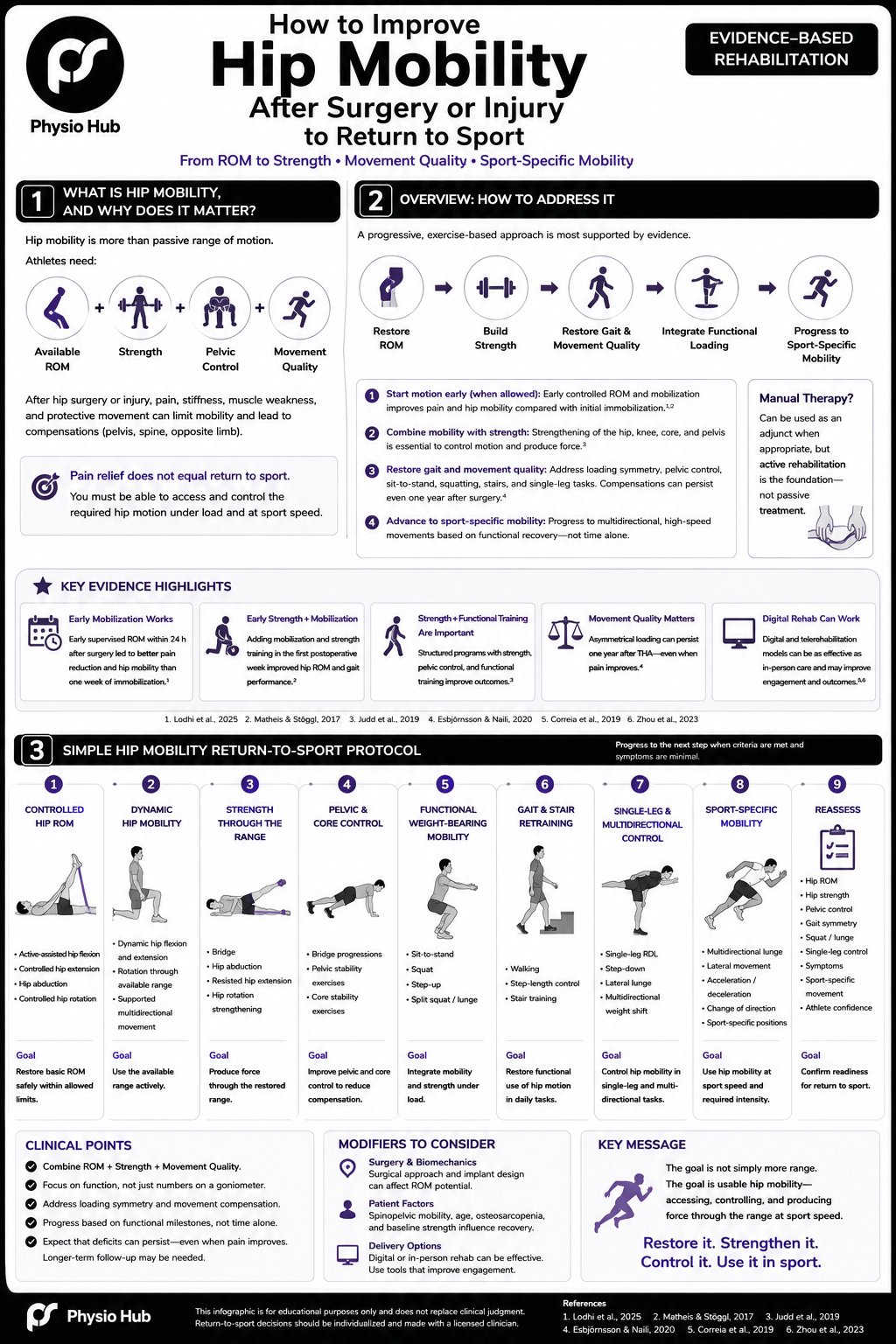
Simple Hip Mobility Return-to-Sport Rehabilitation Protocol
- Controlled Hip ROM
Examples:
- Active-Assisted Hip Flexion
- Controlled Hip Extension
- Hip Abduction
- Controlled Hip Rotation
Goal: Restore basic available ROM safely.
- Dynamic Hip Mobility
Examples:
- Active Hip Flexion / Extension
- Controlled Rotation Through Available Range
- Supported Multidirectional Hip Movement
Goal: Convert passive mobility into actively controlled mobility.
- Strength Through the Available Range
Examples:
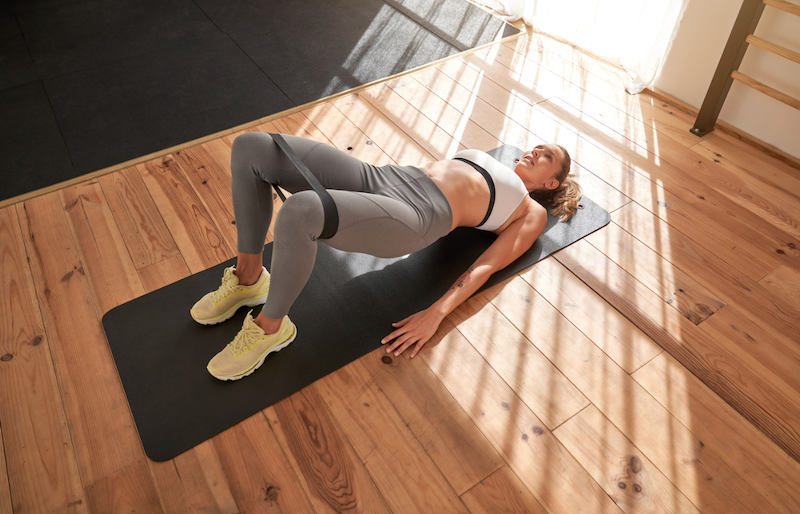
- Bridge
- Hip Abduction
- Resisted Hip Extension
- Hip Rotation Strengthening
Goal: Produce force through the restored range.
- Pelvic and Core Control
Examples:
- Bridge Progressions
- Pelvic Stability Exercise
- Core Stability Exercise
Goal: Reduce excessive trunk and pelvic compensation.
- Functional Weight-Bearing Mobility
Examples:
- Sit-to-Stand
- Squat
- Step-Up
- Split Squat / Lunge
Goal: Integrate hip mobility and strength under load.
- Gait and Stair Retraining
- Walking
- Step-Length Control
- Stair Training
Goal: Restore functional use of hip motion.
- Single-Leg and Multidirectional Control
Examples:
- Single-Leg RDL
- Step-Down
- Lateral Lunge
- Multidirectional Weight Shift
Goal: Control hip mobility during unilateral and multidirectional tasks.
- Sport-Specific Mobility
Progress toward:
- Multidirectional Lunges
- Lateral Movement
- Acceleration / Deceleration
- Controlled Change of Direction
- Sport-Specific Hip Positions
Goal: Use the available hip range at sport-relevant speed and load.
- Reassess
Consider:
- Hip flexion, extension, abduction, and rotation ROM
- Hip strength
- Pelvic control
- Gait symmetry
- Squat and lunge mechanics
- Single-leg control
- Symptoms
- Sport-specific movement
- Athlete confidence
If passive ROM improves but the athlete continues to compensate during gait, squatting, or running, the next priority may be strength and motor control rather than additional stretching.
< Take-Home Message >
Improving hip mobility for return to sport is not simply about gaining more ROM.
A practical sequence is:
Restore ROM
→ Strengthen Through the Range
→ Restore Gait and Pelvic Control
→ Integrate Functional Loading
→ Progress to Sport-Specific Mobility
An athlete may be pain free and still be underprepared for sport if they cannot control and use the required hip motion under load and at sport speed.
< PDF file>
< Reference >
- Esbjörnsson AC, Naili JE. Functional movement compensations persist in individuals with hip osteoarthritis performing the five times sit-to-stand test 1 year after total hip arthroplasty. J Orthop Surg Res. 2020;15:151. doi:10.1186/s13018-020-01663-0.
- Özçadırci A, Çağlar Ö, Coşkun G. Range of motion and muscle strength deficits of patients with total hip arthroplasty after surgery. Balt J Health Phys Act. 2021;13(2):67-77.
- Matheis C, Stöggl T. Strength and mobilization training within the first week following total hip arthroplasty. J Bodyw Mov Ther. 2018;22(2):519-527. doi:10.1016/j.jbmt.2017.06.012.
- Judd DL, Cheuy V, Peters A, et al. Incorporating functional strength integration techniques during total hip arthroplasty rehabilitation: a randomized controlled trial. Phys Ther. 2024;104(3):pzad168. doi:10.1093/ptj/pzad168.
- Correia FD, Nogueira A, Magalhães I, et al. Digital versus conventional rehabilitation after total hip arthroplasty: a single-center, parallel-group pilot study. JMIR Rehabil Assist Technol. 2019;6(1):e14523. doi:10.2196/14523.