
How to Improve Baseball Fastball Pitching Velocity
A Practical Strength + Power + Mechanics + Throwing Program
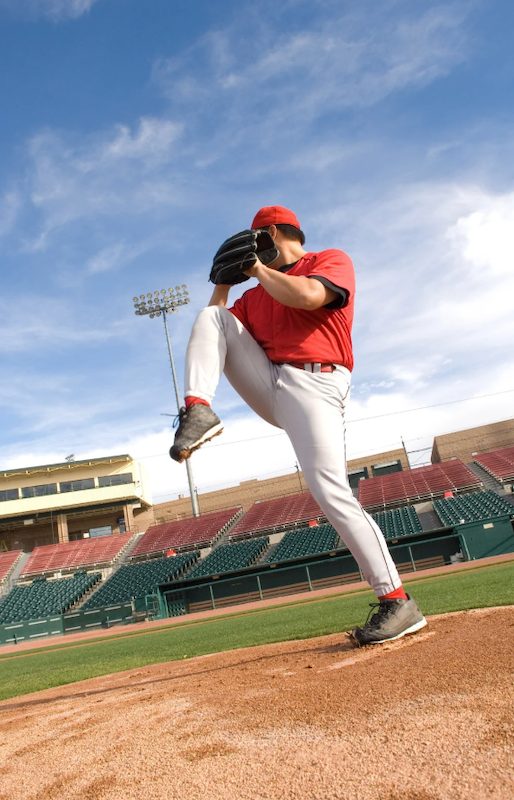
What Is Fastball Velocity, and Why Does It Matter?
Fastball velocity is an important performance characteristic for a baseball pitcher.
But throwing harder is not simply a matter of creating a faster arm.
Pitching is a whole-body kinetic-chain movement:
Ground → Lower Body → Pelvis → Trunk → Shoulder → Elbow → Hand → Ball
Biomechanical modeling in high school and collegiate pitchers identified lead-leg ground-reaction force, pelvis-to-trunk timing, trunk position at release, humeral rotation velocity, and elbow-extension velocity among the strongest predictors of fastball velocity.¹
Lower-body explosive ability also appears relevant. In Division I pitchers, countermovement-jump concentric impulse and peak power were strongly correlated with fastball velocity.²
Therefore, a practical velocity program should target:
Strength + Explosive Power + Rotational Power + Pitching Mechanics + Throwing Skill
rather than focusing on the throwing arm alone.
How Can Fastball Velocity Be Improved?
Build Lower-Body Strength
The pitcher first needs the capacity to produce force against the ground.
Useful training options include:
- Squat
- Romanian Deadlift
- Split Squat
- Deadlift variations
A review of velocity-training methods supports resistance training across a range of loading intensities as part of throwing-velocity development.³
The goal is not to find one magical lift. It is to build enough force-producing capacity to support the pitching movement.
Develop Lower-Body Explosive Power
Pitching occurs too quickly for maximal strength alone to explain performance.
The athlete also needs to produce force rapidly.
Useful exercises include:
- Countermovement Jump
- Broad Jump
- Lateral Bound
- Single-Leg Jump
CMJ concentric impulse and peak power have demonstrated meaningful relationships with fastball velocity,² and lateral-bound power has also been associated with velocity in collegiate pitchers.
These findings support developing explosive force in multiple directions rather than treating pitching as an upper-body power task.
Develop Rotational Power
Pitching requires rapid transfer of momentum through the pelvis and trunk.
Practical options include:
- Medicine-Ball Rotational Throw
- Step-Behind Rotational Throw
- Scoop Toss
- Shot-Put–Style Medicine-Ball Throw
A systematic review identified hip–shoulder separation, trunk power, trunk-rotation timing, and several trunk kinematic variables as factors associated with higher pitch velocity.⁴
Importantly, this does not mean that every pitcher should simply attempt to create as much hip–shoulder separation as possible. The goal is efficient sequencing that fits the individual pitcher.
Improve Pitching Mechanics and Sequencing
Force production matters, but so does how that force is transferred.
Important areas may include:
- Stride strategy
- Lead-leg force and stabilization
- Pelvis rotation
- Pelvis-to-trunk sequencing
- Hip–shoulder separation
- Trunk rotation
- Arm acceleration
- Release mechanics
Biomechanical research supports the importance of proximal-to-distal sequencing, with better sequencing associated with higher velocity rather than simply attempting to accelerate individual segments in isolation.⁵
There is no single mechanical template that every successful pitcher must copy.
The goal is to create and transfer momentum efficiently.
Address Mobility When It Is Actually Limiting
Hip rotation, thoracic rotation, and shoulder rotational motion can influence a pitcher’s ability to access desired positions.
If a meaningful limitation is present, mobility work can include:
- Hip rotation
- Thoracic rotation
- Shoulder rotational mobility
However, the evidence provided for velocity development does not show that simply becoming more flexible automatically increases fastball velocity.
Mobility should therefore support mechanics rather than become the primary velocity-training strategy.
Practice Throwing Hard
Physical development must eventually transfer into actual pitching.
A useful progression is:
Lower-Intensity Throwing → Higher Intent → Mound Pitching
A 15-week program using 3- and 4-oz lighter baseballs along with standard 5-oz baseballs increased average fastball velocity by 4.8 mph in a case series of youth pitchers; no shoulder or elbow injuries occurred during the program. Because it was a multicomponent case series, this should not be interpreted as proof that lighter balls alone caused the improvement.⁸
A related analysis found substantial velocity development during the mound portion of the program, supporting the importance of practicing the actual sport skill when attempting to improve pitching velocity.⁹
What About Heavy Weighted Balls?
They may improve velocity, but they deserve caution.
In a randomized 6-week weighted-ball study, pitching velocity increased by 3.3%, but the experimental group also demonstrated increased shoulder external-rotation ROM and a 24% injury rate, including 4 elbow injuries; no control-group pitchers were injured.⁶
Reviews conclude that weighted-ball programs can increase velocity, but protocols vary substantially in ball weight, volume, intensity, and progression, and an optimal safe protocol has not been established.⁷
For that reason, heavy weighted-ball throwing does not need to be a foundational component of a general velocity program.

Simple Fastball Velocity Training Program
- Squat
Goal: Develop lower-body force-producing capacity.
- Romanian Deadlift
Goal: Build hip-extensor and posterior-chain strength.
- Split Squat
Goal: Develop unilateral lower-extremity strength.
- Countermovement Jump
Goal: Develop vertical impulse and explosive power.
- Lateral Bound
Goal: Develop lateral and horizontal lower-body power.
- Medicine-Ball Rotational Throw
Goal: Develop rotational power from the lower body through the trunk.
- Step-Behind Medicine-Ball Throw
Goal: Integrate momentum generation and rotational power.
- Individualized Mobility Work
Address hip, thoracic, or shoulder mobility only when a meaningful limitation exists.
Goal: Maintain enough movement availability for efficient pitching.
- Pitching Mechanics / Sequencing Work
Focus on:
- Stride
- Lead-leg stabilization
- Pelvis-to-trunk sequencing
- Trunk rotation
- Efficient arm acceleration
Goal: Transfer physical power efficiently into the baseball.
- Progressive Throwing
Progress:
Easy Throwing → Higher Intent → Mound
Goal: Convert physical capacity into throwing performance.
- Fastball Mound Work
Throw fastballs from the mound with appropriate recovery and workload control.
Goal: Train the actual performance skill.
- Optional Lighter-Ball Throwing
Lighter baseballs may be incorporated under appropriate supervision.
Heavy weighted-ball throwing is optional—not mandatory.
- Reassess
Monitor:
- Fastball velocity
- Command / accuracy
- Lower-body power
- Lateral-bound performance
- Pitching mechanics
- Throwing workload
- Shoulder and elbow symptoms
- Recovery
< Take-Home Message >
Improving fastball velocity should not mean simply:
throwing harder more often.
A more evidence-aligned progression is:
Build Lower-Body Strength
→ Develop Explosive & Rotational Power
→ Improve Kinetic-Chain Sequencing
→ Practice High-Quality Throwing
→ Transfer It to the Mound
The most useful general strategy is therefore a multifactor program combining lower-body strength and power, rotational power, individualized mechanics, and well-managed pitching practice, rather than relying on any single drill or weighted-ball program.¹⁻⁷
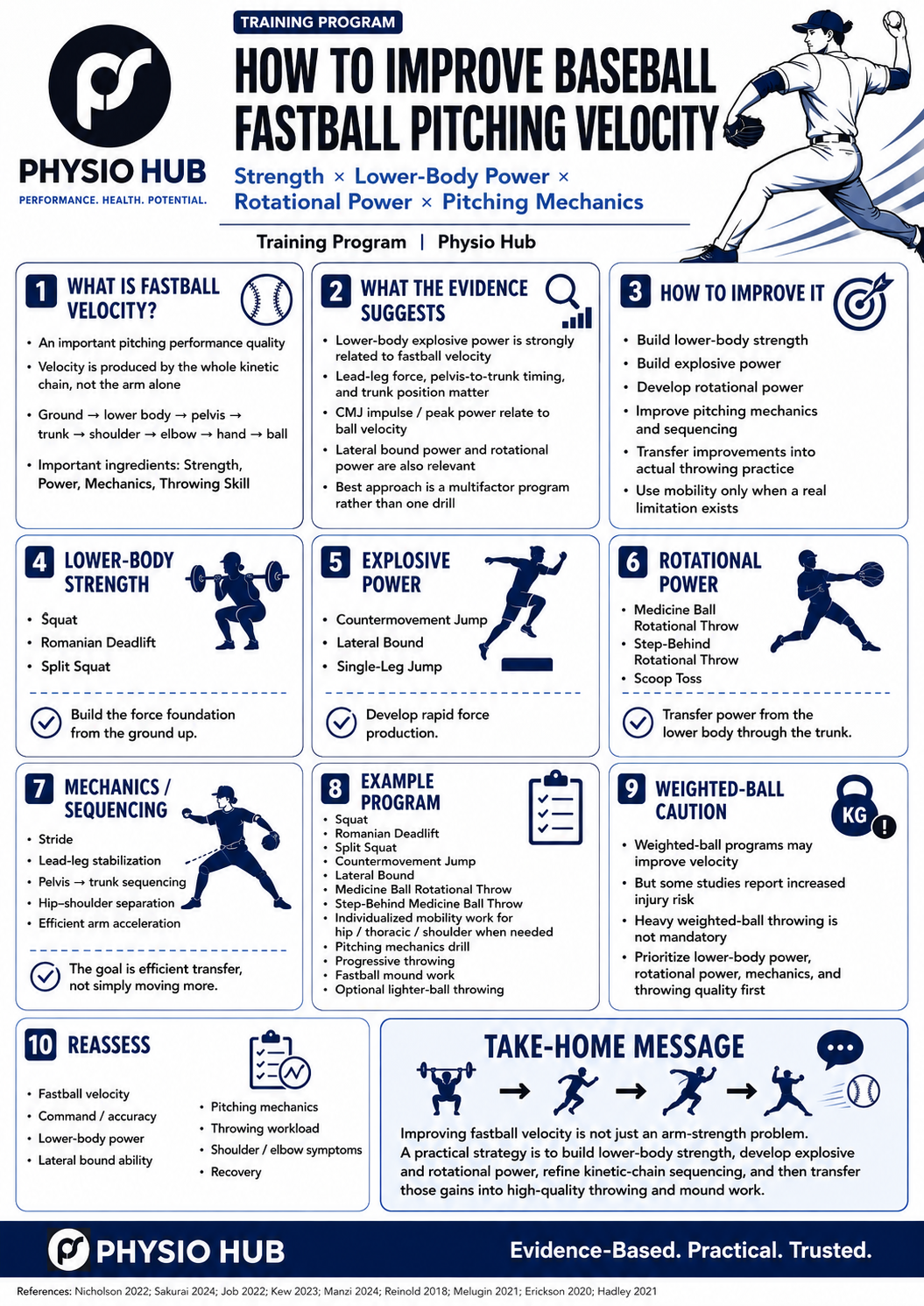
< PDF file>
< Reference >
- Nicholson KF, Collins GS, Waterman BR, Bullock GS. Machine learning and statistical prediction of fastball velocity with biomechanical predictors. J Biomech. 2022;134:110999. doi:10.1016/j.jbiomech.2022.110999.
- Sakurai M, Qiao M, Szymanski DJ, Crotin RL. Countermovement jump and momentum generation associations to fastball velocity performance among Division I collegiate pitchers. J Strength Cond Res. 2024;38(7):1288-1294. doi:10.1519/JSC.0000000000004776.
- Job TDW, Neville J, Cahill MJ, Bourgeois FA, Crotin RL, Cronin JB. Training methods to increase throwing velocity in baseball athletes: a brief review. Strength Cond J. 2022;44(4):1-9. doi:10.1519/SSC.0000000000000694.
- Kew ME, Koo A, Manzi JE, et al. Kinematic parameters predictive of pitch velocity in youth to professional baseball pitchers: a qualitative systematic review. Orthop J Sports Med. 2023;11(11):23259671231196539. doi:10.1177/23259671231196539.
- Manzi JE, Dowling B, Wang Z, et al. An analysis of intrapitch variation in joint and segment velocities with throwing arm kinetics in high school and professional baseball pitchers. Am J Sports Med. 2024;52(7). doi:10.1177/03635465241247546.
- Reinold MM, Macrina LC, Fleisig GS, Aune K, Andrews JR. Effect of a 6-week weighted baseball throwing program on pitch velocity, pitching arm biomechanics, passive range of motion, and injury rates. Sports Health. 2018;10(4):327-333. doi:10.1177/1941738118779909.
- Melugin HP, Smart A, Verhoeven M, Dines JS, Camp CL. The evidence behind weighted ball throwing programs for the baseball player: do they work and are they safe? Curr Rev Musculoskelet Med. 2021;14(1):88-94. doi:10.1007/s12178-020-09686-0.
- Erickson BJ, Atlee TR, Chalmers PN, et al. Training with lighter baseballs increases velocity without increasing the injury risk. Orthop J Sports Med. 2020;8(3):2325967120910503. doi:10.1177/2325967120910503.
- Hadley C, Atlee TR, Chalmers PN, et al. Does velocity increase from flat-ground to mound work during a lighter baseball training program? J Am Acad Orthop Surg. 2021;29(19):827-831. doi:10.5435/JAAOS-D-19-00876.