
Gluteus Medius
A Key Hip Stabilizer for Single-Leg Control and Athletic Movement
The gluteus medius (GMed) is one of the primary hip abductors and plays a major role in controlling the pelvis and femur during single-leg weight-bearing tasks such as running, cutting, jumping, and landing.¹⁻⁴
For athletes, its function goes far beyond simply moving the leg away from the body.
During unilateral loading, the gluteus medius helps maintain pelvic position and control excessive hip adduction and femoral rotation, contributing to lower-extremity alignment and efficient force transfer. Its anterior, middle, and posterior regions also demonstrate somewhat different functional roles, meaning that no single exercise necessarily trains every aspect of gluteus medius function.¹˒⁴
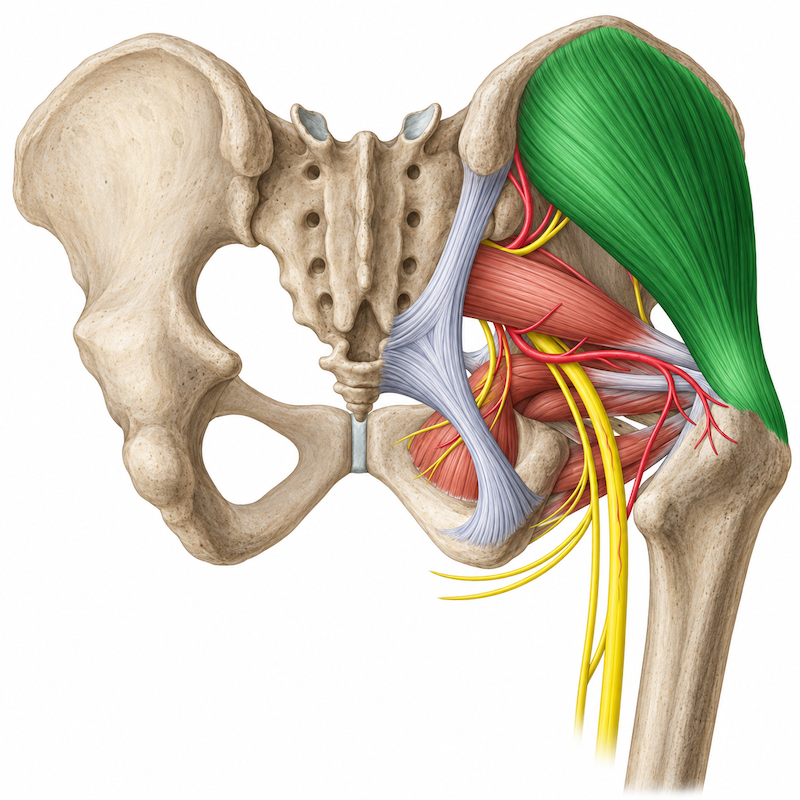
Function and Sports Relevance
Single-Leg Stability
Running, cutting, and single-leg landing all require the athlete to repeatedly support the body on one limb.
During these tasks, the gluteus medius contributes to:
- Pelvic stability
- Control of hip adduction
- Control of femoral rotation
- Lower-extremity alignment
- Force transfer between the lower extremity and trunk¹˒⁵
The posterior portion of the gluteus medius can also contribute to external-rotation control, helping resist excessive femoral internal rotation during functional activity.⁵
Dynamic Knee Valgus
Reduced hip-abductor function can be associated with greater hip adduction, femoral internal rotation, and dynamic knee valgus.
However:
“The knee moves inward = weak gluteus medius”
is too simplistic.
Dynamic knee valgus is influenced by multiple factors, including:
- Hip function
- Ankle function
- Trunk control
- Movement skill
- Fatigue
- External load
The gluteus medius should therefore be viewed as one important contributor within a larger movement system, not the sole explanation for valgus mechanics.¹˒⁵
ACL Relevance
Changes in gluteus medius strength or activation have been reported following ACL injury and reconstruction.
However, the evidence is not uniform.
A 2025 systematic review identified studies demonstrating gluteus medius inhibition or weakness after ACL injury or reconstruction, but other studies found no meaningful deficit.⁶
Therefore, current evidence does not support the simple conclusion that:
“Weak gluteus medius causes ACL injury.”
A more appropriate interpretation is that gluteus medius function represents one component of the proximal neuromuscular control system that may influence lower-extremity mechanics and rehabilitation after ACL injury.
What About the Ankle?
Although the gluteus medius is a hip muscle, its functional influence is not limited to the hip.
Research has also examined gluteus medius activity in people with chronic ankle instability. Current evidence remains somewhat inconsistent, although altered gluteus medius recruitment may be present in some populations.⁷
This highlights an important athletic concept:
the hip, knee, and ankle function as an integrated kinetic chain rather than isolated joints.
Strength and Endurance Are Not the Same
Maximum hip-abductor strength is only one part of gluteus medius function.
In research including 273 youth athletes, performance on a clinical gluteus medius repetition test showed only a weak relationship with maximal isometric hip-abductor torque, suggesting that the tests likely represent different domains—particularly muscle endurance versus maximum strength.⁵
A strong gluteus medius is therefore not necessarily an enduring gluteus medius.
Depending on the sport, athletes may need both.
Anatomy of the Gluteus Medius
Origin
The gluteus medius originates broadly from the:
external surface of the ilium, primarily between the anterior and posterior gluteal lines.¹
It is a fan-shaped muscle whose fibers converge toward the proximal femur.
Insertion
The gluteus medius inserts onto the:
**lateral surface of the greater trochanter of the femur.**¹
This anatomy allows it to generate hip abduction while also stabilizing the pelvis over the femur during single-leg weight bearing.
Primary Actions
Major functions include:
- Hip abduction
- Pelvic stabilization during unilateral stance
- Control of hip adduction
- Rotational control of the femur¹˒⁴
Different Fibers, Different Functions
The gluteus medius can be functionally divided into:
- Anterior fibers
- Middle fibers
- Posterior fibers
The posterior fibers can contribute to external rotation and help resist excessive femoral internal rotation, while the other portions have somewhat different mechanical roles depending on hip position.¹˒⁵
This partly explains why different exercises target different regions of the muscle.
Why Does This Matter for Athletes?
Running repeatedly places the athlete in single-leg stance.
Cutting places large external forces through one leg while the athlete rapidly controls the pelvis, hip, knee, and foot.
Landing requires the same system to absorb force.
Therefore, the athletic role of the gluteus medius is not simply:
“Move the leg out to the side.”
It is:
Control the pelvis and femur while substantial forces are produced and absorbed through one limb.
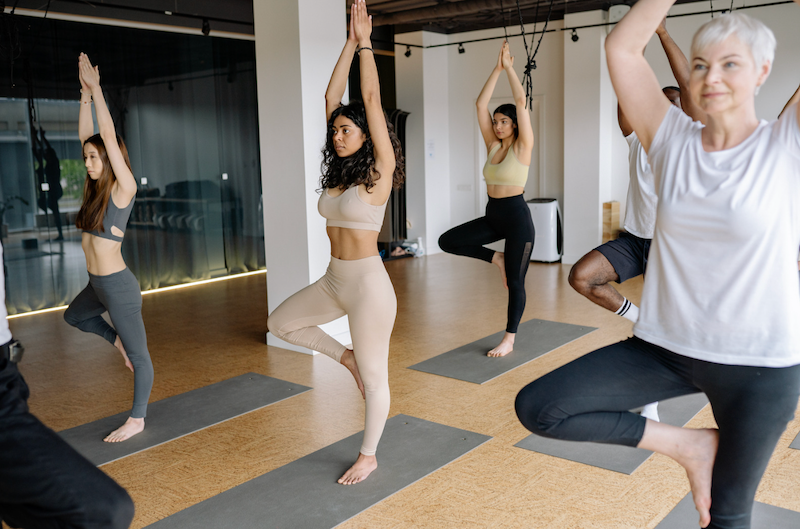
Effective Exercises for the Gluteus Medius
When discussing the “best” gluteus medius exercise, an important distinction must be made:
EMG activation and mechanical muscle force are not the same measurement.
High EMG does not automatically mean an exercise produces the greatest mechanical load.
Exercise selection should therefore depend on the training goal.
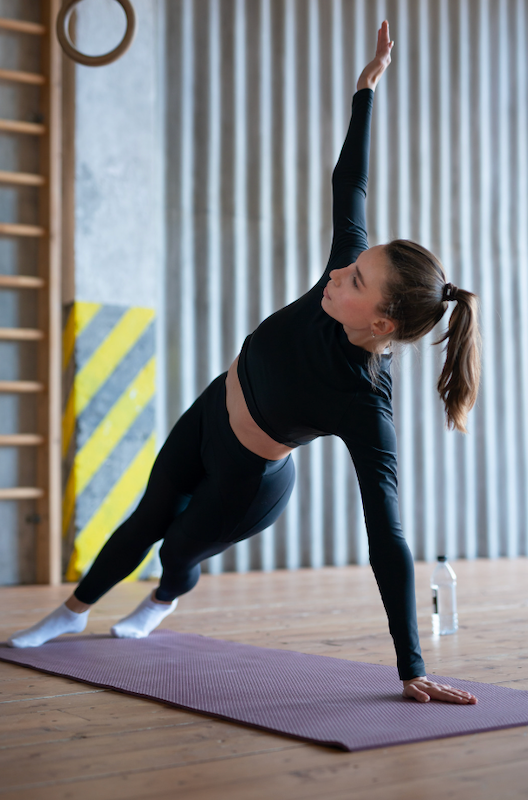
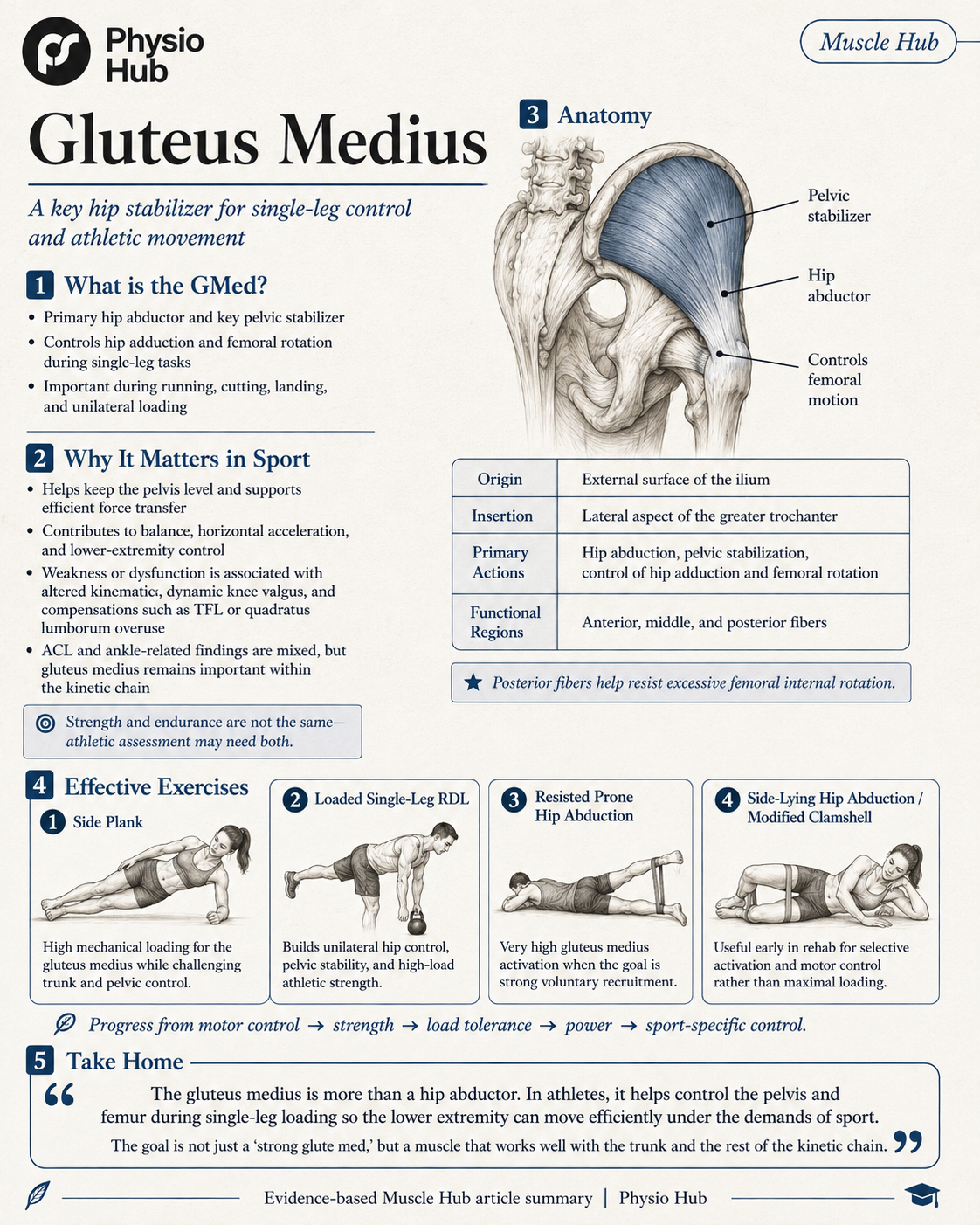
Exercise 1 | Side Plank
Collings and colleagues used an EMG-informed neuromusculoskeletal model to estimate gluteal muscle forces during eight commonly used exercises.
For the gluteus medius, the bodyweight Side Plank was classified as a Tier 1 exercise for peak estimated muscle force.²
Other Tier 1 exercises included:
- Loaded Single-Leg Squat
- Loaded Single-Leg Romanian Deadlift²
Why Is It Effective?
During a Side Plank, the hip abductors must prevent the pelvis from dropping toward the floor.
This allows the gluteus medius to experience substantial loading while working together with the trunk and pelvic stabilizers.
Exercise 2 | Single-Leg Romanian Deadlift
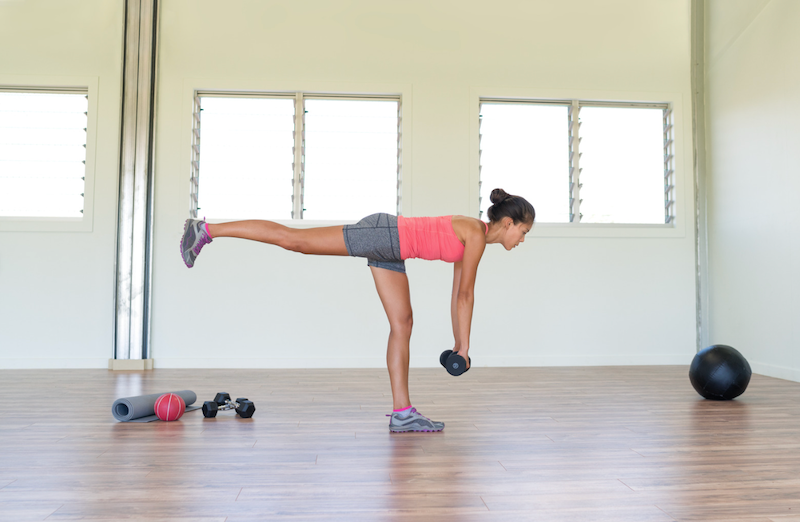
The loaded Single-Leg Romanian Deadlift was also a Tier 1 exercise for estimated gluteus medius force.²
Why Is It Useful for Athletes?
The Single-Leg RDL simultaneously challenges:
- Hip hinging
- Single-leg stability
- Pelvic rotational control
- Hip-adduction control
Adding external resistance further increases gluteal muscle force.²
It therefore provides an excellent transition from isolated hip-abduction exercises toward high-load unilateral athletic function.
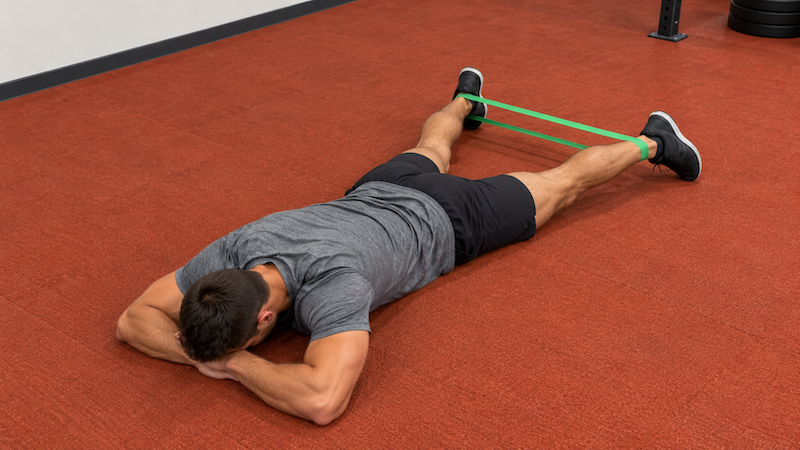
Exercise 3 | Resisted Prone Hip Abduction
If the goal is specifically high EMG activation, research provides a different perspective.
Goller and colleagues compared four gluteus medius exercises in 24 resistance-trained participants.
Resisted Prone Hip Abduction produced the highest mean peak gluteus medius activity at approximately 149% MVIC and significantly exceeded:
- Resisted Side-Stepping
- Side-Plank with Leg Abduction
- Isometric Clam³
This makes it an option when high voluntary gluteus medius recruitment is the primary training goal.
Early Rehabilitation |
Side-Lying Hip Abduction and Clamshell
Early rehabilitation does not always require maximum loading.
The Side-Lying Hip Abduction is simple and can help athletes learn to generate hip abduction while maintaining pelvic control.
A 2025 study in individuals with gluteus medius weakness compared several hip-abduction and side-bridge variations and supported side-lying hip abduction as a useful option when trying to recruit the gluteus medius while limiting excessive quadratus lumborum compensation.⁹
The Modified Clamshell can also be used for motor-control training.
A 2026 study found favorable gluteus medius-to-TFL and gluteus medius-to-quadratus-lumborum activation ratios around 90° of knee flexion.¹⁰
However, because its absolute loading is relatively low, the Clamshell is better considered an early motor-control exercise than an end-stage strength exercise.
Sport-Specific Progression
Once sufficient strength has been developed, athletes should progress toward tasks that resemble sporting demands.
Research comparing plyometric exercises found particularly high gluteus medius activity during:
- Single-Leg Frontal Plane Hop
- Single-Leg Sagittal Plane Hop¹¹
Lateral Band Walks and Monster Walks can also be useful. A 2025 review reported moderate-to-high gluteal activation, particularly when the band was positioned around the ankles or forefeet and the exercise was performed in a semi-squat posture.¹²
Practical Progression
One possible progression is:
Modified Clamshell / Side-Lying Hip Abduction
↓
Lateral Band Walk
↓
Side Plank
↓
Loaded Single-Leg Squat / Single-Leg RDL
↓
Single-Leg Hopping and Landing
↓
Sprinting / Cutting / Change of Direction
The goal is to progressively move from:
Motor Control → Strength → Load Tolerance → Power → Sport-Specific Control
rather than performing low-level “glute activation” exercises indefinitely.
< Take-Home Message >
The gluteus medius is much more than a hip-abduction muscle.
For athletes, it contributes to:
pelvic stability, control of hip adduction and femoral rotation, single-leg force transfer, and lower-extremity movement control.
When high mechanical loading is the goal, strong options include:
**Side Plank, Loaded Single-Leg Squat, and Loaded Single-Leg Romanian Deadlift.**²
When high EMG activation is desired, Resisted Prone Hip Abduction is another excellent option.³
Side-Lying Hip Abduction and Modified Clamshell variations can be useful earlier in rehabilitation, while unilateral loaded and plyometric exercises become increasingly important as the athlete progresses.
The ultimate goal is not simply to develop a:
“strong gluteus medius.”
It is to develop a muscle that can work with the trunk, other gluteal muscles, thigh musculature, and the rest of the kinetic chain to control the pelvis and femur under the speed and forces of sport.
< PDF file>
< Reference >
- Baik SM, Shin HS, Kim SH. Understanding and exercise of gluteus medius weakness: a systematic review. Phys Ther Korea. 2021;28(1):27-35. doi:10.12674/ptk.2021.28.1.27.
- Collings TJ, Bourne MN, Barrett RS, et al. Gluteal muscle forces during hip-focused injury prevention and rehabilitation exercises. Med Sci Sports Exerc. 2023;55(4):650-660. doi:10.1249/MSS.0000000000003091.
- Goller M, Quittmann OJ, Alt T. How to activate the glutes best? Peak muscle activity of acceleration-specific pre-activation and traditional strength training exercises. Eur J Appl Physiol. 2024;124:1757-1769. doi:10.1007/s00421-023-05400-3.
- Moore D, Semciw AI, Pizzari T. A systematic review and meta-analysis of common therapeutic exercises that generate highest muscle activity in the gluteus medius and gluteus minimus segments. Int J Sports Phys Ther. 2020;15(6):856-881. doi:10.26603/ijspt20200856.
- Teixeira ASS, Silva PL, Cintra SP, Viegas F, Mendonça LD, Bittencourt NFN. Concurrent validation and reference values of gluteus medius clinical test. Int J Sports Phys Ther. 2021;16(2):335-341. doi:10.26603/001c.21477.
- Tarchichi J, Zalaket J, Graveleau N, Laboudie P, Bouguennec N. Evidence for arthrogenic inhibition of the gluteus medius after anterior cruciate ligament injury: a systematic review. J Exp Orthop. 2025;12(4):e70551. doi:10.1002/jeo2.70551.
- Luan L, Xia Z, Adams R, et al. Gluteus medius for individuals with chronic ankle instability: assessing muscle activity. J Hum Kinet. 2024;94:5-21. doi:10.5114/jhk/190267.
- Ebert JR, Edwards PK, Fick DP, Janes GC. A systematic review of rehabilitation exercises to progressively load the gluteus medius. J Sport Rehabil. 2017;26(5):418-436. doi:10.1123/jsr.2016-0088.
- Jung KH, Moon IY, Lim OB, Yi CH. Comparison of gluteus medius and quadratus lumborum muscle activity during hip abduction exercises in individuals with gluteus medius weakness. Phys Ther Korea. 2025;32(2):111-120. doi:10.12674/ptk.2025.32.2.111.
- Lee HY, Zhang YH, Kim KC, Lim HW. Effects of knee flexion angle on gluteus medius activation and activation ratios during the modified clamshell exercise. Medicina (Kaunas). 2026;62(6):1025. doi:10.3390/medicina62061025.
- Pourmahmoudian P, Minoonejad H, Jamshidi AA. Comparison of gluteus medius and hamstring activation during seven plyometric exercises on three training surfaces. Physiother Quart. 2023;31(1):65-72. doi:10.5114/pq.2023.123529.
- González-de-la-Flor Á. Optimizing hip abductor strengthening for lower extremity rehabilitation: a narrative review on the role of monster walk and lateral band walk. J Funct Morphol Kinesiol. 2025;10(3):294. doi:10.3390/jfmk10030294.
- Stastny P, Tufano JJ, Golas A, Petr M. Strengthening the gluteus medius using various bodyweight and resistance exercises. Strength Cond J. 2016;38(3):91-101. doi:10.1519/SSC.0000000000000221.
- Oh S, Kim Y, Han J. Immediate effect of posture-dependent and weight-bearing gluteus medius exercise on muscle function in the lower extremities and dynamic knee valgus. Isokinet Exerc Sci. 2025;33(1):46-57. doi:10.3233/IES-240045.