
Dead Bug
A Core-Stability Exercise for Controlling the Trunk and Pelvis During Limb Movement
The Dead Bug is a supine core-stability exercise in which the athlete maintains control of the trunk and pelvis while moving the extremities, typically beginning with the hips and knees near 90° and the arms directed toward the ceiling.¹
Its primary purpose is not simply to “contract the abs.”
The goal is to:
maintain lumbopelvic control while the arms and legs move.
This makes the exercise useful as a bridge between isolated trunk training and more complex athletic movements in which the extremities generate force while the trunk provides an appropriately controlled foundation.¹
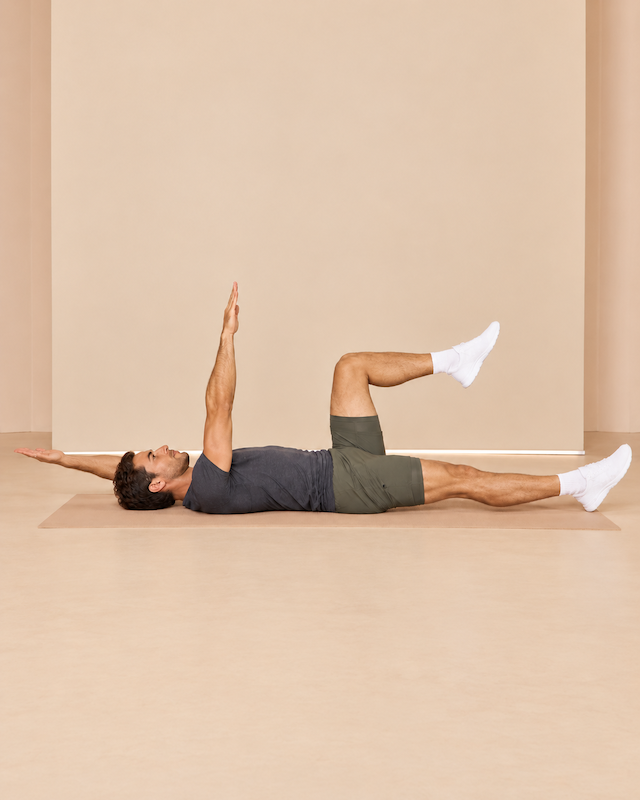
Exercise Overview
The standard Dead Bug begins in a supine 90/90 position:
- Hips flexed approximately 90°
- Knees flexed approximately 90°
- Arms extended toward the ceiling
- Trunk and pelvis maintained in a controlled position
The athlete then extends:
one arm + the opposite leg
without allowing excessive lumbar extension, pelvic rotation, or loss of trunk position.
Conceptually, the Dead Bug primarily challenges the athlete to resist an extension moment at the lumbar spine while coordinating contralateral limb movement.
It therefore combines:
Limb Mobility + Trunk Stability.
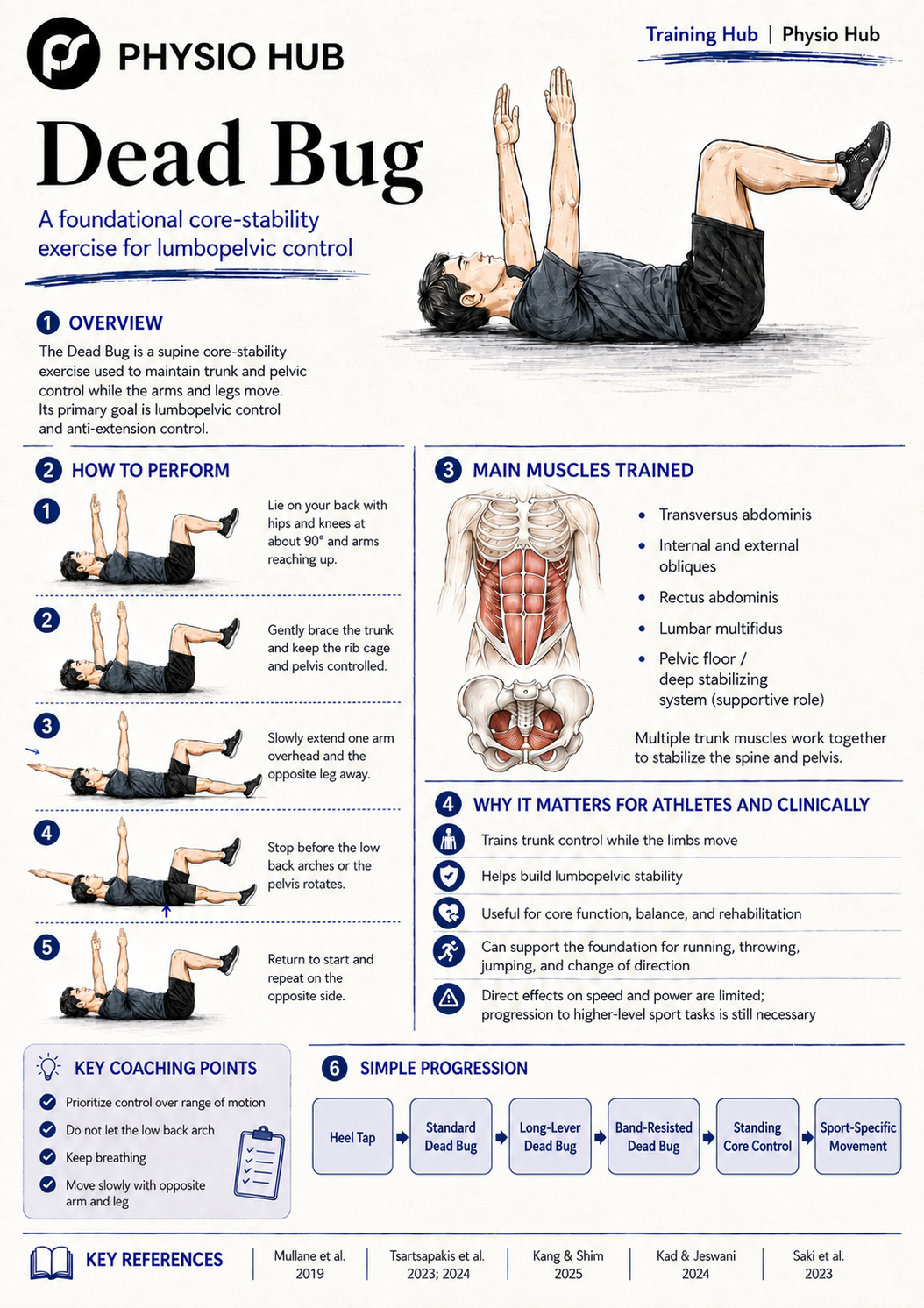
How to Perform the Dead Bug
Step 1 | Set the Starting Position
Lie on your back.
Lift both legs so the hips and knees are each flexed to approximately 90°.
Reach both arms toward the ceiling so the hands are positioned approximately over the shoulders.¹
Step 2 | Establish Trunk Control
Gently brace the abdominal wall and position the rib cage over the pelvis.
The goal is not necessarily to forcefully flatten the lumbar spine.
Instead:
maintain a controlled lumbar position without allowing the low back to progressively arch as the limbs move.
Continue breathing rather than using a prolonged breath hold.
Step 3 | Extend the Opposite Arm and Leg
Slowly reach one arm overhead while extending the opposite leg away from the body.
For example:
Right arm + Left leg
Move only as far as you can while maintaining:
- Lumbar control
- Pelvic position
- Rib position
- Smooth breathing
Step 4 | Stop at the Limit of Control
The hand and heel do not need to reach the floor.
If the lumbar spine begins to extend or the pelvis begins to rotate, the lever has become too challenging.
Reduce the range, keep the knee more flexed, or regress to arm-only or leg-only movement.
Step 5 | Return and Alternate
Slowly return to the 90/90 starting position.
Reset the trunk if necessary, then repeat with the opposite arm and leg.
The key principle is:
quality of lumbopelvic control is more important than range of motion.
What Muscles Does the Dead Bug Train?
The Dead Bug is not an isolation exercise.
Multiple muscles work together to stabilize the trunk while the extremities move.
Transversus Abdominis
The transversus abdominis (TrA) is a deep abdominal muscle involved in lumbopelvic stabilization.
In a study comparing five Pilates-based trunk exercises, the Dead Bug produced the largest relative increase in TrA thickness among the exercises tested.³
This supports the Dead Bug as a useful exercise for recruiting the TrA.
However, ultrasound thickness is an indirect measure of muscle activation and should not be interpreted to mean that the Dead Bug selectively strengthens only the TrA.
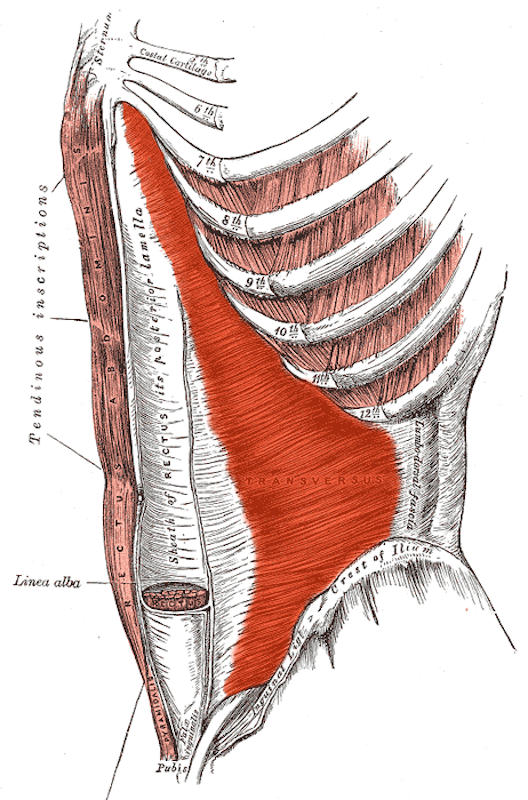
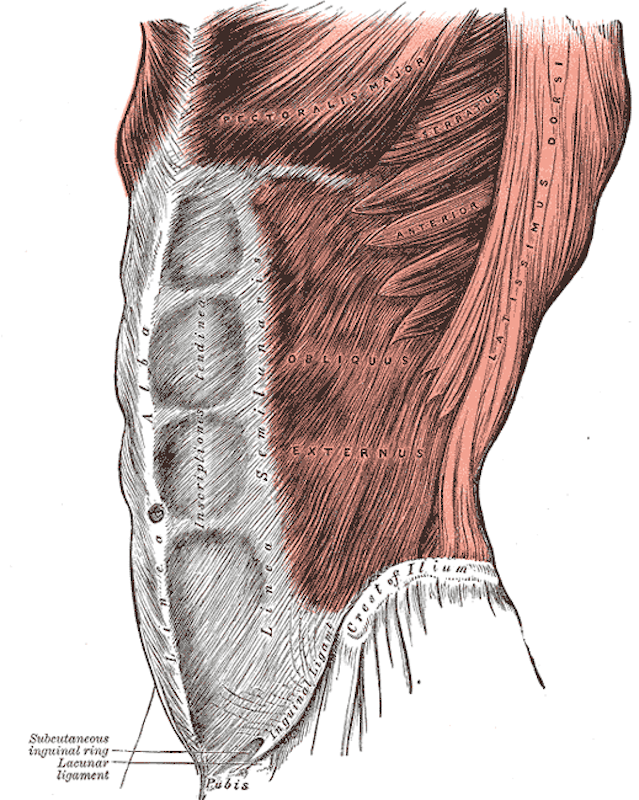
Internal and External Obliques
The obliques contribute to abdominal pressure, rotational control, and stabilization of the rib cage and pelvis.
Because the Dead Bug involves contralateral arm and leg movement, the trunk must resist unwanted rotation.
Surface-EMG research found greater rectus abdominis, external oblique, and internal oblique activity when both the upper and lower extremities were incorporated into the Dead Bug compared with upper- or lower-extremity-only variations.²
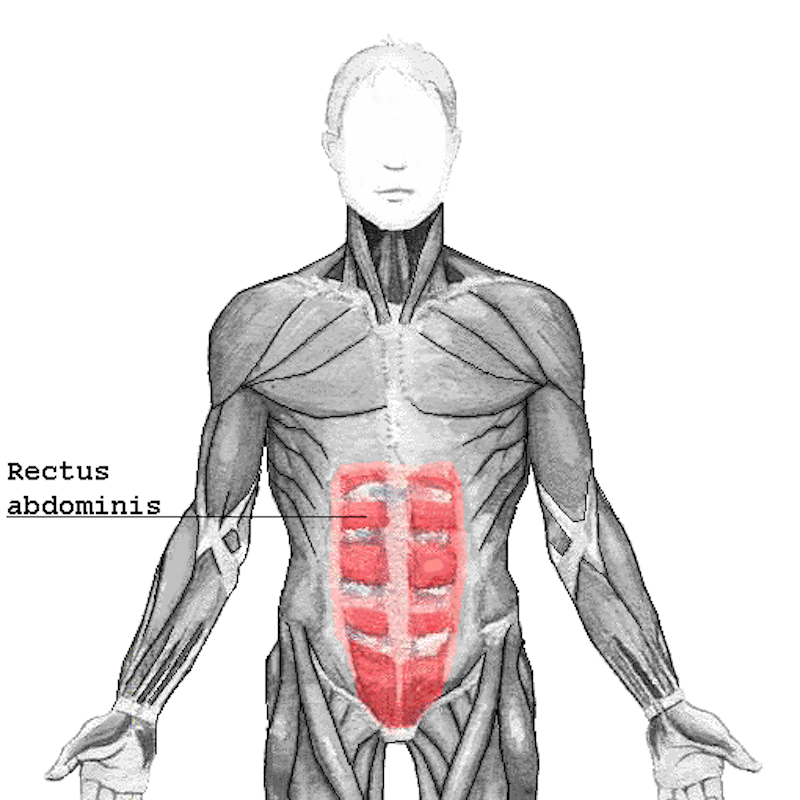
Rectus Abdominis
The rectus abdominis helps resist the lumbar-extension demand created as the limbs move farther from the body.
Unlike a crunch, however, the objective is not repeated spinal flexion.
The muscle contributes largely to:
maintaining trunk position while the extremities move.
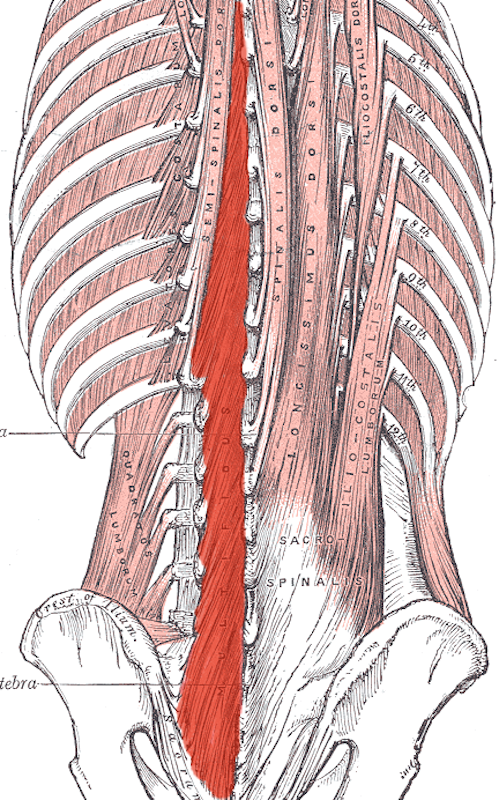
Lumbar Multifidus
The multifidus is an important posterior stabilizer of the lumbar spine.
Ultrasound research comparing common core-stability exercises has demonstrated changes in lumbar multifidus thickness during Dead Bug and other stabilization tasks.⁴
Therefore, the Dead Bug is better understood as a coordinated trunk-stability exercise than simply an abdominal exercise.
The pelvic floor, diaphragm, and spinal extensors also participate within the broader pressure and trunk-control system, although direct evidence that a standard Dead Bug preferentially strengthens each of these structures is more limited.
Clinical Relevance
Lumbopelvic Control
The major clinical value of the Dead Bug is that it challenges the patient or athlete to:
move the hips and shoulders without unnecessarily moving the lumbar spine and pelvis.
This makes it useful for developing:
- Lumbopelvic motor control
- Trunk endurance
- Limb-trunk dissociation
- Early-to-intermediate core stabilization
- Progressive return to more demanding movement
The exercise is commonly used in rehabilitation, including low-back rehabilitation, but direct evidence showing that the Dead Bug by itself treats low back pain is limited.
It should therefore be viewed as one exercise option within a broader rehabilitation strategy, not a diagnosis-specific treatment.
Why It Matters for Athletes
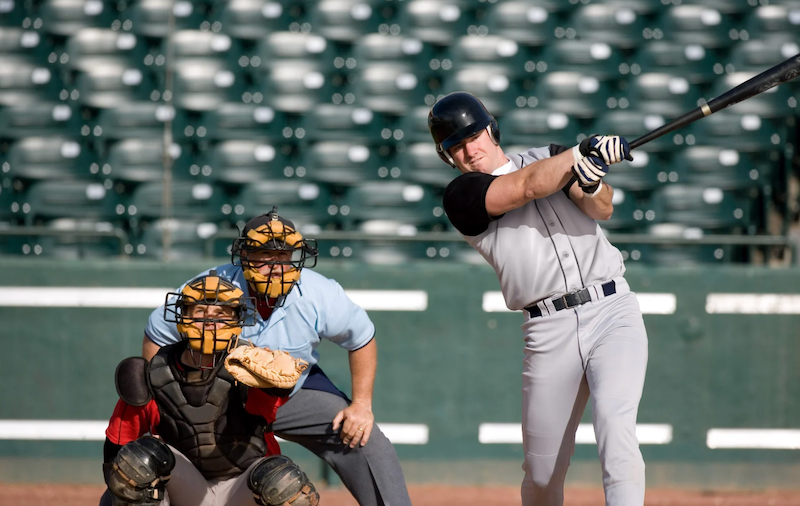
Athletic movement rarely occurs with the trunk completely motionless.
Instead, the athlete needs an appropriate amount of trunk control while the extremities rapidly produce and absorb force.
The Dead Bug provides a relatively low-load environment in which this fundamental skill can be developed.
Balance and Agility
A 4-week intervention in adolescent badminton players reported improvements in dynamic balance and agility following Dead Bug training.⁷
Core Function
A controlled study in young adults found improvements in measures of core stability following Dead Bug training, with benefits in strength, endurance, and flexibility compared with abdominal-crunch training.⁶
Rehabilitation and Lower-Extremity Control
The Dead Bug itself was not isolated in this study, but an 8-week core-stabilization program in athletes after ACL reconstruction improved core endurance, hip strength, and landing mechanics.⁸
This supports the broader concept that trunk control can be relevant when rebuilding integrated lower-extremity function.
Does the Dead Bug Improve Sports Performance?
This is where claims should remain conservative.
A meta-analysis of randomized trials found that core training had substantial effects on core endurance and balance, but little overall effect on speed or power, with inconsistent effects on more sport-specific outcomes.¹¹
Reviews of core stability and athletic function reach a similar conclusion: trunk control is clearly relevant to human movement, but transfer from isolated core exercises to specific competitive performance is complex and not guaranteed.¹²
Therefore, the Dead Bug should not be presented as an exercise that directly makes an athlete:
faster, more powerful, or a better jumper.
Its role is better described as developing a foundational trunk-control capacity that can later be integrated into higher-level athletic tasks.
Practical Progression
Arm Only / Heel Tap
↓
Standard Contralateral Dead Bug
↓
Long-Lever Dead Bug
↓
Band- or Load-Resisted Dead Bug
↓
Standing / Loaded Core Control
↓
Running, Throwing, Jumping, and Change of Direction
The goal is not to become exceptionally good at lying on the floor performing Dead Bugs.
The goal is to develop the required control and then transfer it progressively into loaded, upright, faster, and sport-specific movement.
< Take-Home Message >
The Dead Bug is a **core-stability exercise designed to train control of the lumbar spine and pelvis while the extremities move.**¹
It recruits several trunk muscles, including the transversus abdominis, internal and external obliques, rectus abdominis, and lumbar multifidus.²⁻⁴
Its major clinical and athletic value is therefore not simply:
“strengthening the abs.”
It is teaching the athlete to:
control the trunk while independently moving the arms and legs.
Dead Bug training can improve core function and may support balance and rehabilitation, but direct transfer to speed, power, or sport performance is less established.⁶˒⁷˒¹¹
For athletes, the Dead Bug is best considered a foundation—not the final destination.
Once control is established, training should progress toward the standing, loaded, high-speed, and sport-specific environments in which that trunk control is actually required.
< PDF file>
< Reference >
- Mullane M, Turner AN, Bishop C. Exercise technique: the dead bug. Strength Cond J. 2019;41(5):114-120. doi:10.1519/SSC.0000000000000455.
- Yun BG, Lee SJ, So HJ, Shin WS. Changes in muscle activity of the abdominal muscles according to exercise method and speed during dead bug exercise. Phys Ther Rehabil Sci. 2017;6(1):1-6. doi:10.14474/ptrs.2017.6.1.1.
- Tsartsapakis I, Gerou M, Zafeiroudi A, Kellis E. Transversus abdominis ultrasound thickness during popular trunk-Pilates exercises in young and middle-aged women. J Funct Morphol Kinesiol. 2023;8(3):110. doi:10.3390/jfmk8030110.
- Tsartsapakis I, Bagioka I, Fountoukidou F, Kellis E. A comparison between core stability exercises and muscle thickness using two different activation maneuvers. J Funct Morphol Kinesiol. 2024;9(2):70. doi:10.3390/jfmk9020070.
- Kang HJ, Shim J. Effect of Kegel and dead-bug exercises combined with the abdominal draw-in maneuvers on abdominal muscle thickness in young adults. Korean J Neuromuscul Rehabil. 2025;15(3):122-132. doi:10.37851/kjnr.2025.15.3.13.
- Ikele CN, Ikele IT, Ojukwu CP, et al. Comparative analysis of the effects of abdominal crunch exercise and dead bug exercise on core stability of young adults. Niger J Med. 2020;29(4):680-687. doi:10.4103/NJM.NJM_85_20.
- Kad P, Jeswani K. Effect of dead bug exercises on dynamic balance and agility among adolescent badminton players at the end of four weeks—an experimental study. Int J Health Sci Res. 2024;14(8):140-147. doi:10.52403/ijhsr.20240819.
- Saki F, Shafiee H, Tahayori B, Ramezani F. The effects of core stabilization exercises on the neuromuscular function of athletes with ACL reconstruction. Sci Rep. 2023;13:2202. doi:10.1038/s41598-023-29126-6.
- Strutzenberger G, Ellenberger L, Bruhin B, Frey WO, Scherr J, Spörri J. Deadbug bridging performance in 6- to 15-year-old competitive alpine skiers—a cross-sectional study. Biology (Basel). 2022;11(2):329. doi:10.3390/biology11020329.
- Hanimann J, Ellenberger L, Bernhard T, et al. More than just a side effect: dynamic knee valgus and deadbug bridging performance in youth soccer players and alpine skiers have similar absolute values and asymmetry magnitudes but differ in terms of the direction of laterality. Front Physiol. 2023;14:1129351. doi:10.3389/fphys.2023.1129351.
- Dong K, Yu T, Chun B. Effects of core training on sport-specific performance of athletes: a meta-analysis of randomized controlled trials. Behav Sci (Basel). 2023;13(2):148. doi:10.3390/bs13020148.
- Zemková E, Zapletalová L. The role of neuromuscular control of postural and core stability in functional movement and athlete performance. Front Physiol. 2022;13:796097. doi:10.3389/fphys.2022.796097.