
How to Improve Tennis Serve Velocity
A Practical Strength + Plyometric + Whole-Chain Power + Serve-Specific Training Program
What Is Serve Velocity, and Why Does It Matter?
The serve is unique in tennis because the player initiates the stroke rather than reacting to an opponent’s shot.
Greater serve velocity can reduce the opponent’s reaction time and potentially create a stronger offensive advantage on service points.
But a fast serve is not simply an expression of shoulder or arm strength.
The tennis serve is a whole-body kinetic-chain action:
Leg Drive → Hip/Pelvis → Trunk → Shoulder → Arm → Racket
Physical qualities associated with serve velocity include:
- Lower-body force production
- Maximal strength
- Rate of force development
- Impulse
- Shoulder strength and power
- Whole-body coordination²,³
Serve-specific isometric strength, RFD, and early impulse have all demonstrated meaningful relationships with serve velocity in young players.³
The goal is therefore to improve the athlete’s ability to produce force throughout the body and transfer it rapidly into racket speed.
How Can Serve Velocity Be Improved?
Build Whole-Body Strength
A 2025 systematic review and meta-analysis of 16 randomized trials found that resistance training significantly improved serve speed, while multimodal strength-and-conditioning programs demonstrated a larger overall effect. Core training alone did not significantly improve serve speed.¹
Practical strength exercises may include:
- Squat
- Split Squat
- Romanian Deadlift
- Upper-body push and pull exercises
The goal is not to isolate one “serve muscle,” but to build the force capacity of the full kinetic chain.
Develop Explosive Leg Drive
The legs contribute to racket acceleration through the forces produced against the court.
Importantly, force timing appears to matter as much as simply generating large force.
Competitive players with better synchronization between vertical and forward ground-reaction forces demonstrated higher maximal racket velocity.⁴
Useful explosive exercises include:
- Countermovement Jump
- Jump Squat
- Split-Squat Jump
The practical objective is to develop the ability to apply force rapidly and in coordination with the rest of the serve.
Develop Serve-Specific Rotational Power
Medicine-ball exercises provide a useful bridge between general strength and the serve.
In male competitive tennis players, a multisegmental medicine-ball shot-put test was the strongest field-test predictor of serve velocity in one study.⁵
Useful exercises may include:
- Medicine-Ball Serve Throw
- Rotational Medicine-Ball Throw
- Step-In Shot-Put Throw
- Overhead Medicine-Ball Throw
The emphasis should be on transferring power through:
Legs → Pelvis → Trunk → Upper Extremity
rather than throwing primarily with the arm.
Build Shoulder Strength and High-Velocity Power
Upper-extremity strength and power also matter.
Six weeks of joint-specific isometric shoulder training increased serve velocity by 7.0% without reducing serve accuracy in young competitive tennis players.⁶
A separate 6-week flywheel resistance program produced an approximately 4.7% improvement in serve velocity without an accuracy decrement.⁷
Eight weeks of upper-limb plyometric training also improved upper-extremity strength, power, and serve velocity in male youth players.⁸
This supports integrating:
- Serve-position shoulder internal-rotation strength
- Shoulder force-development training
- Upper-limb plyometrics
within the broader whole-body program.
Improve Serve Mechanics
More physical capacity only helps if the athlete can transfer it into the serve.
Important technical considerations include:
- Leg drive
- Knee flexion and extension
- Pelvis and trunk rotation
- Segment sequencing
- Toss and impact position
A randomized trial in junior players found that specifically training greater knee flexion during the serve increased racket velocity while not increasing shoulder internal-rotation or elbow-extension velocity.⁹ This suggests that improving lower-body contribution may enhance performance without simply asking the arm to move faster.
However, this should not be interpreted as:
“More knee flexion is always better.”
Technique should be individualized to the athlete.
Practice the Actual Serve
Strength and power gains must eventually transfer to tennis.
A practical progression is:
General Physical Training
→ Serve-Like Power Exercise
→ Serve Mechanics
→ High-Intent Serving
Velocity should also be trained alongside accuracy.
A faster serve that cannot consistently reach the intended service area is not necessarily a better competitive serve.
What About Mobility?
Mobility work can be included when a meaningful restriction limits the player’s serve mechanics.
Potential areas include:
- Shoulder rotation
- Thoracic rotation and extension
- Hip mobility
- Ankle mobility
However, the evidence provided for this article supports strength, power, and multimodal training more directly than mobility training as a stand-alone velocity intervention.
Mobility should therefore be treated as an individualized supporting component, not the primary strategy for increasing serve speed.

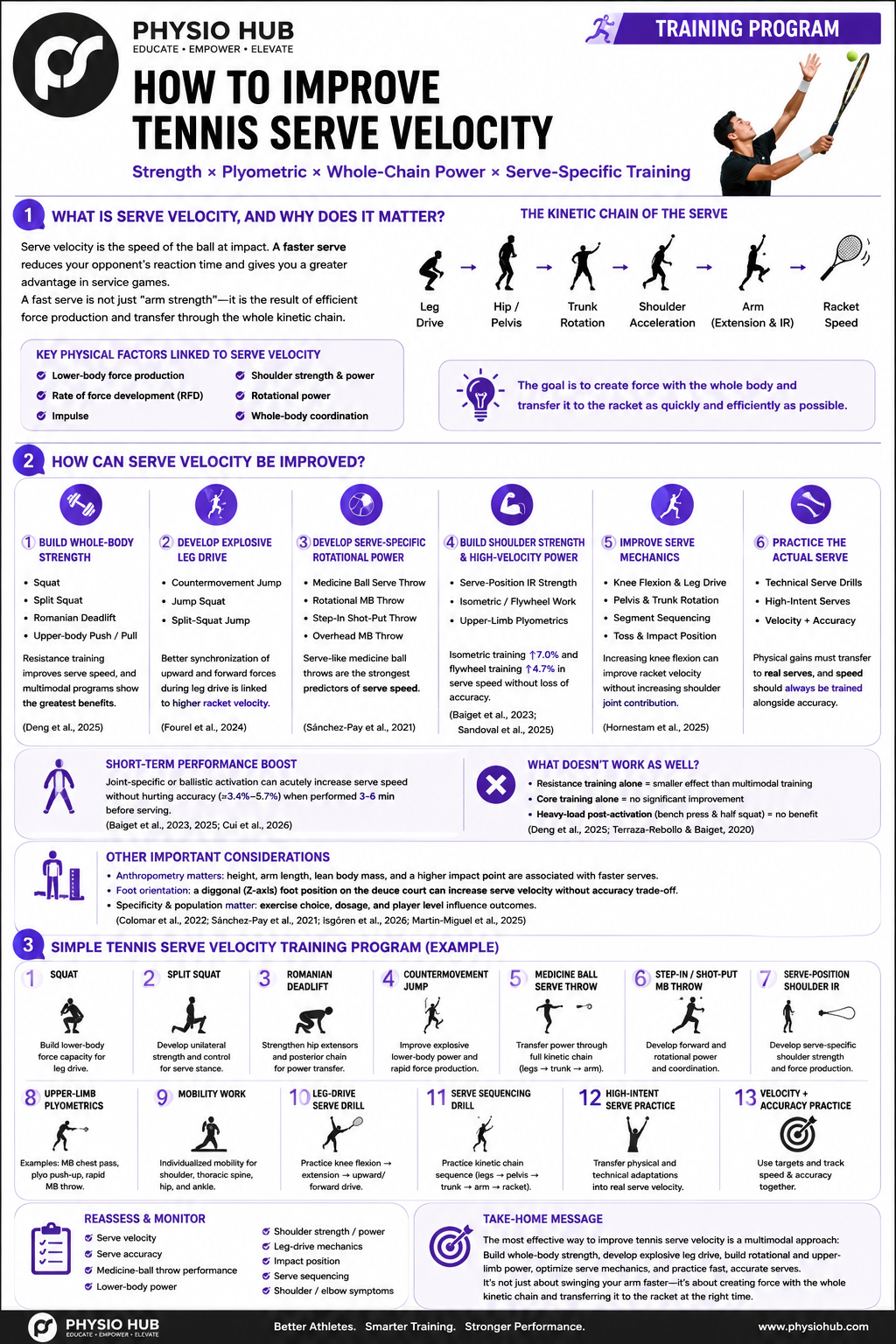
Simple Tennis Serve Velocity Training Program
This is an example framework, not one universally optimal program.
- Squat
Goal: Build lower-body force capacity for leg drive.
- Split Squat
Goal: Develop unilateral lower-body strength and control.
- Romanian Deadlift
Goal: Develop hip-extensor and posterior-chain strength.
- Countermovement Jump
Goal: Improve explosive lower-body force production.
- Medicine-Ball Serve Throw
Goal: Transfer power through the full serve-like kinetic chain.
- Step-In / Shot-Put Medicine-Ball Throw
Goal: Develop forward and rotational power.
- Serve-Position Shoulder Internal Rotation
Use a band, cable, or other appropriate resistance.
Goal: Develop serve-specific shoulder force production.
- Upper-Limb Plyometric Exercise
Examples:
- Medicine-Ball Chest Pass
- Plyometric Push-Up
- Rapid Medicine-Ball Throw
Goal: Develop rapid upper-extremity force production.
- Individualized Mobility Work
Address shoulder, thoracic, hip, or ankle mobility only when a relevant restriction exists.
Goal: Provide enough motion for effective serve mechanics.
- Leg-Drive Serve Drill
Practice:
Knee Flexion → Extension → Upward/Forward Drive
Goal: Transfer lower-body power into the serve.
- Serve Sequencing Drill
Practice the progression:
Legs → Pelvis/Trunk → Arm → Racket
at controlled speed before increasing intent.
Goal: Improve kinetic-chain timing.
- High-Intent Serve Practice
Goal: Transfer physical and technical adaptations into actual serve velocity.
- Velocity + Accuracy Practice
Use targets while monitoring serve speed.
Goal: Build a serve that is both fast and usable in competition.
Reassess
Monitor:
- Serve velocity
- Serve accuracy
- Medicine-ball throw performance
- Lower-body power
- Shoulder strength/power
- Leg-drive mechanics
- Impact position
- Serve sequencing
- Shoulder or elbow symptoms
< Take-Home Message >
Improving tennis serve velocity is not simply a matter of strengthening the shoulder or repeatedly serving at maximum effort.
A practical evidence-based pathway is:
Build Whole-Body Strength
→ Develop Explosive Leg Drive
→ Develop Rotational & Upper-Limb Power
→ Optimize Serve Mechanics
→ Practice Fast and Accurate Serves
The strongest general evidence currently favors a multimodal program, because a powerful serve depends on producing force throughout the kinetic chain and transferring that force efficiently into racket speed.¹⁻⁹
< PDF file>
< Reference >
- Deng N, Soh KG, Xu F, Yang X. The effects of strength and conditioning interventions on serve speed in tennis players: a systematic review and meta-analysis. Front Physiol. 2025;15:1469965. doi:10.3389/fphys.2024.1469965.
- Colomar J, Corbi F, Brich Q, Baiget E. Determinant physical factors of tennis serve velocity: a brief review. Int J Sports Physiol Perform. 2022;17(8):1159-1169. doi:10.1123/ijspp.2022-0091.
- Colomar J, Corbi F, Baiget E. Relationship between isometric force-time curve variables and serve velocity in young tennis players. Sports Biomech. 2024;23(12):3009-3021. doi:10.1080/14763141.2022.2084151.
- Fourel L, Touzard P, Fadier M, et al. Relationships between force-time curve variables and tennis serve performance in competitive tennis players. J Strength Cond Res. 2024;38(9):1667-1674. doi:10.1519/JSC.0000000000004848.
- Sánchez-Pay A, Ramón-Llin J, Martínez-Gallego R, Sanz-Rivas D, Sánchez-Alcaraz BJ, Frutos S. Fitness testing in tennis: influence of anthropometric characteristics, physical performance, and functional test on serve velocity in professional players. PLoS One. 2021;16(11):e0259497. doi:10.1371/journal.pone.0259497.
- Baiget E, Colomar J, Corbi F. Six-week joint-specific isometric strength training improves serve velocity in young tennis players. Int J Sports Physiol Perform. 2023;18(2):148-156. doi:10.1123/ijspp.2022-0292.
- Sandoval I, Colomar J, Corbi F, Baiget E. Effects of 6-week flywheel resistance training on tennis serve velocity and accuracy. J Sports Med Phys Fitness. 2025;65(12):1590-1598. doi:10.23736/S0022-4707.25.16732-7.
- Wang J, Xu Q. Single-session upper limb plyometric training is as effective as two sessions for improving muscle strength, power, and serve velocity in male youth tennis players: a randomized parallel controlled study. Front Psychol. 2025;16:1539739. doi:10.3389/fpsyg.2025.1539739.
- Hornestam JF, Souza TR, Magalhães FA, Begon M, Elliott B, Fonseca ST. Training junior tennis players to increase knee flexion improves their service performance. Sports Biomech. 2026;25(5):643-658. doi:10.1080/14763141.2025.2568220.