
How to Improve First-Step Acceleration in Sports
A Practical Strength + Power + Mechanics + Sport-Specific Acceleration Program

What Is First-Step Acceleration, and Why Does It Matter?
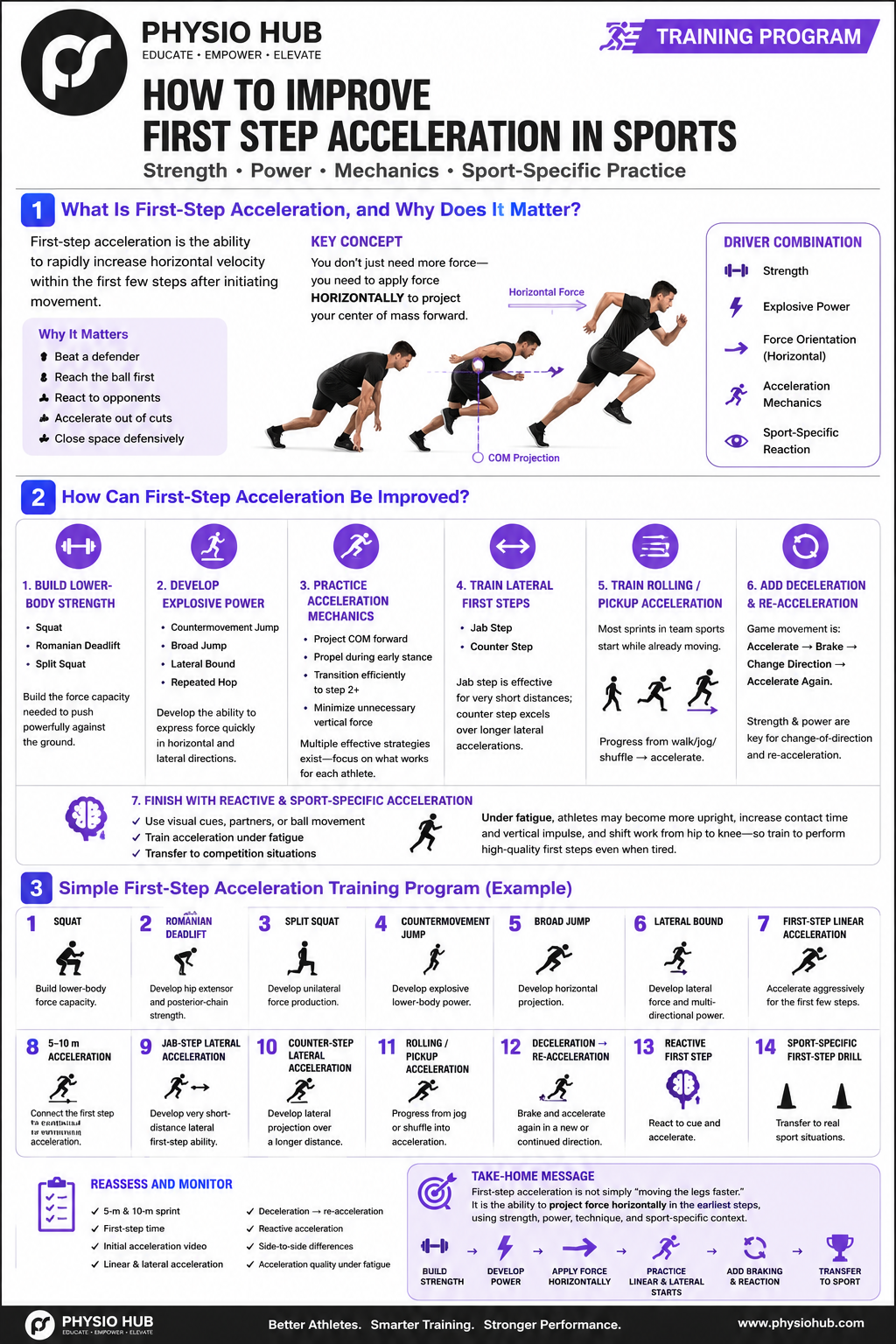
First-step acceleration is the athlete’s ability to rapidly increase horizontal velocity within the first few steps after initiating movement.
It matters when an athlete needs to:
- Beat a defender
- Close space defensively
- Reach a loose ball first
- React to an opponent
- Accelerate out of a cut
- Move quickly from a low-speed or stationary position
Initial acceleration is mechanically different from later sprinting. Research in highly trained sprinters shows that **step 1 has a distinct coordination pattern compared with subsequent acceleration steps.**¹
The key performance concept is not simply producing more total force.
The athlete needs to effectively orient force so that the center of mass is projected horizontally.
First-step performance can therefore be viewed as a combination of:
Strength + Explosive Power + Force Orientation + Acceleration Mechanics + Sport-Specific Reaction
How Can First-Step Acceleration Be Improved?
Build Lower-Body Strength
The athlete needs sufficient force capacity to push effectively against the ground.
Useful exercises include:
- Squat
- Romanian Deadlift
- Split Squat
Strength and power tests including isometric squat, countermovement jump, and repeated hopping show large-to-very-large relationships with coordination features during initial acceleration, supporting the integration of physical development and sprint technique rather than treating them separately.⁵
An 8-week 2026 study in sprinters also found that complex strength training produced greater improvements in first-step frequency, peak ground-reaction force, joint torque, and joint stiffness than loaded plyometric or eccentric training alone.⁶
Develop Explosive Power
Athletes need to express force quickly.
Useful options include:
- Countermovement Jump
- Broad Jump
- Lateral Bound
- Repeated Hop
Because early acceleration depends heavily on forward propulsion, it is practical to include horizontal and lateral power tasks, not only vertically oriented jumping.
Practice Acceleration Mechanics
Strength must be translated into forward movement.
The athlete should learn to:
- Project the center of mass forward
- Produce effective propulsion during early stance
- Transition efficiently from step 1 into later steps
- Avoid unnecessarily directing excessive effort vertically
However, coaches should avoid assuming there is one universal acceleration technique.
Different effective coordination strategies have been identified among highly trained sprinters, meaning two athletes can solve the acceleration task differently while still performing well.⁷
The goal is therefore effective horizontal acceleration, not forcing every athlete into the exact same visual model.
Train Lateral First Steps
Team and racquet sports require movement in multiple directions.
Research comparing lateral start techniques found that jab-step and counter-step strategies were generally more effective than gravity- and pivot-step strategies. Jab steps performed particularly well over very short distances, whereas counter steps became advantageous over longer lateral accelerations.³
For athletes, acceleration training should therefore include both:
Linear + Lateral first steps.
Train Rolling or Pickup Acceleration
Sport acceleration frequently begins while the athlete is already moving.
In English Premier League match play, 66% of recorded sprint actions began from rolling acceleration, and many included curved paths and torso rotation.⁴
Therefore, training only stationary straight-line starts may not fully prepare team-sport athletes.
Progress toward:
Walk / Jog / Shuffle → Accelerate
Add Deceleration and Re-Acceleration
Game movement often looks like:
Accelerate → Brake → Change Direction → Accelerate Again
Lower-body strength and power are also relevant to change-of-direction ability. In junior team-sport athletes, horizontal, maximal-strength, explosive-strength, and vertical-jump training approaches all improved COD performance.⁸
Acceleration training should therefore eventually connect to braking and directional change.
Finish With Reactive and Sport-Specific Acceleration
In competition, athletes rarely know exactly when and where they will accelerate.
Use:
- Visual cues
- Partner movement
- Ball movement
- Offensive or defensive reactions
to make the first step increasingly reactive.
Acceleration also frequently occurs while fatigued. Well-trained athletes studied after a fatiguing multidirectional protocol maintained acceleration by altering their mechanics, including becoming more upright, increasing contact time and vertical impulse, and shifting work from the hip toward the knee.⁹
Once high-quality fresh acceleration is established, repeated and sport-specific acceleration under fatigue can therefore become a later progression.
Simple First-Step Acceleration Training Program
This is an example framework, not one universally optimal program.
- Squat
Goal: Build general lower-body force capacity.
- Romanian Deadlift
Goal: Develop hip-extensor and posterior-chain strength.
- Split Squat
Goal: Develop unilateral force production.
- Countermovement Jump
Goal: Develop explosive lower-body power.
- Broad Jump
Goal: Develop explosive horizontal projection.
- Lateral Bound
Goal: Develop lateral force and multidirectional power.
- First-Step Linear Acceleration
Accelerate aggressively for the first few steps from an athletic stance.
Goal: Transfer force capacity into horizontal acceleration.
- 5–10 m Acceleration
Goal: Connect the first step to continued acceleration.
- Jab-Step Lateral Acceleration
Goal: Develop very short-distance lateral first-step ability.
- Counter-Step Lateral Acceleration
Goal: Develop lateral projection over a slightly longer acceleration.
- Rolling / Pickup Acceleration
Progress from jogging or shuffling into acceleration.
Goal: Reproduce common team-sport starts.
- Deceleration → Re-Acceleration
Brake and accelerate again in a new or continued direction.
Goal: Connect acceleration to game movement.
- Reactive First Step
React to a coach, partner, ball, or visual cue.
Goal: Combine acceleration with perception and reaction.
- Sport-Specific First-Step Drill
Examples:
Basketball: defensive stance → reaction → sprint
Soccer: jog → visual cue → accelerate
Tennis: split-step → lateral acceleration
Goal: Transfer first-step ability to competition.
Reassess
Consider:
- 5-m sprint
- 10-m sprint
- First-step time
- Initial acceleration video
- Linear and lateral acceleration
- Deceleration → re-acceleration
- Reactive acceleration
- Side-to-side differences
- Acceleration quality under fatigue
< Take-Home Message >
First-step acceleration is not simply about moving the legs faster.
A useful development pathway is:
Build Strength
→ Develop Explosive Power
→ Improve Horizontal Force Application
→ Practice Linear & Lateral Starts
→ Add Braking & Reaction
→ Transfer to Sport
Because sport acceleration often begins from rolling, lateral, rotational, or reactive situations, the final goal is not just a fast 5-m sprint from a perfect stationary stance.
The goal is to produce an effective first step from the positions, directions, and situations the athlete actually encounters in competition.
< PDF file>
< Reference >
- Donaldson BJ, Bezodis NE, Bayne H. Inter- and intra-limb coordination during initial sprint acceleration. Biol Open. 2022;11(10):bio059501. doi:10.1242/bio.059501.
- Wild JJ, Bezodis IN, North JS, Bezodis NE. Differences in step characteristics and linear kinematics between rugby players and sprinters during initial sprint acceleration. Eur J Sport Sci. 2018;18(10):1327-1337. doi:10.1080/17461391.2018.1490459.
- Vuong JL, Edel A, Voß P, Ferrauti A. Effectiveness and kinematic analysis of initial step patterns for multidirectional acceleration in team and racquet sports. J Hum Kinet. 2022;85:13-22. doi:10.2478/hukin-2022-0106.
- Caldbeck P, Dos’Santos T. A classification of specific movement skills and patterns during sprinting in English Premier League soccer. PLoS One. 2022;17(11):e0277326. doi:10.1371/journal.pone.0277326.
- Donaldson B, Bezodis N, Bayne H. Relationships between coordination, strength and performance during initial sprint acceleration. J Sports Sci. 2025;43(12):1095-1107. doi:10.1080/02640414.2025.2482361.
- Lu XZ, Liu W, Zhao GH, Fan YX. Effects of three resistance strength training methods on the biomechanics and kinematics of the lower limbs during the first step of sprinters’ start. J Hum Kinet. Published online June 1, 2026. doi:10.5114/jhk/217150.
- Donaldson B, Bezodis N, Bayne H. Characterising coordination strategies during initial acceleration in sprinters ranging from highly trained to world class. J Sports Sci. 2023;41(19):1768-1778. doi:10.1080/02640414.2023.2298100.
- Keller S, Koob A, Corak D, von Schöning V, Born DP. How to improve change-of-direction speed in junior team sport athletes—horizontal, vertical, maximal, or explosive strength training? J Strength Cond Res. 2020;34(2):473-482. doi:10.1519/JSC.0000000000002814.
- Vial S, Cochrane Wilkie J, Turner M, Scanlan M, Blazevich AJ. Does fatigue influence joint-specific work and ground force production during the first steps of maximal acceleration? Scand J Med Sci Sports. 2023;33(6):894-906. doi:10.1111/sms.14318.