
How to Improve Ankle Reactive Stability After Ankle and Foot Injuries
A Practical Progression From Balance to Reactive Landing and Sport-Specific Control
What Is Ankle Reactive Stability, and Why Does It Matter?
Ankle reactive stability is the ability to rapidly respond when the foot or ankle is unexpectedly displaced.
A successful response requires the athlete to:
Detect the change
→ activate the appropriate muscles
→ stabilize the ankle
→ continue the movement
This becomes important during:
- Landing
- Cutting
- Contact
- Uneven ground
- Unexpected inversion
- Rapid changes of direction
After an ankle sprain, an athlete may become pain free yet continue to demonstrate:
- Impaired proprioception
- Reduced postural control
- Neuromuscular deficits
- Strength loss
- Recurrent “giving way”
- Reduced confidence
These deficits are characteristic of chronic ankle instability and help explain why rehabilitation should progress beyond passive support or simple range-of-motion restoration.¹
Systematic-review and meta-analytic evidence supports exercise therapy for improving function and dynamic balance in chronic ankle instability, particularly through balance, proprioceptive, and strengthening interventions.¹,²
For an athlete, the goal is therefore not simply:
“Can you stand on one leg?”
It is:
“Can the ankle rapidly stabilize when the athlete lands, cuts, or experiences an unexpected perturbation?”
How Can It Be Addressed?
A useful progression is:
Strength
→ Static Balance
→ Proprioception
→ Perturbation
→ Landing / Hop Stabilization
→ Reactive Sport-Specific Control
Strength
The ankle needs enough force-producing capacity to respond when instability occurs.
Important targets can include:
- Plantarflexors
- Evertors / peroneals
- General lower-extremity strength
- Hip strength when relevant
Balance and strength training can both improve dynamic balance, while strengthening may provide additional improvements in selected sensory and joint-position outcomes.³
Balance and Proprioception
Foundational training may include:
- Single-leg stance
- Eyes-closed balance
- Multidirectional reach
- SEBT / Y-Balance–style tasks
Balance training has moderate-certainty evidence for improving dynamic postural control in chronic ankle instability.²
Unstable-Surface Training
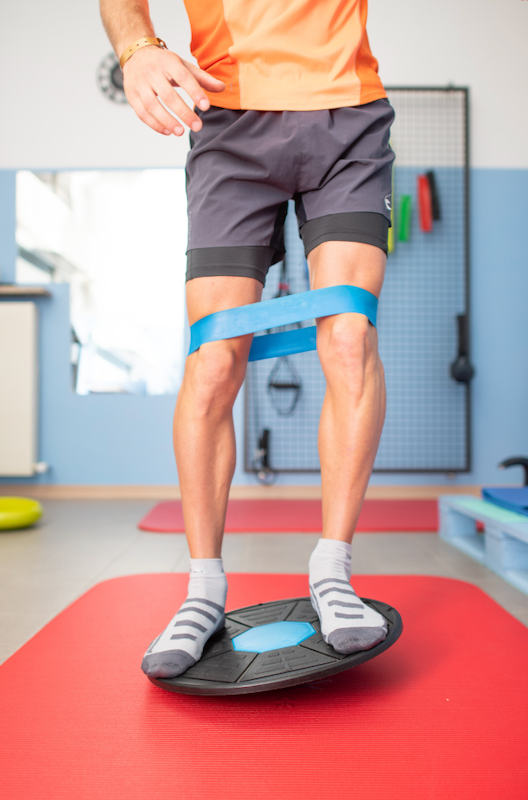
Foam pads, wobble boards, and similar devices can increase proprioceptive demand.
Studies following ankle sprain have reported improvements in balance and selected ankle outcomes with unstable-surface training.⁴
However, unstable surfaces should be considered a tool, not the final goal.
Most sports require the athlete to control high forces on firm ground.
Perturbation Training
Reactive stability requires the athlete to correct unexpected movement.
Examples include:
- Partner perturbations
- Balance-device perturbation
- Unexpected reaching
- Reactive single-leg balance
Balance-device training has been associated with improvements in peroneal reaction time, eversion torque, and postural control, all of which are relevant when the ankle is suddenly exposed to inversion stress.⁵
Landing and Hop Stabilization
The next step is to manage faster, higher-force movement.
Examples:
- Forward Hop & Stick
- Lateral Hop & Stick
- Diagonal Hop & Stick
- Single-Leg Drop Landing
- Multidirectional hopping
Hop-stabilization training has demonstrated advantages over traditional balance training for some dynamic functional and ankle-strength outcomes, likely because it more closely resembles multidirectional sport demands.⁶
Timely peroneus longus activation and coordinated lower-extremity control are also important during landing.⁷
Reactive Sport-Specific Stability
Finally, make the movement unpredictable.
Examples:
- Reactive hop
- Partner cue
- Unplanned landing direction
- Reactive cutting
- Jump → land → accelerate
- Ball or opponent-based tasks
The athlete should eventually be able to:
land → stabilize → react → move again
at progressively more sport-relevant speeds.
What About Bracing or Taping?
External support can be useful, especially during return to activity, but it should not replace active rehabilitation.
A network meta-analysis found that bracing, taping, and orthotic insoles used alone did not clearly improve dynamic postural control compared with control interventions.⁸
Some studies suggest additional benefits when taping is combined with exercise.
The practical message is:
Exercise is the foundation. External support is an adjunct.

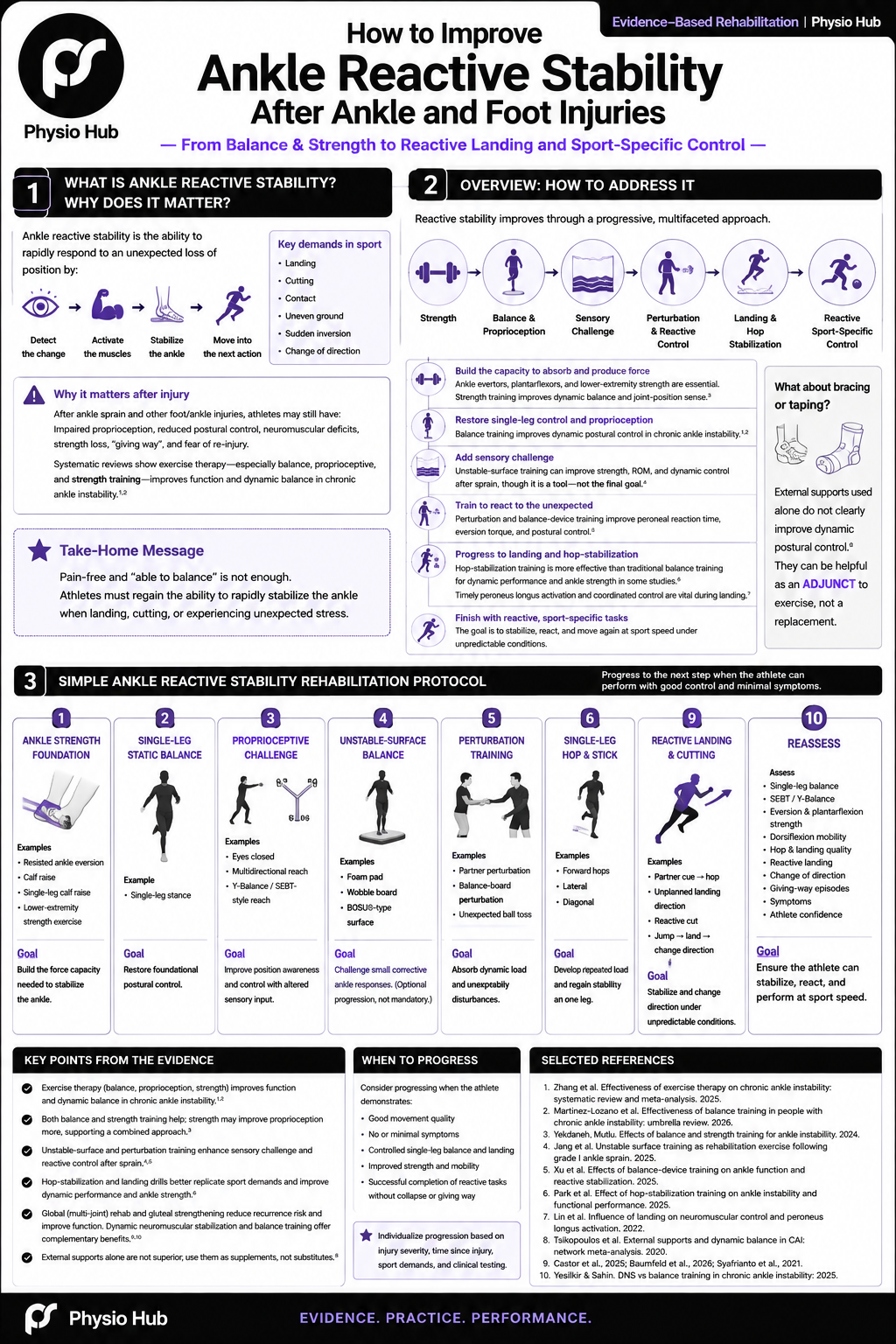
Simple Ankle Reactive Stability Rehabilitation Protocol
- Ankle Strength Foundation
Examples:
- Resisted Ankle Eversion
- Calf Raise
- Single-Leg Calf Raise
- Lower-Extremity Strength Exercise
Goal: Build the force capacity needed to stabilize the ankle.
- Single-Leg Static Balance
- Single-Leg Stance
Goal: Restore foundational postural control.
- Proprioceptive Challenge
Examples:
- Eyes Closed
- Multidirectional Reach
- SEBT / Y-Balance–style Reach
Goal: Improve position awareness and control with altered sensory input.
- Unstable-Surface Balance
Examples:
- Foam Pad
- Wobble Board
Goal: Challenge small corrective ankle responses.
This is optional rather than mandatory.
- Perturbation Training
Examples:
- Partner Perturbation
- Balance-Board Perturbation
- Unexpected Ball Toss
Goal: Restore rapid correction after unexpected movement.
- Single-Leg Hop & Stick
- Forward
- Lateral
- Diagonal
Goal: Absorb dynamic load and regain stability.
- Repeated Multidirectional Hopping
- Forward
- Lateral
- Diagonal
- Continuous hops
Goal: Develop repeated reactive stability.
- Reactive Landing and Cutting
Examples:
- Partner Cue → Hop
- Unplanned Landing Direction
- Reactive Cut
- Jump → Land → Change Direction
Goal: Control unpredictable high-speed loading.
- Sport-Specific Reactive Task
Add:
- Ball handling
- Passing
- Dribbling
- Cutting
- Opponent cues
- Sprint transitions
depending on the sport.
Goal: Transfer ankle stability into actual competition demands.
- Reassess
Consider:
- Single-leg balance
- SEBT / Y-Balance
- Eversion and plantarflexion strength
- Ankle dorsiflexion
- Hop and landing quality
- Reactive landing
- Change of direction
- Giving-way episodes
- Symptoms
- Athlete confidence
< Take-Home Message >
Improving ankle reactive stability requires more than static balance training.
A useful rehabilitation progression is:
Strength
→ Balance & Proprioception
→ Perturbation
→ Hop & Landing Stabilization
→ Reactive Movement
→ Sport-Specific Control
An athlete may regain pain-free motion and basic strength after an ankle injury but still be underprepared for sport if the ankle cannot rapidly stabilize during an unexpected landing, inversion stress, or change of direction.
For return to sport, the evidence therefore supports using balance and proprioceptive training as the foundation, then progressively adding **strength, perturbation, multidirectional hopping, landing control, and reactive sport-specific tasks.**¹⁻⁷
< PDF file>
< Reference >
- Zhang et al. Effectiveness of exercise therapy on chronic ankle instability: systematic review and meta-analysis. 2025.
- Martínez-Lozano et al. Effectiveness of balance training in people with chronic ankle instability: umbrella review. 2026.
- Yekdaneh, Mutlu. Effects of balance and strength training for ankle instability. 2024.
- Jang et al. Unstable surface training as rehabilitation exercise following grade I ankle sprain. 2025.
- Xu et al. Effects of balance-device training on ankle function and reactive stabilization. 2025.
- Park et al. Effect of hop-stabilization training on ankle instability and functional performance. 2025.
- Lin et al. Influence of landing on neuromuscular control and peroneus longus activation. 2022.
- Tsikopoulos et al. External supports and dynamic balance in chronic ankle instability: network meta-analysis. 2020.