
How to Improve Single-Leg Control and Balance for Return to Sport
A Practical Progression After Lower-Extremity Injury
What Is Single-Leg Control, and Why Does It Matter for Return to Sport?
Athletes spend a large amount of time controlling their body on one leg.
In basketball, soccer, volleyball, tennis, and many other sports, athletes must repeatedly:
- Accelerate and decelerate
- Change direction
- Land from jumps
- React to opponents
- Kick, pass, or shoot
- Push off from one leg
Single-leg control therefore means much more than simply standing on one leg.
It requires the interaction of:
Strength + Proprioception + Postural Control + Dynamic Stability + Reactive Control
to accept force, control the center of mass, and transition into the next movement.
Single-leg balance training consistently improves balance control,¹ while neuromuscular training also improves dynamic balance in athletes.²
Why It Matters After Lower-Extremity Injury
After a lower-extremity injury, restoring pain-free range of motion and strength is important—but those improvements alone do not necessarily mean an athlete is ready for sport.
The athlete eventually has to regain the ability to:
Accept force on one leg
→ stabilize
→ react to the environment
→ produce force again
This is particularly relevant during cutting, landing, deceleration, and reactive movement.
Balance-based rehabilitation has improved static and dynamic stability in athletes with chronic ankle instability, while hop-stabilization approaches can improve functional performance.³ Combined balance and plyometric programs have also improved dynamic postural control and stability after single-leg landing.⁴,⁵
For this reason, athletes recovering from lower-extremity injury should generally not skip the progressive single-leg control phase before returning fully to unrestricted sport.
How Can It Be Addressed?
For return to sport, static balance should be viewed as the beginning—not the endpoint.
A useful progression is:
Strength & Control
→ Static Balance
→ Dynamic Stability
→ Landing & Hopping
→ Reactive Control
→ Sport-Specific Control
Single-Leg Strength and Control
Begin by restoring the ability to produce and absorb force on one leg.
Examples:
- Single-Leg Squat
- Step-Down
- Single-Leg RDL
- Split Squat
The goal is not simply strength. The athlete must coordinate the hip, knee, and ankle while controlling the body over the stance leg.
Stable-surface multicomponent neuromuscular training has improved dynamic balance, unilateral force production, jumping, and agility in elite soccer players.⁶
Static Single-Leg Balance
Build foundational unilateral postural control.
Examples:
- Single-Leg Stance
- Arm or head movements
- Ball toss
- Eyes closed
Single-leg balance training itself has relatively consistent evidence for improving balance performance.¹
Dynamic Single-Leg Stability
Next, move the center of mass while maintaining control of the stance limb.
Examples:
- Single-Leg Reach
- Multidirectional Reach
- Y-Balance–style Reach
- Single-Leg Squat With Reach
The Y-Balance Test can help assess dynamic neuromuscular control, although universal asymmetry thresholds should not be used alone to determine injury risk or return-to-sport readiness.⁷
Landing and Plyometric Control
The athlete then needs to stabilize after rapidly absorbing force.
Examples:
- Forward Hop & Stick
- Lateral Hop & Stick
- Diagonal Hop & Stick
- Single-Leg Drop Landing
Progress from:
Hop & Stick → Repeated Hopping
Combined balance and plyometric programs have demonstrated improvements in dynamic postural control and post-landing stability in athletic populations.⁴,⁵
Reactive Control
Sport is unpredictable.
Progress toward tasks such as:
- Partner cues
- Reactive reaches
- Ball catch/pass
- Reactive hops
- Perturbations
- Unplanned changes of direction
Proprioceptive training has been associated with improvements in balance, agility, muscle activation, joint-position sense, and selected sport-specific skills.⁸
Sport-Specific Single-Leg Control
The final stage should look increasingly like the athlete’s sport.
For example:
Basketball
- Defensive reaction
- Catch → cut
- Single-leg landing → acceleration
- Closeout → change of direction
Soccer
- Single-leg support + pass
- Dribble → reactive cut
- Kick → regain control
- Decelerate → change direction
At this stage, the question is no longer:
“Can the athlete balance on one leg?”
It becomes:
“Can the athlete accept force, stabilize, react, and move again at sport speed?”
Are Unstable Surfaces Necessary?
No.
Foam pads, wobble boards, and BOSU-type devices can be useful for changing sensory demands, but they are not automatically superior for return-to-sport transfer.
In elite soccer players, multicomponent neuromuscular training on stable surfaces produced greater improvements across several balance, jumping, force, and agility measures than the same program performed on unstable surfaces.⁶
Unstable surfaces can therefore be used as a training variation, while stable-ground force production, absorption, and redirection should remain highly relevant as athletes approach return to sport.
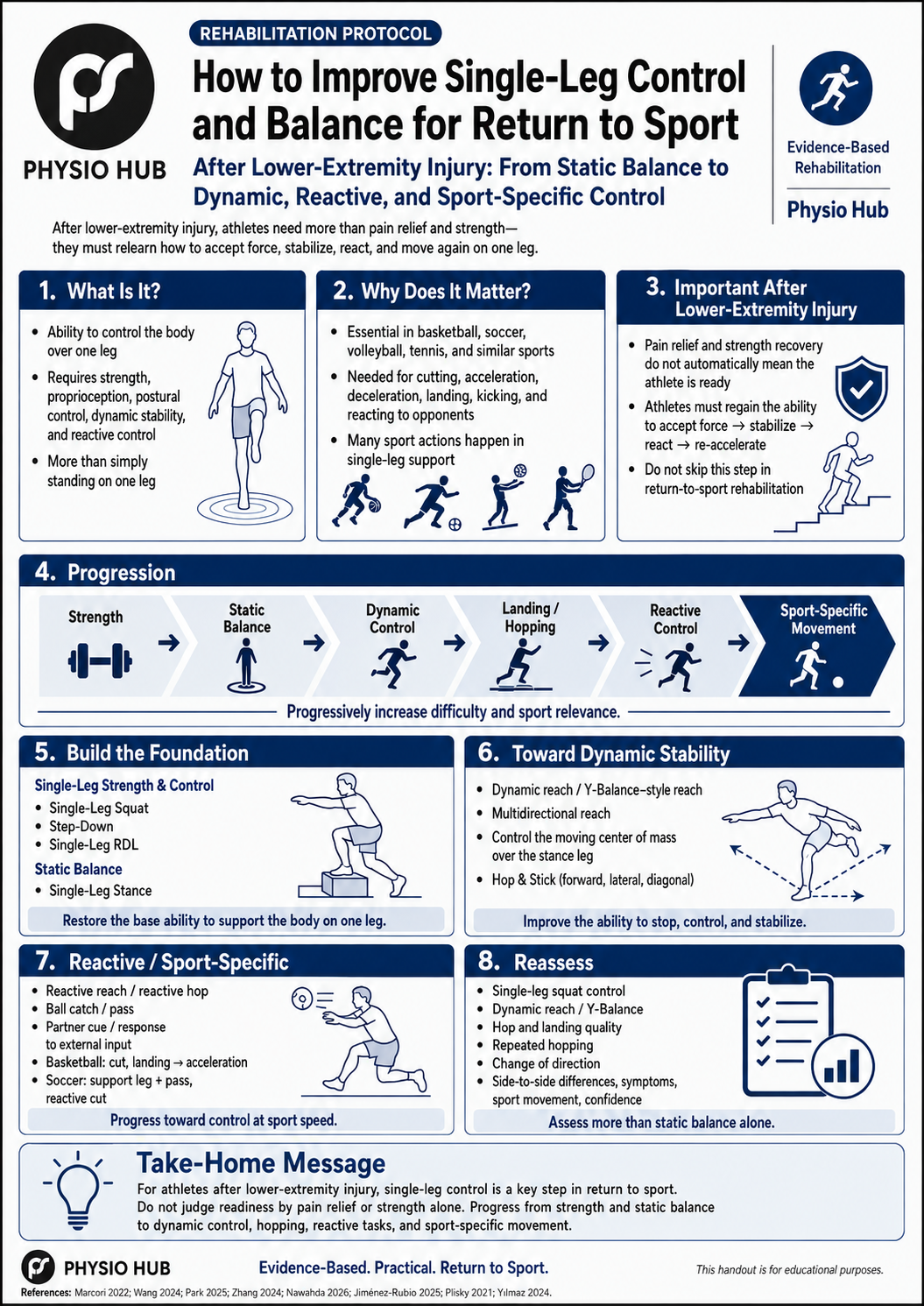
Simple Return-to-Sport Rehabilitation Protocol
- Single-Leg Strength and Control
- Single-Leg Squat
- Step-Down
- Single-Leg RDL
Goal: Build unilateral strength and force-control capacity.
- Single-Leg Static Balance
- Single-Leg Stance
Goal: Restore basic unilateral postural control.
- Sensory / Dual-Task Balance
- Eyes closed
- Ball toss
- Head / arm movements
Goal: Maintain control under changing sensory demands.
- Multidirectional Single-Leg Reach
- Forward
- Diagonal
- Lateral reaches
Goal: Control a moving center of mass over the stance leg.
- Single-Leg Hop & Stick
- Forward
- Lateral
- Diagonal
Goal: Absorb force and stabilize after dynamic movement.
- Repeated Multidirectional Hopping
- Continuous forward, lateral, and diagonal hops
Goal: Restore repeated dynamic stability.
- Reactive Single-Leg Control
- Partner cue
- Reactive reach
- Reactive hop
- Ball catch/pass
Goal: Maintain control while responding to unpredictable stimuli.
- Sport-Specific Reactive Movement
Examples:
- Cutting
- Deceleration
- Landing → acceleration
- Dribbling / passing / kicking
- Defensive reaction
Goal: Transfer rehabilitation capacity to actual sport demands.
- Reassess
Monitor:
- Single-leg squat control
- Dynamic reach / Y-Balance
- Hop and landing quality
- Repeated hopping
- Deceleration ability
- Change-of-direction control
- Side-to-side differences
- Symptoms
- Sport-specific movement
- Athlete confidence
Return-to-sport assessment should therefore consider movement quality, load tolerance, reaction, and sport demands, rather than static balance alone.
< Take-Home Message >
For an athlete recovering from a lower-extremity injury, single-leg control should not be viewed as an optional balance exercise at the end of rehabilitation.
A practical progression is:
Strength
→ Static Balance
→ Dynamic Control
→ Landing & Hopping
→ Reactive Control
→ Sport-Specific Movement
An athlete may have minimal pain and restored strength but still be underprepared for sport if they cannot accept force on one leg, stabilize, react, and transition into the next movement at game speed.
Progressive single-leg control training should therefore be an important component of return-to-sport rehabilitation following lower-extremity injury.¹⁻⁶
< PDF file>
< Reference >
- Marcori AJ, Monteiro PHM, Oliveira JA, Doumas M, Teixeira LA. Single leg balance training: a systematic review. Percept Mot Skills. 2022;129(2):232-252.
- Wang Y, Liu Y, et al. Effects of neuromuscular training on dynamic balance in athletes: a systematic review and meta-analysis. 2024.
- Park J, Oh J, et al. Effect of hop-stabilization training on ankle instability and functional performance in basketball athletes. 2025.
- Zhang Y, Zhou X, et al. Effects of six weeks of combined balance and plyometric training on postural control after single-leg landing in elite badminton players. 2024.
- Nawahda Y, Paillard T, et al. Combined multidirectional plyometric and balance training enhances postural and sport-specific performance in soccer players. 2026.
- Jiménez-Rubio S, García-Albín D, et al. Effects of neuromuscular training on stable versus unstable surfaces in elite male soccer players. J Funct Morphol Kinesiol. 2025;10(4):379.
- Plisky P, Schwartkopf-Phifer K, Huebner B, Garner MB, Bullock G. Systematic review and meta-analysis of the Y-Balance Test Lower Quarter. Int J Sports Phys Ther. 2021;16(5):1190-1209.
- Yılmaz O, Soylu Y, Erkmen N, Kaplan T, Batalik L. Effects of proprioceptive training on sports performance: a systematic review. BMC Sports Sci Med Rehabil. 2024;16:149.